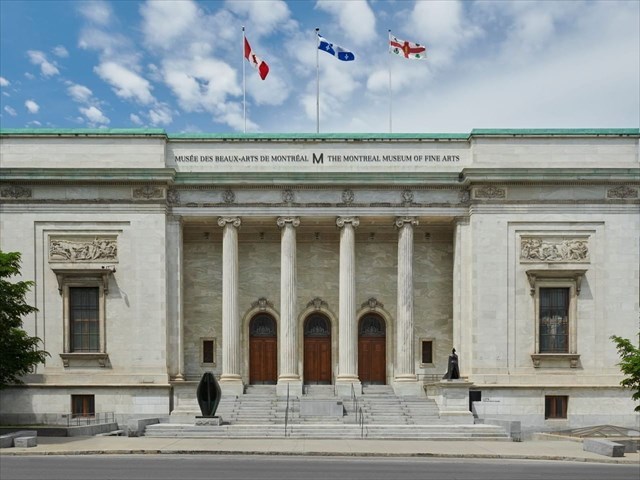
Founded in 1860, the Museum of Fine Arts in Montreal is Canada's oldest art museum, featuring a diverse collection spanning classical, modern, and contemporary periods. Its collection include works by European masters, Canadian artists, and Indigenous creators, along with decorative arts and design pieces. As a prominent cultural institution in Montreal, the museum plays a central role in the city's arts scene.
The Museum of Fine Arts is built from Vermont Marble, which formed between 500 and 450 million years ago during the Cambrian and Ordovician Periods. Initially, this marble began as marine limestone deposited in shallow seas, primarily composed of calcium carbonate from the shells and skeletons of marine organisms. As tectonic forces acted on the region during the Taconic Orogeny (orogeny is defined as a mountain building period), intense pressure and heat altered this limestone. The calcite in the limestone recrystallized under these conditions, forming the denser and more crystalline structure of marble.
During this metamorphic transformation, the impurities present in the original limestone, such as clay, silt, and iron oxides, contributed to the veining and coloration in Vermont marble. The Taconic Orogeny also played a critical role in the folding and faulting of the rock layers, which facilitated further metamorphism. This regional metamorphism produced large, uniform deposits of marble with varying textures and compositions depending on the original sedimentary conditions and the degree of metamorphism the rock experienced.
Some common mineral impurities found in marble, and their impact on color/veining include:
- Iron oxides (hematite and limonite) can create reddish or yellowish tones.
- Clay minerals may lead to gray, brown, or greenish tints.
- Graphite results in dark gray or black streaks.
- Mica minerals (such as muscovite and biotite) can produce silvery or metallic flecks.
- Dolomite, a variant of calcite, can create shades of pink or cream.
Logging Requirements:
- Examine the Vermont Marble closely and describe the color, texture, and grain size.
- Describe the veining in the stone. Does the veining appear random, or does it follow a recognizable pattern? Next, identify the minerals you believe are responsible for the colors seen in the veins.
- Upload a photo with the Museum of Fine Arts. You don't have to be in the photo, though it is strongly encouraged.
Sources:
- https://www.mcgill.ca/redpath/article/building-stones-and-fossils-downtown-montreal