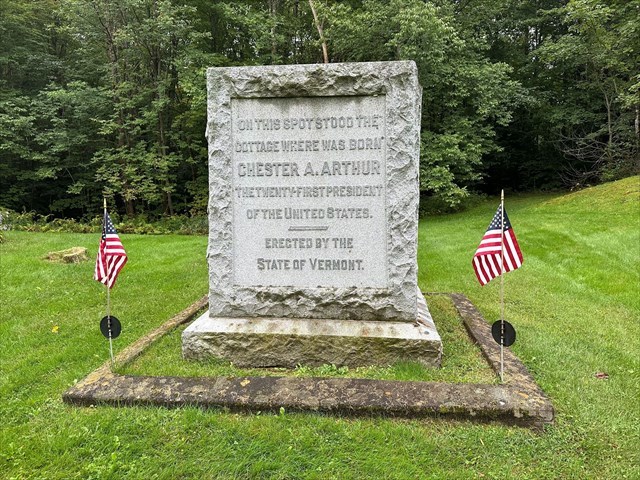
The Chester A. Arthur Historic Site is located in Fairfield, Vermont and commemorates the birthplace of the 21st President of the United States, Chester Alan Arthur. Although the original home no longer stands, the site includes a reconstructed replica of the small farmhouse where Arthur was born in 1829. The location offers insights into Arthur's early life, highlighting his humble beginnings before ascending to the presidency. The surrounding landscape, typical of rural Vermont, adds context to the simple upbringing that shaped one of America's lesser known presidents.
The President Chester A. Arthur Monument is constructed from Barre Granite that was quarried at the E.L Smith Quarry in Barre, Vermont. Barre Granite formed during the Devonian period, around 380 million years ago, when tectonic forces caused large sections of the Earth's crust to fold and fracture. Molten magma from deep within the Earth's mantle was pushed upward through these fractures, but instead of erupting at the surface, it slowly cooled and solidified underground in large plutons, forming what is known as an intrusive igneous rock. The slow cooling process allowed individual mineral crystals (such as quartz, feldspar, and mica) to grow evenly, resulting in the fine-grained texture characteristic of Barre Granite.
Now let's learn about some of the physical and chemical properties of Barre Granite. Physically, the granite exhibits high compressive strength, often exceeding 30,000 psi, which makes it highly resistant to cracking and wear. It also has a low porosity which minimizes water absorption, and as a result prevents damage from freeze-thaw cycles. The stone is also able to take a high polish, which also makes it an ideal material for monuments, sculptures, and architectural features. Chemically, Barre Granite has a low iron content that prevents oxidation and rust staining over time. It also has a quartz rich composition which results in a high degree of chemical stability, thereby making the granite resistant to acid rain.
Logging Requirements:
- Describe the color, texture, and grain size of the Barre Granite. Are these properties consistent throughout the stone, or are there some slight variations?
- Based on your observations, how well has the Barre Granite stood up to the test of time? Besides the symbolic reason, why else do you think Barre Granite was chosen for the President Chester A. Arthur Monument?
- Upload a photo with the President Chester A. Arthur Monument. You don't have to be in the photo, though it is strongly encouraged.
Sources:
- https://historicsites.vermont.gov/chester-arthur/exhibits