Marble
Marble is a rock consisting mainly of carbonates: more than 95% of the rock volume is calcium carbonate (calcite, CaCO3), to a lesser extent dolomite (magnesium-calcium carbonate, CaMg(CO3)2). The rest are various silicates, quartz, limonite, graphite, and/or organic impurities.
Pure marble is white. The characteristic swirls and veins of many colored marble varieties, sometimes called striations, are usually due to various mineral impurities.
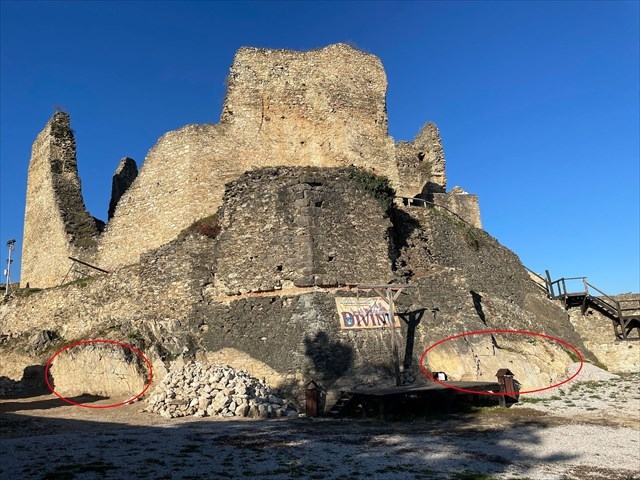
The courtyard of Divín Castle with visible outcrops of crystalline limestone (red color).
Marble is created by the recrystallization of limestone, so it is a metamorphic rock. Limestone is mainly composed of calcium carbonate - calcite. Limestones are formed by deposition and have a massive texture, without visible mineral grains. Alternatively, they contain fossils, as most limestones are deposited in the seas.
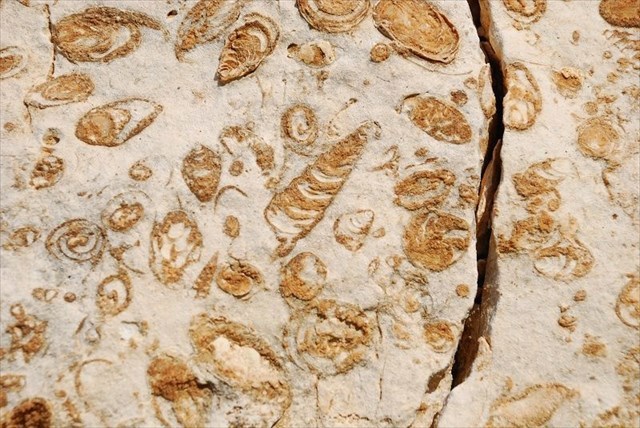
Mesozoic limestone with bivalve fossils from Lebanon.
During the metamorphism of limestone, calcite grains are recrystallized. Under the high pressure and temperature, microscopic calcite crystals change their shape, orientation and size, but not their composition. The result is a compact, coarse-crystalline rock without preserving the original textures, with disturbed fossils, etc.

Statue of David by Michelangelo made of Carrara white marble.
Impurities in the original limestone also undergo metamorphosis, giving the otherwise white rock different shades of color. For example, an increased proportion of magnesium in limestone (the presence of dolomite, clay minerals, etc.) in combination with silica creates greenish-colored minerals from the serpentine group. The presence of ferrous cations can cause ocher to red coloration. The gray streaks come from graphite, and the opposite, almost completely black marble with white streaks from the Basque Country is colored by organic matter - bitumen.

Green marble from Connemara, Ireland.
Marble is mostly used as material for stonemasonry and sculptors, but they name all rocks based on carbonates, which were created by processes other than marble, as marble. It has a wide range of uses - from building cladding to various utility items to works of art.
Tuhár marble
In the area between the villages of Tuhár, Divín and Ružiná there is a complex of carbonates referred to as the tuhár mesozoic. The complex consists of dolomite, limestone, marl and marble formations and their age is estimated to be Middle to Upper Triassic (~ 240 - 220 million years) and the thickness of the complex is approximately > 500 meters.
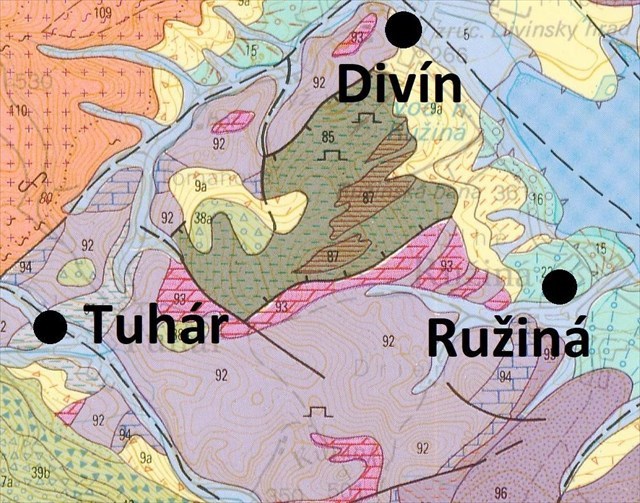
Geological map of the Tuhár area. Legend:
.....
- Clay, loess (Pleistocene)
.....
- Volcanic rocks (andesites) (Neogene)
.....
- Phyllites (Jurassic)
.....
- Magnesite deposits (Jurassic)
.....
- Crystalline limestones (Tuhár marble) (Triassic)
.....
- Dolomites and dolomitic limestones (Triassic)
.....
- Granite rocks (Paleozoic/Proterozoic)
The complex was formed by compression during ocean closure in the early stages of Alpine orogeny. In cross section it forms a hand fan structure. The conditions prevailing at the time of compression were as follows: temperature ~ 350-400 °C and pressure 350 MPa, which is approximately 3500 times standard atmospheric pressure.
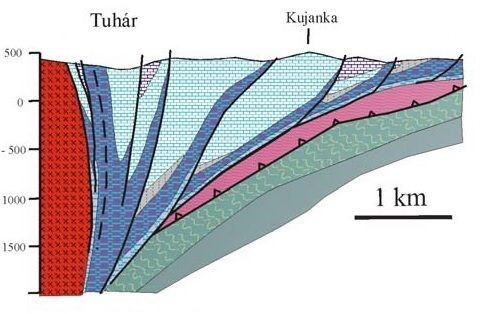
Cross-section through fan compression structure. Legend:
.....
- Granitoids, migmatites
.....
- Quartzites
.....
- Limestones
.....
- Dolomites
.....
- Migmatites
.....
- Amphibolites
Tuhár Mesozoic limestones are similar to wetterstein limestones, which are carbonate deposits of mesosoic shallow subtropical seas. In Slovakia, the wetterstein limestones form extensive sets of rocks in the Slovak Karst, the Slovak Paradise, the Muránská Planina, the nappe of Tlstá...

A fragment of tuhar marble in the wall of Divín castle.
Tuhár marble is predominantly pale gray in color, with numerous veins and layers of darker gray, yellowish, orange, or reddish shades. It was quarried (and is still sporadically quarried at the present time) in a quarry in Tuhár, a lower quality raw material was quarried and processed into lime in Ružina. Tuhár marble is significantly tectonically broken, so larger continuous blocks of rock cannot be obtained from it, and it was used more for the production of decorative items (vases, pedestals, etc.).