
古くから利用されてきた鉱物群で、特に青銅器時代には宝石や研磨剤のような形で利用されてきたのでよく知られている。ガーネットは強く美しい色を持ち、光沢がある。研磨して宝石として使うこともできる。また、ガーネットは鉱物学的に6½~7½と非常に硬いため、研磨剤としても使われる。
ガーネットの結晶は通常、深い赤や茶色、黒に近い色、または淡い黄色から緑色をしています。つまり、色の幅が広いのです。ガーネットは琥珀と混同してはいけません。これは、ガーネットがより硬く、より結晶面があるという事実で説明できます。
This is a mineral group that has been used for a long time and is well known because it has been used in its form like gems and abrasives, especially in the Bronze Age. Garnets have strong, beautiful colors and have high gloss. It can be sanded and used as gemstones. Garnet is also used as abrasive because of its enormous hardness with mineralogy of 6½-7½.
Garnet crystals are usually deep red or brown, almost black or light yellow to green. In other words, it has a wide range of colors. Garnet must not be confused with amber, this can be explained by the fact that the garnet is much harder and has a more crystalline surface.
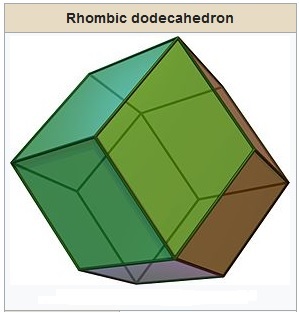
ガーネットは菱形12面体(12面体)の結晶構造を持つことが多い。ガーネットは立方晶系に結晶し、その3つの軸の長さは等しく、すべて互いに垂直である。ガーネットには劈開角がない。
Garnet most often occurs in a rhombic dodecahedron crystal structure (a twelve sided surfaces). Garnets are crystallized into a cubic system, its with three axes of equal lengths and all perpendicular to each other. Garnets have no cleavage angle.
構造と発生:
ガーネットは、実際には、マグネシウム(Mg2 +)、鉄(Fe2 +)、マンガン(Mn2 +)、カルシウム(Ca2 +)、アルミニウム(Al3 +)およびクロム(Cr3 +)のような単一のケイ酸塩が多種多様を形成する同じ結晶構造を有するケイ酸塩鉱物の全体のグループです。化学成分によって、ガーネットはさまざまな色に見える。最も一般的なガーネットであるアルマンディン(アルマンディンは鉄アルミナガーネット)(Fe3AI2 (SiO4) 3)は暗赤色で、カルシウムを含むガーネットであるグロスラー(Ca3AI2 (SiO4) 3)は緑色から暗緑色をしています。
ガーネットは特に変成岩中に産出する。圧力に対するガーネットの融点曲線の知識に基づいて、岩石がどのような圧力と温度レベル以下で形成されたかを判断するために使用される。ガーネットは、大理石、光輝頁岩、片麻岩、角閃岩などの変成岩に多く含まれる。
Structure and occurrence:
Garnet is in fact an entire group of silicate minerals with the same crystal structure, which single silicate form a wide variety, such as magnesium (Mg2 +), iron (Fe2 +), manganese (Mn2 +), calcium (Ca2 +), aluminum (Al3 +) and chromium (Cr3 +). Depending on the chemical, garnet appears in many different colors. The most common garnet, almandine (Almandine is an iron alumina garnet) (Fe3AI2 (SiO4) 3), that is dark red while calcium-containing garnet, grossular (Ca3AI2 (SiO4) 3) is green to dark green in color.
Garnet occurs especially in metamorphic rocks. Based on knowledge of the melting point curve of garnet relative to pressure, it is used to determine what pressure and temperature level the rock is formed below. Garnet occurs most frequently in metamorphic rocks such as marble, glitter shale, gneiss and amphibolite.
ガーネットの特徴
* 深い赤や茶色、黒に近い、または淡い黄色から緑色の結晶。宝石のような輝き、ガラスのような光沢。
* ガーネットは非常に硬い鉱物で、モース硬度は7。
* 特徴的な立方体の結晶。
* 密度 3.5-4.3 g / cm3
モース硬度は、傷のつきにくさを表す相対的でややランダムな尺度であり、絶対的な硬度とは大きく異なる場合がある。しかし、絶対硬度は、管理された実験室での試みのもとで決定されますが、このスケールはほんのわずかしか使われていません。
モース硬度7、絶対硬度100、石英- SiO2と同じクラス。
Characteristics of garnet:
* The crystals are of deep red or brown, almost black or light yellow to green. Gemstone-like shine, glass gloss.
* Garnet is very hard mineral and goes under Moh's hardness scale as No. 7
* Characteristic cubic crystals
* Density 3.5-4.3 g / cm3
Moh's scale is a relative and somewhat random scale of scratch resistance, and the difference between the different levels can vary a lot from absolute hardness. Absolute hardness, however, is determined under controlled laboratory attempts, but this scale is only used to a small extent.
Moh's hardness 7, Absolute Hardness 100, in the class with Quartz- SiO2
このキャッシュを記録する
このキャッシュを記録するためには、アースキャッシュの座標に関連した質問に答えなければなりません。
答えが集まったら、確認のためCOに送ってください。
回答がCOに送られた後、すぐにログを取ることができます。あなたの答えに質問がある場合は、COがあなたに連絡します。
COへの回答がないログや、COからの質問が保留されているログは予告なく削除されます。
質問の答えとなるような写真をログに含めないでください。
To log this cache.
To get to log this cache you will have to visit and answer the questions which are related to the coordinates given the earthcache.
When answers are collected, send them to CO for verification.
You can log immediately after answers are sent CO. If there are any questions about your answers CO will contact you.
Logs without answers to CO or with pending questions from CO will be deleted without any further notice.
Please do not include pictures in your log that may answer the questions.

質問
1. 以下の質問に答えてください。
A. 指定された座標に行き、ここで見られるガーネットを注意深く観察しなさい。あなたが観察できる最大のガーネットの大きさは何mmですか?
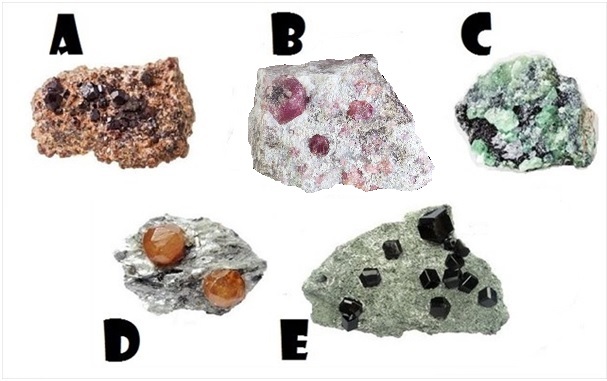
B. 与えられた選択肢はどれか: 上の写真のA、B、C、D、Eのうち、グラウンドゼロで見られるガーネットに似ているものはどれ?
C. このガーネットがアルマンダイン型かカルシウム型かわかりますか?その理由を述べなさい!
2. あなた、グループ、またはGPSの写真を、答えを明かさずにその場所から撮ってください。
Questions:
1. Answer the questions under by visiting the coordinates..
A. Go to the given coordinates and carefully study the garnets that you find here. How big in mm are the biggest garnets that you can observe?
B. Which of the given option: A, B, C, D, or E from the photo above is similar to the garnets that we find here at ground zero?
C. Can you tell if the garnets are the almandine or the calcium type? Describe why!
2. Take a photo of you, the group or the GPS from the location without revealing any of the answers.