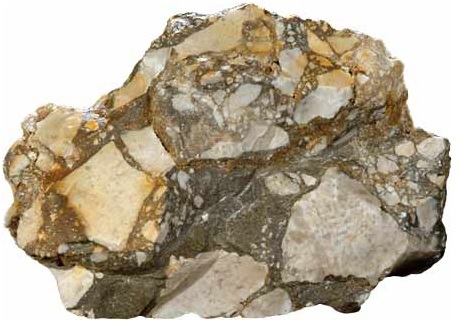
このアースキャッシュの学習ポイントは、ジオキャッシャーに角礫岩に親しんでもらうことです。
堆積岩
堆積岩は堆積物からなる岩石で、地表に作用するプロセスによって形成された岩石です。
石灰化とは、堆積岩が形成される過程を表す「おしゃれな」言葉です。
The learning point of this earthcache is to get the geocacher to become familiar with Breccia.
Sedimentary Rocks
Sedimentary rocks are rocks composed of sediment, and are the rocks formed by processes acting on the earth's surface.
Lithification is the “fancy” term for the sedimentary rock-forming process.

堆積物とは、風化した岩石や鉱物の粒子を指す。粒子や粒には様々な形、大きさ、幅広い組成がある。すべての堆積物には共通点があり、風、川、波、氷河など、地球表面の地質学的プロセスの1つ以上によって堆積したものである。
緩い堆積物の山と堆積岩の違いは、堆積物の粒が互いにくっついているかどうかである。堆積物が岩石化する主な方法は2つあり、1つは堆積物の重さで層が押し固められ岩石になる「圧縮」、もう1つは堆積物の周囲に鉱物が形成され、層が結合する「セメンテーション」である。
Sediment refers to particles and grains of weathered rock or mineral remains. The particles and grains comes in many shapes, sizes and a wide range of compositions. All the sediment types have one thing in common, they were deposited by one or more of Earth's surface geological processes, such as wind, rivers, waves, and glaciers.
The difference between a loose pile of sediment and a sedimentary rock is whether or not the sediment grains are stuck together. The two main ways for sediment to become lithified are by compaction, where the layers' weight squeezes them together into rock, and cementation, where minerals form around the layers and bind them together.
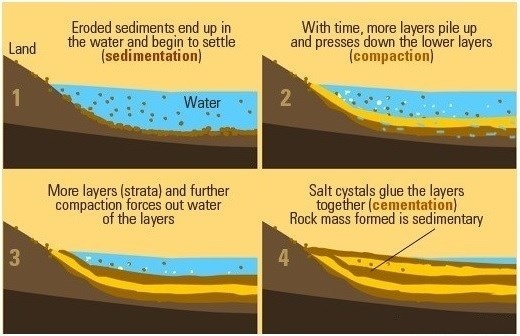
すべての堆積岩の特徴は、堆積物が長い時間をかけて堆積した結果である層(ベッド)を形成することである。堆積岩はほぼ水平な層で見られることもあるが、これは造山や移動によって傾いた場合に限られる。
堆積岩は3つのタイプに分けられる:
角礫岩、礫岩、砂岩、シルト岩、頁岩のような砕屑性堆積岩は、機械的風化の破片から形成される。
岩塩、鉄鉱石、チャート、フリント、ドロマイトの一部、石灰岩の一部などの化学的堆積岩は、溶解した物質が溶液から沈殿して形成される。
石炭、ドロマイトの一部、石灰岩の一部などの有機堆積岩は、植物や動物の残骸が堆積して形成される。
A characteristics property of all sedimentary rocks is that they form in beds, or layers, which are the result of how the sediment was deposited over time. They may also be found in approx horizontal layers, but this only when or if the mountain building or movement has tilted it.
The sedimentary rock can be separated in three different types:
Clastic sedimentary rocks such as breccia, conglomerate, sandstone, siltstone, and shale are formed from mechanical weathering debris.
Chemical sedimentary rocks, such as rock salt, iron ore, chert, flint, some dolomites, and some limestones, form when dissolved materials precipitate from solution.
Organic sedimentary rocks such as coal, some dolomites, and some limestones, form from the accumulation of plant or animal debris.
角礫岩
角礫岩は、角ばった礫や転石大の砕屑物が母岩の中で固まってできた岩石である。砕屑物の角張った性質は、それらが源からあまり遠くへ運ばれていないことを示している。角礫岩にはいくつかの形成様式がある。急斜面や崖のふもとに堆積した固結体もある。異形断層角礫岩は、断層運動中の岩石の破砕によって生成される。火山角礫岩(凝集体)は、火山灰を母岩とする溶岩の塊からなり、爆発的噴火の産物である。熱水角礫岩は、熱水が岩盤を破砕して形成される。衝撃角礫岩は、隕石が地表に衝突し、衝突地点で岩石が破壊されたときに形成される。角礫岩の砕屑物を結合するセメントは、一般に方解石、シリカ、酸化鉄のいずれかである。母岩はセメント質のみから成ることもあるが、粗い岩塊の間にセメントで固められた砂やシルトの大きさの岩塊を含むこともある。
角礫岩はさらに次のように分けられる:
クラス - 角礫岩は大きく2つのクラスに分けられる:
砕屑物支持型-砕屑物同士が接触し、マトリックスが空隙を埋めているもの。
マトリクス支持-クラストが接触しておらず、マトリクスが各クラストを取り囲んでいるもの;
クラストサイズ- 細目(2~6mm)、中目(6~20mm)、粗目(20~60mm)、極粗目(60mm以上);
選鉱- 様々な大きさのクラストが混在する角礫岩は選鉱が不十分であり、同じ大きさのクラストが大部分を占める角礫岩は選鉱が良好である;
岩相- 破片が複数の岩種からなる角礫岩はポリミクティック(またはペトロミクティック)と呼ばれ、一方、破片が単一の岩種からなる角礫岩はモノミクティック(またはオリゴミクティック)と呼ばれる。
テクスチャー:砕屑物(粗粒)。
粒度- > 2mm;クラストは肉眼で容易に確認でき、識別可能でなければならない。
硬度- 変化があり、軟らかいものから硬いものまで、クラストの組成とセメントの強度に依存する。
色- 変化があり、クラストとマトリックスの組成に依存する。
砕屑物- 変化があるが、一般に硬い岩石や鉱物が多い。
その他の特徴- 角張った砕屑物のため、触るとざらざらしている。
Breccia
Breccia is a rock formed from angular gravel and boulder-sized clasts cemented together in a matrix. The angular nature of the clasts indicates that they have not been transported very far from their source. There are several modes of formation for breccia. Some represent consolidated material accumulated on steep hill slopes or at the foot of cliffs. Cataclastic breccias are produced by the fragmentation of rocks during faulting. Volcanic breccias (agglomerates) comprise blocks of lava in an ash matrix and are the product of an explosive eruption. Hydrothermal breccias are formed when hydrothermal fluid fractures a rock mass. Impact breccias are formed when a meteor impacts the Earth's surface, fracturing rock at the site of the impact. The cement that binds the clasts in a breccia is generally one of either calcite, silica or iron oxide. The matrix can consist solely of the cementing material, but may also contain sand and / or silt sized clasts cemented together among the coarser clasts.
Breccia can be further divided according to:
Class - breccia can be divided into two broad classes:
Clast supported - where the clasts touch each other and the matrix fills the voids; and
Matrix supported - where the clasts are not in contact and the matrix surrounds each clast;
Clast size - fine (2 - 6mm), medium (6 - 20mm), coarse (20 - 60mm), very coarse (> 60mm);
Sorting - a breccia comprising a mixture of clast sizes is poorly sorted, while one comprising mostly clasts of the same size is well sorted;
Lithology - a breccia where the clasts represent more than one rock type is termed polymictic (or petromictic), while one where the clasts are of a single rock type are monomictic (or oligomictic).
Texture - clastic (coarse-grained).
Grain size - > 2mm; clasts easily visible to the naked eye, should be identifiable.
Hardness - variable, soft to hard, dependent on clast composition and strength of cement.
Color - variable, dependent on clast and matrix composition.
Clasts - variable, but generally harder rock types and / or minerals dominate.
Other features - rough to touch due to angular clasts.
このキャッシュを記録する
このキャッシュを記録するためには、アースキャッシュの座標に関連した質問に答えなければなりません。
答えが集まったら、確認のためCOに送ってください。
回答がCOに送られた後、すぐにログを取ることができます。あなたの答えに質問がある場合は、COがあなたに連絡します。
COへの回答がないログや、COからの質問が保留されているログは予告なく削除されます。
質問の答えとなるような写真をログに含めないでください。
To log this cache.
To get to log this cache you will have to visit and answer the questions which are related to the coordinates given the earthcache.
When answers are collected, send them to CO for verification.
You can log immediately after answers are sent CO. If there are any questions about your answers CO will contact you.
Logs without answers to CO or with pending questions from CO will be deleted without any further notice.
Please do not include pictures in your log that may answer the questions.
質問
1. 以下の質問に答えてください。
A. gzの石を調査して、その石にどのような岩石組成があるか。
B. 典型的な角礫岩の平均的な大きさは?
C. 角礫岩の混合物は、よく分別されているか、それとも分別されていないか。
D. 角礫岩はどのような色をしているか?
2. あなた、グループ、またはGPSの写真を、答えを明かさずにその場所から撮ってください。
Questions:
1. Answer the questions under by visiting the Coordinates.
A. Study the stone at gz, what Lithology of clast composition do we have in the stone?
B. What average size is the typical Breccia/clast size?
C. Study the the Breccia, are the mixture well sorted or poorly sorted?
D. What colors are the Breccia stones representing?
2. Take a photo of you, the group or the GPS from the location without revealing any of the answers.