
ポーフィリー」という用語は、火成岩に見られる特定のテクスチャーを表すもので、特定の鉱物(特に長石や石英)の大きな結晶を含み、これらの結晶の周囲を、より小さなサイズの結晶を持つ鉱物の複合体が取り囲んでいる。大きな結晶は「フェノクリススト」または「スプリンクル粒」と呼ばれる。ポルフィリン構造は、溶岩や、ダイクやシルに見られる火成岩に特徴的である。表現晶粒は、マグマが深部でゆっくりと冷却されることによって分離し、小さいサイズの母岩は、マグマが地殻の亀裂に押し込まれた後、または地表に到達した後、より急速に冷却されることによって生じる。
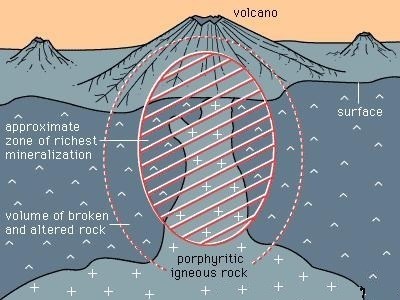
ポルフィリー鉱床は、上昇するマグマの柱が2段階で冷却されることで形成される。第一段階では、マグマが地殻の奥深くでゆっくりと冷やされ、直径2mm以上の大きな結晶粒ができる。2つ目の最終段階では、マグマが比較的浅い深さで、あるいは火山から噴出する際に急速に冷却され、通常は肉眼では見えない小さな結晶粒ができる。
The term 'porphyry' describes a specific texture found in igneous rocks, where they contain larger crystals of certain minerals (especially feldspar or quartz), these being surrounded by a composite of minerals that have a much smaller sized crystal. The larger crystals are called 'phenocrysts' or 'sprinkle grains'. Porphyritic structures are characteristic of lavas and the igneous rocks found in dykes and sills. The phenocrysts are separated by the slower cooling of magma at depth, while the smaller-sized matrix is caused by a more rapid cooling after the magma is squeezed into a crack in the Earth's crust and/or it has reached the Earth's surface.
Porphyry deposits are formed when a column of rising magma is cooled in two stages. In the first, the magma is cooled slowly deep in the crust, creating the large crystal grains with a diameter of 2 mm or more. In the second and final stage, the magma is cooled rapidly at relatively shallow depth or as it erupts from a volcano, creating small grains that are usually invisible to the unaided eye.
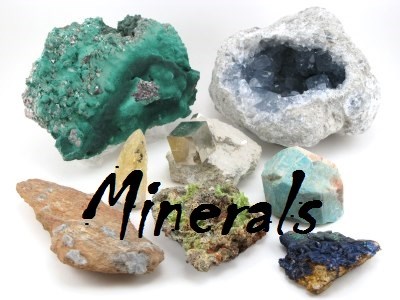
鉱物とは、結晶の形、色、線色、光沢、硬度、劈開、破砕、密度、光学的条件などの特徴的な物理的性質を持つ、天然に存在する元素や化学化合物のことです。
GZでは、この石の中で特に長石や石英の鉱物を見つけることができます。
Minerals, naturally occurring elements and chemical compounds having characteristic physical properties such, crystal shape, color, line color, gloss, hardness, cleavage, fracture, density and optical conditions.
At GZ you will in this stone find especially the minerals feldspar or quartz.
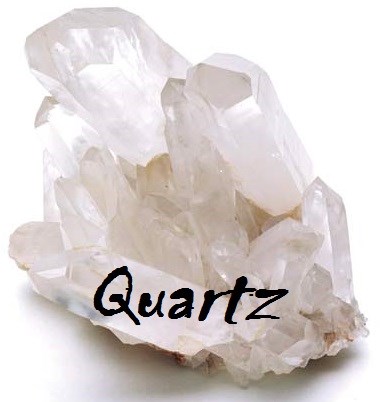
石英 は、SiO4四面体のすべての酸素原子が2つの四面体間で共有され、複雑な3次元骨格を持つ複雑なケイ酸塩である。このため、石英はフレームワーク珪酸塩と呼ばれる。
石英は、岩石を形成する鉱物の中で最も一般的なものの一つであり、多くの変成岩、堆積岩、花崗岩や流紋岩のようなシリカを多く含む火成岩に含まれている。一般的な鉱脈鉱物であり、鉱床に付随することが多い。
Quartz is a complex silicate in which all the oxygen atoms of the SiO4 tetrahedra are shared between two tetrahedra, leading to complex 3-dimensional frameworks. For this reason, quartz is referred to as a framework silicate.
Quartz is among the most common of all rock forming minerals and is found in many metamorphic rocks, sedimentary rocks, and those igneous rocks that are high in silica content such as granites and rhyolites. It is a common vein mineral and is often associated with mineral deposits.
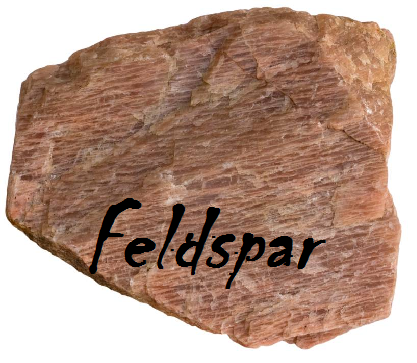
斜長石 長石グループの一員で(斜長石と同様)、骨格を持つ珪酸塩である。斜長石は、黒雲母と黒雲母の間の固溶体からなり、石英とともに岩石形成鉱物の中で最も一般的である。
斜長石 は、斜長石と同じ長石グループの一員で、骨格を持つケイ酸塩である。オルソクレーズは、アルカリ長石またはK長石としても知られ、オルソクレーズとアルバイトの固溶体の一端メンバーである。
オルソクレースは、花崗岩のようなシリカに富む火成岩や、高品位の変成岩に含まれる。
Plagioclase is a member of the feldspar group (like orthoclase) and is a framework silicate. Plagioclase consists of a solid solution between the albite and anorthite end-members, and together with quartz is the most common of the rock forming minerals.
Orthoclase is a member of the feldspar group (like plagioclase) and is a framework silicate. Orthoclase, also known as alkali feldspar or K-feldspar, is one end-member of a solid solution between orthoclase and albite.
Orthoclase is found in silica-rich igneous rocks such as granite, and in high grade metamorphic rocks.
このキャッシュを記録する
このキャッシュを記録するためには、アースキャッシュの座標に関連した質問に答えなければなりません。
答えが集まったら、確認のためCOに送ってください。
回答がCOに送られた後、すぐにログを取ることができます。あなたの答えに質問がある場合は、COがあなたに連絡します。
COへの回答がないログや、COからの質問が保留されているログは予告なく削除されます。
質問の答えとなるような写真をログに含めないでください。
To log this cache.
To get to log this cache you will have to visit and answer the questions which are related to the coordinates given the earthcache.
When answers are collected, send them to CO for verification.
You can log immediately after answers are sent CO. If there are any questions about your answers CO will contact you.
Logs without answers to CO or with pending questions from CO will be deleted without any further notice.
Please do not include pictures in your log that may answer the questions.
質問
1. 以下の質問に答えてください。
A. キャッシュのページにある用語を使って、ポーフィリーの結晶、色、質感、石の中に見える鉱物を説明してください。
B. キャッシュページの頭の写真を見てください。GZにあるポルフィリーの種類は何ですか?A、B、C、それともD?
C. ポルフィリーの結晶の平均サイズは?
D. この石が冷えたのは一段階ですか、それとも二段階以上ですか?どのように結論に達したかを説明してください。
2. その場所から、あなた、グループ、またはGPSの写真を、答えを明かさずに撮ってください。
Questions:
1. Answer the questions under by visiting the coordinates.
A. Using the terms in the cache page to help you describe the porphyry crystals, color, texture and the minerals that you see in the stone?
B. Look at the head photo of the cachepage. What type of porphyry do you locate at GZ? A, B, C or D?
C. What average size are the porphyry crystals?
D. Has this stone cooled in one stage or more than one? Please explain how you reached your conclusions.
2. Take a photo of you, the group or the GPS from the location without revealing any of the answers.