
このアースキャッシュの学習ポイントは、タフォニをもっとよく知ることだ、
GZでは、穴のあいた壁、「傷」のある壁、タフォニと呼ばれるものからなる地層の破壊を観察することができる。これらの穴や石の一部は、大きさや深さが異なり、多少不均一であることがわかります。この現象が何であるかは、以下の文章を読めばわかるだろう。この文章は、あなたがこの場所で勉強することになる内容に基づいて、あなたが目にするものをうまく説明してくれている。下の質問に答えられるように、石から目を離さないでください。
The learning point with this earthcache is to get to know tafoni better,
At GZ, you will be able to observe a holey wall, wall with "wounds" and formation failure which consists of what goes under the name tafoni. You will find that these holes and parts of the stone are somewhat uneven, of different sizes and depths. You will find out what this phenomenon is about by reading through the text below, which gives you a good description of what you see based on what you will be studying here at the location. Keep a close eye on the stone to be able to answer the questions below.
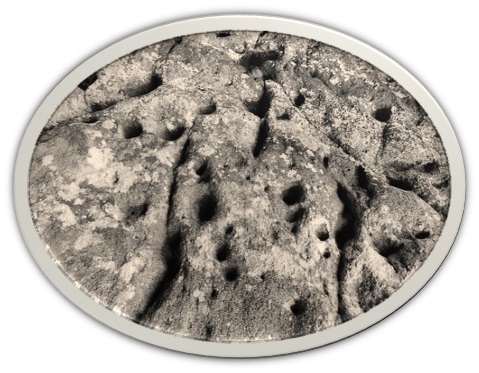
タフォーニ
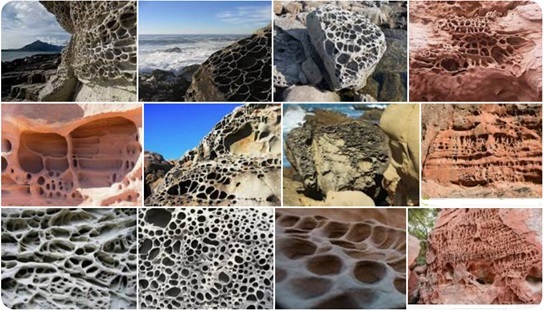
タフォーニ(Tafoni)とは、小さな洞窟、陥没、「傷」、地層破壊に似た地層で、丸い入り口と滑らかで凹んだ壁を持つ。一般に、1cm未満の小さなものから1mを超える大きなものまであり、自然または人工の作品に発達する空洞地形と定義される。タフォニは、崖の側面、丘、岩場でよく見られる。タフォーニは、花崗岩、砂岩、砂質石灰岩に形成されるのが最も一般的で、特に半乾燥気候から乾燥砂漠気候の地域でよく見られる。この地層は、ハニカム(蜂の巣)状または「キノコ状」の外見から容易に見分けることができる。
タフォニの形成は通常、凍結融解、湿気乾燥、塩類風化などの原因からなる。塩類風化の一種であるハニカム風化は、最も一般的な説明である。塩類風化は、通常、海の波や霧、風によって、浸透性のある岩石の表面に塩分が蓄積することで起こる。塩水が蒸発すると、塩分が残る。塩分は石の気孔に入り込み、そこで結晶化して気孔をさらに押し広げる。拡大した岩石の気孔は、前述の湿潤乾燥や凍結融解のサイクルを含む、さらなる風化にさらされる。かなりの時間が経つと、風化はタフォニという形で顕著になる。
沿岸地域にタフォニが存在することを説明する理論は他にもある。塩類風化に加えて、軟体動物やその他の海洋生物もタフォニを形成すると考えられている。軟体動物やその他の海洋生物は、岩石海岸に小さな穴を開け、そこに付着してミネラルを抽出する。穴は時間とともに大きくなり、最終的には軟体動物や他の生物が落ちてしまう。穴はその後、風、雨、潮などの要素に委ねられる。これらが相まって、タフォニ地層が形成されるのである。
タフォニーの起源については、多くの説明が提唱されている。海洋摩耗、風による腐食、短期間の温度変化による機械的風化、保護地殻の下での岩石内部の化学的風化(コアの軟化)(ケースハードニング)、その後軟化した物質の機械的除去、地衣類による生物地球化学的風化、沿岸地域での塩の発散に影響する温度変化、塩類風化などである。近年、地質学者や研究者は、タフォニー形成の主な説明として塩類風化を提唱している。現在のところ、タフォニアは多因子性であり、塩類風化と周期的な湿潤・乾燥を含む物理的・化学的風化過程の複雑な相互作用の結果であると考えられている。
Tafoni
Tafoni is a geological formation that resembles a small cave, cave-in, "wound", formation failure, with a round entrance and smooth, concave walls. Generally defined as small less than 1 cm to large, greater than 1 meter cavity features that develop in either natural or man-made works. Tafoni is often found in cliff sides, hills and rocky areas. Tafoni is most commonly formed in granite, sandstone or sandy limestone and is particularly common in semi-arid to arid desert climates. This formation is easy to recognize because of its honeycomb or "mushroom-like" appearance.
The formation of tafoni typically consists of causes such as freezing-thawing, moisture-drying and salt weathering. Honeycomb weathering, a form of salt weathering, is the most common explanation. It occurs when salt accumulates on the surface of permeable rocks, usually by ocean waves, fog or wind. When the salt water evaporates, it leaves the salt behind. The salt works its way into the stone pores, where it crystallizes and pushes the pores open further. These enlarged rock pores are subjected to further weathering, including the aforementioned wetting-drying and freeze-thaw cycles. After a considerable time, the weathering becomes noticeable in the form of tafoni.
There are other theories that explain the presence of tafoni in coastal areas. It is believed that in addition to salt weathering, molluscs and other marine life can also initiate tafoni. They do this by making small holes in the rocky coastlines, where they attach themselves and extract minerals. The hole grows larger over time until eventually the mollusk, or another organism, falls off. The hole is then left to the elements, such as wind, rain and tides. These work together to create the tafoni formations.
Many explanations have been proposed for the origin of taphoney. They include marine wear; wind corrosion; mechanical weathering as a result of short-term temperature variations; chemical weathering of the interior of the rock (core softening) under a protective crust (case-hardening) followed by mechanical removal of the softened material; biogeochemical weathering of lichens; temperature variations affecting salt efflorescence in coastal areas; and salt weathering. In recent times, geologists and researchers have advocated salt weathering as the primary explanation for the formation of tafoni. Currently, tafonia is considered to be polygenetic in origin, and is the result of complex interaction between physical and chemical weathering processes, which include salt weathering and cyclic wetting and drying.
風化とは、岩石、鉱物、土壌、その他の物質が、空気、水(氷)、温度変動、生物との直接接触によって分解されることである。風化は浸食とともに景観を形成する。
風化と浸食の主な違いは、そのプロセスがどこで起こるかである。風化作用が岩石をその場で砕くのに対し、侵食作用は緩んだ物質を除去する。風化の強さに影響する重要な要因は、岩石の種類、気候、地殻変動である。
風化はその場で起こり、分解生成物の移動はほとんどない。機械的風化と化学的風化を区別するのが一般的であるが、どちらも生物学的な要素を含むことがあり、したがって生物学的風化は第三の主要なタイプと考えることができる。機械的風化と化学的風化は同時に起こることもあり、その結果、互いに補強し合うことになる。寒冷で乾燥した環境や高温多湿の環境など、より極端な環境では、主に1つのタイプが優勢になる傾向がある。
一方、侵食は、物質を粉砕または分解するプロセスであり、緩んだ物質、すなわち分解生成物を輸送するプロセスでもある。侵食は、流水、波、風、雪、氷、重力など、さまざまな作用物質(すなわち、プロセスを推進または維持するもの)の助けを借りて起こる。分解生成物は、1つまたは複数の作用物質によって運搬されるため、発生源地域からさまざまな距離に堆積する可能性がある。
Weathering is the breakdown of rocks, minerals, soil and other materials by direct contact with air, water (ice), temperature fluctuations and biological organisms. Weathering shapes the landscape together with erosion.
The main difference between weathering and erosion is where the process takes place. As weathering crumbles the rocks in place, the erosive forces remove the loose material. Important factors that affect the intensity of weathering are the type of rock, climate and tectonic setting.
Weathering takes place in situ with little or no movement of the decomposition products. It is common to distinguish between mechanical and chemical weathering, but both can have a biological component, and biological weathering can therefore be considered a third main type. Mechanical and chemical weathering can take place simultaneously and thus reinforce each other. In more extreme environments, such as cold and dry or hot and humid, one main type will tend to dominate.
Erosion, on the other hand, is a process that grinds or breaks down material and also transports the loose material, i.e. the breakdown products. Erosion occurs with the help of various agents (i.e. what drives or maintains a process), such as running water, waves, wind, snow, ice or gravity. The decomposition products are transported by one or more agents and can therefore be deposited at varying distances from the source area.
機械的風化
機械的風化とは、化学的変化を伴わない純粋な岩石の崩落である。温度と圧力の変化によってひび割れが生じ、時間の経過とともに地表が崩れていく。機械的風化はクラストや粒子の大きさの減少につながり、寒冷で乾燥した環境で支配的となる傾向がある。
例としては、凍土風化の一種であるフロスト・ブラストがある。もうひとつの例は、昼夜の温度差が大きい地域での剥離やひび割れである。岩石の表面は内部よりも強く加熱され、緊張状態が生じてひび割れにつながる。
化学的風化
化学的風化は、特に水(雨水や地下水)の溶解作用と関連しており、酸性水が最も効果的である。化学的風化は、岩石の表面付近の組成を変化させる。岩石中の特定の物質、例えばナトリウム化合物は非常に容易に溶解するが、他の物質は変化しない。すべての化学的プロセスと同様に、化学的風化は低温よりも高温の方が速く進行するため、高温多湿の熱帯地方で顕著となる。また、植物の覆いも有機酸を供給するため、大きな役割を果たす。
化学的風化の例として、錆の形成が挙げられる。岩石中の鉄含有化合物が水や空気と反応し、赤褐色の酸化鉄が形成される。
Mechanical weathering
Mechanical weathering is a pure crumbling of the rocks without chemical changes. Changes in temperature and pressure can lead to cracking and, over time, crumbling of the land surface. Mechanical weathering leads to a reduction in clast or particle size, and tends to dominate in cold and dry environments.
An example is frost blasting, which is a type of frost weathering. Another example is peeling and cracking in areas where there are large temperature differences between day and night. The surface of the rock is heated more strongly than the interior, and tensions arise that lead to cracking.
Chemical weathering
Chemical weathering is particularly linked to the dissolving effect of water (rainwater and groundwater), where acidic water will be most effective. Chemical weathering causes a rock's composition to change near the surface. Certain substances in the rocks dissolve very easily, for example the sodium compounds, while others remain unchanged. Like all chemical processes, chemical weathering is faster at higher than at lower temperatures, and is therefore more pronounced in the tropics, where it is hot and humid. The plant cover also plays a major role because it contributes organic acids.
An example of chemical weathering is rust formation. Iron-containing compounds in rocks can react with water and air, and red-brown colored iron oxide is formed.
このキャッシュを記録する
このキャッシュを記録するためには、アースキャッシュの座標に関連した質問に答えなければなりません。
答えが集まったら、確認のためCOに送ってください。
回答がCOに送られた後、すぐにログを取ることができます。あなたの答えに質問がある場合は、COがあなたに連絡します。
COへの回答がないログや、COからの質問が保留されているログは予告なく削除されます。
質問の答えとなるような写真をログに含めないでください。
To log this cache.
To get to log this cache you will have to visit and answer the questions which are related to the coordinates given the earthcache.
When answers are collected, send them to CO for verification.
You can log immediately after answers are sent CO. If there are any questions about your answers CO will contact you.
Logs without answers to CO or with pending questions from CO will be deleted without any further notice.
Please do not include pictures in your log that may answer the questions.
質問
1. 以下の質問に答えてください。
A. GZのタフォニを観察・研究してください!タフォニの平均直径と深さをmm単位で見積もる!
B. 1. また、タフォニが減少し、影響を受けていない部分に移っていく原因について説明してください。
B 2. タフォニがある部分とない部分で、構造、鉱物、色、滑らかさに違いはあるか?
C. あなたがGZで研究し、観察してきたことに基づいて、その穴はどのような風化の過程や反応から生じたと言えるのでしょうか?また、浸食はここで起こったプロセスの一部ですか?あなた自身の言葉で説明してください!
2. その場所から、あなた、グループ、またはGPSの写真を、答えを明かさずに撮ってください。
Questions:
1. Answer the questions below by visiting the coordinates.
A. Observe and study the tafoni at GZ! Estimate the average diameter and depth of the tafoni in mm!
B. 1. How much of the area/wall consists of tafoni, and describe what causes the tafoni to decrease and go over to unaffected parts?
B 2. Do you see any differences in structure, minerals, colors or smoothness in the area/wall with and without tafoni?
C. Based on what you have studied and observed at GZ, what weathering would you say the holes have arisen from in terms of process and reactions? And is erosion part of the process that has taken place here? Describe in your own words!
2. Take a photo of you, the group or the GPS from the location without revealing any of the answers