[ENGLISH VERSION BELOW]
Aquí encontrarás las impresionantes secuencias turbidíticas que se formaron hace millones de años en las profundidades de un antiguo océano. Estas formaciones rocosas cuentan la fascinante historia de procesos submarinos y, gracias a la erosión, ahora crean paisajes espectaculares como las "colas de dragón".
¿Qué son las secuencias turbidíticas?
Los turbiditas son capas de roca formadas por deslizamientos submarinos. La arena y el lodo fueron transportados a las cuencas oceánicas por ríos prehistóricos, donde se depositaron en capas. Las capas duras de arenisca se alternan con capas blandas de margas, que más tarde fueron moldeadas por la erosión para formar las características distintivas del paisaje actual.
¿Qué distingue a las colas de dragón de otras formas erosivas?
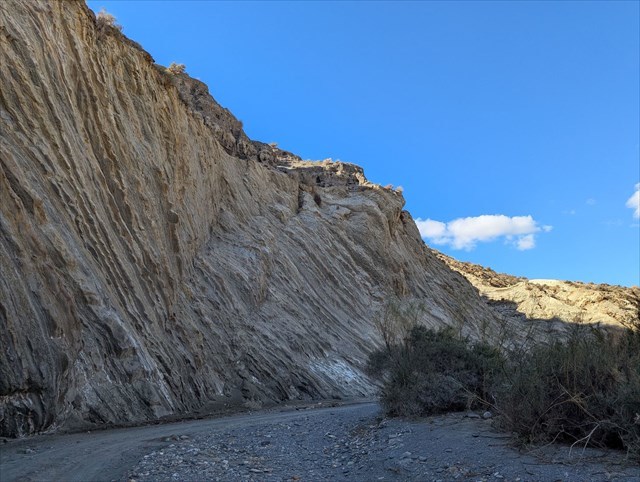
En algunos valles del Desierto de Tabernas, las secuencias turbidíticas están inclinadas. Esta inclinación, combinada con la erosión diferencial, hace que las capas más duras de arenisca sobresalgan de las margas, asemejándose al lomo y la cola de un poderoso dragón.
Aquí encontrarás algunas colas de dragón particularmente hermosas y, en el WP1, una impresionante pared de secuencias turbidíticas. Examina ambos y responde las siguientes preguntas:
- Describe la estructura visible de la pared (WP1). ¿En qué se diferencian las capas más duras de arenisca de las capas más blandas en cuanto a color, dureza y textura?
- Estima o mide el ángulo de inclinación de las capas (en grados). ¿En qué dirección están inclinadas las capas?
- ¿Qué formas de erosión (por ejemplo, protuberancias, bordes, surcos) puedes identificar? ¿Cómo crees que estas se formaron debido a las diferencias en la dureza de las capas?
- Considera cómo los ríos y una antigua cuenca oceánica pudieron haber contribuido a la formación de estas estructuras rocosas. Descríbelo con tus propias palabras.
- Hazte una foto sujetando un objeto personal de geocaching delante de la cola de un dragón.
Para obtener el permiso para registrar este caché, ¡solo envíame tus respuestas correctas! No necesitas esperar aprobación. En caso de que haya algún problema con tus respuestas, me pondré en contacto contigo.
Las colas de dragón - the dragon tails
Here you will find the impressive turbiditic sequences that were formed millions of years ago in the depths of an ancient ocean. These rock formations tell the fascinating story of underwater processes and, through erosion, now create spectacular landscapes such as the "dragon tails."
What are turbiditic sequences?
Turbidites are layers of rock created by underwater landslides. Sand and mud were carried into ocean basins by prehistoric rivers, where they settled in layers. Hard sandstone layers alternate with soft marl layers, which were later shaped by erosion to form the characteristic features of the present-day landscape.
What distinguishes the dragon tails from other erosive forms?
In some valleys of the Tabernas Desert, the turbiditic sequences are tilted. This tilt, combined with differential erosion, causes the harder sandstone layers to protrude from the marl, resembling the back and tail of a mighty dragon.
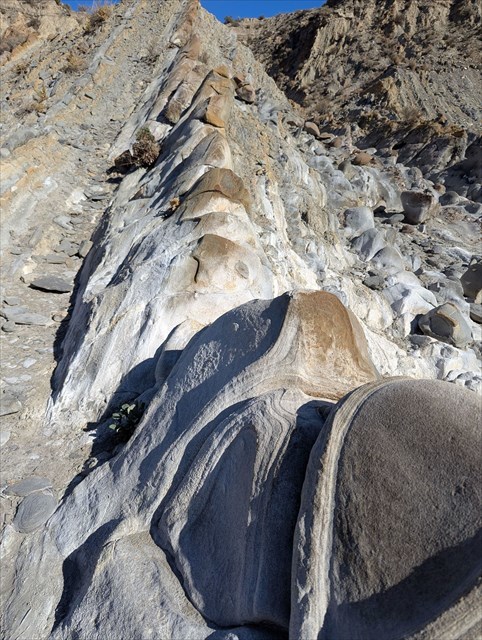
Here you will find some particularly beautiful dragon tails and, at WP1, an impressive wall of turbiditic sequences. Examine both and answer the following questions:
- Describe the visible structure of the wall (WP1). How do the harder sandstone layers differ from the softer layers in color, hardness, and texture?
- Estimate or measure the angle of inclination of the layers (in degrees). In which direction are the layers tilted?
- What forms of erosion (e.g., protrusions, edges, grooves) can you identify? How might these have been created by the varying hardness of the layers?
- Consider how rivers and an ancient ocean basin might have contributed to the formation of these rock structures. Describe this in your own words.
- Take a photo of yourself or a personal geocaching item in front of a dragon tail.
To get a permission to log this cache, just send me your correct answers! You don't have to wait for approval. In case of any problems with your answer, I will contact you!