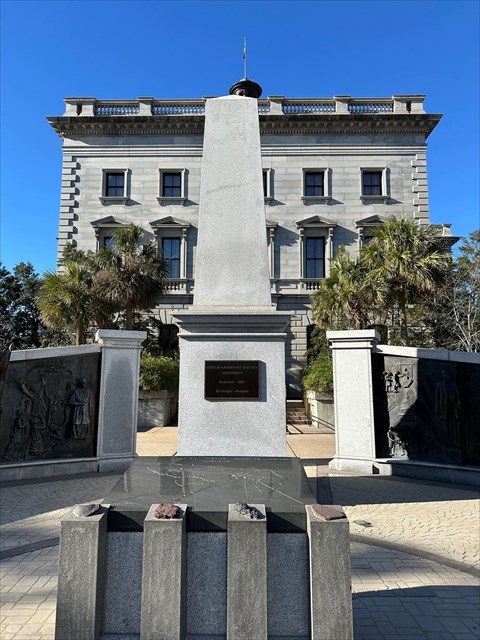
The South Carolina African American History Monument, located on the State House grounds in Columbia, commemorates the contributions and struggles of African Americans throughout the state's history. Dedicated in 2001, the monument features a series of bronze relief panels that depict significant moments, from the horrors of the transatlantic slave trade to the triumphs of the Civil Rights Movement. At its center stands a granite obelisk, symbolizing resilience and hope, surrounded by depictions of cultural and historical achievements. The monument contains 4 stones from regions in Africa where enslaved people were captured: Senegal, Sierra Leone, Ghana, and Republic of Congo. For this earthcache lesson, we will primarily be focusing on the stone from Senegal.
Before we get to the main lesson, it is first important to know the basics. Rocks are classified into three main types based on their formation processes: igneous, sedimentary, and metamorphic. Igneous rocks form when magma or lava cools and solidifies, and they are further divided into intrusive (formed beneath the surface, like granite) and extrusive (formed at the surface, like basalt). They are also classified by composition, with mafic rocks being rich in magnesium and iron (and darker), and felsic rocks being high in silica and lighter minerals like quartz and feldspar.
Sedimentary rocks result from the accumulation and compaction of sediments or the precipitation of minerals from solution. They can be clastic (formed from fragments of other rocks, like sandstone), chemical (like limestone), or organic (like coal). These rocks often preserve evidence of past environments, such as fossils or ripple marks.
Lastly there are metamorphic rocks, which arise from the transformation of existing rocks under heat, pressure, or chemically active fluids. They are categorized as foliated (exhibiting a banded or layered texture, like schist) or non-foliated (lacking a layered structure, like marble). This classification depends on the minerals present and the intensity and direction of the metamorphic forces.
Senegal:
Senegal's geology features two main units: the Precambrian basement in the east and the Senegal Basin in the west. The Precambrian basement (basement refers to all rocks as being Precambrian in age) includes the Hercynian-age Mauritanides chain and the Kedougou–Kenieba inlier, part of the West African Craton (large ancient part of Earth's crust) and rich in gold deposits. The Kedougou–Kenieba inlier is subdivided into three major stratigraphic units: the Mako, Diale, and Daléma Supergroups.
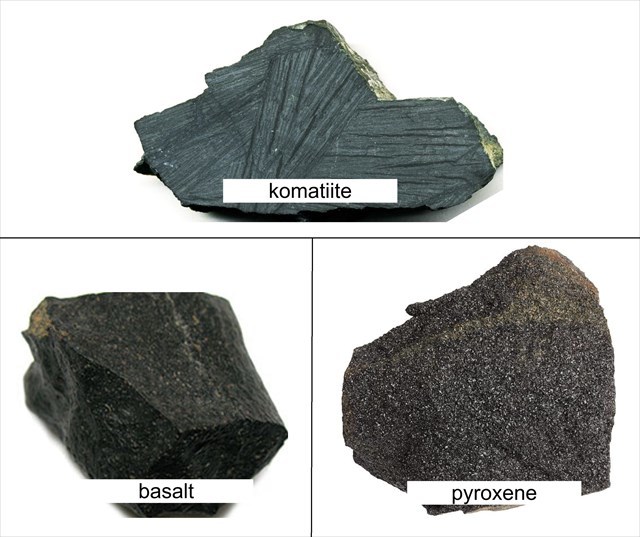
The Mako Supergroup hosts the Sabodala gold deposits in a zone of intense shearing and silicification, associated with pyrite gold mineralization. It consists of volcanic and ultramafic rocks, including basalt, komatiite, and pyroxenite, often altered by carbonate processes. Basalt is a fine grained, dark rock that forms when lava cools quickly. Komatiite is also dark but has a high magnesium content and a needle like texture. Lastly there is pyroxenite which is coarse grained, with large black or greenish crystals of pyroxene.
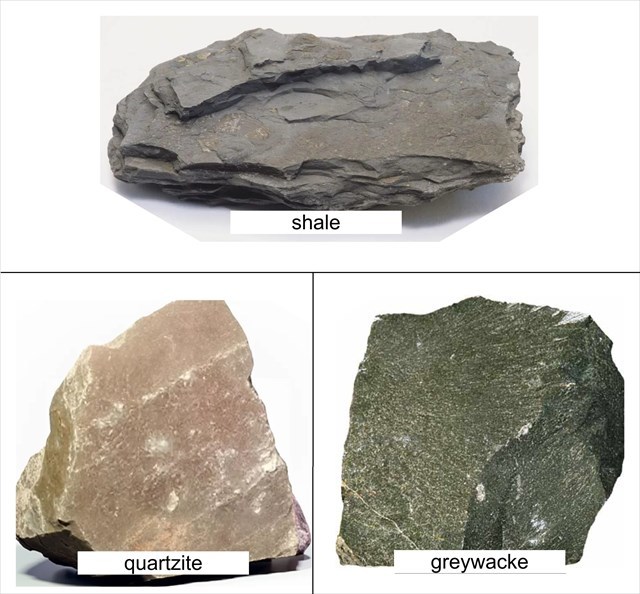
The Diale Supergroup, includes extensively folded formations, deposited after those of the Mako Supergroup, consisting of shale, greywacke, and quartzite. The shale, which is formed from compacted silt and clay, retains its fine grained texture despite metamorphism. Greywacke, which is a sandstone composed of poorly sorted sand-sized grains, suggests rapid deposition near the source rock, likely in a high energy environment such as a submarine fan (underwater deposits of sediments that form at base of submarine canyons). Lastly, there is quartzite, which is derived from sandstone subjected to elevated heat and pressure. The presence of quartzite indicates regional metamorphism strong enough to fuse quartz grains but not obliterate primary sedimentary structures.
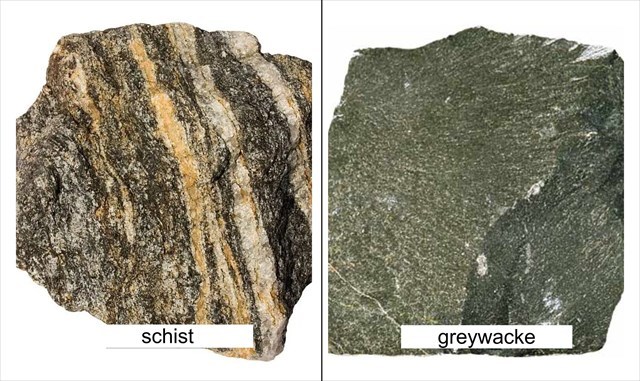
The Daléma Supergroup is located between the Saraya granite and the Faleme River, and extends into Mali but is covered in the south by the Segou Madina Kouta Series. It consists of volcano sedimentary schists and greywacke, shaped by both volcanic activity and sedimentation. Schist is a metamorphic rock with a layered, flaky texture that forms under heat and pressure, while greywacke is a hard, dark sandstone made of mixed grains, often deposited rapidly near its source. These rocks reflect a complex depositional history influenced by both volcanic activity and sedimentation.
Logging Requirements:
- Examine the rock from Senegal closely. Describe the color, texture, grain size, and any other unique characteristics. Based on the description, which Supergroup do you think it is part of and why?
- Geologically speaking, which of the three other rocks do you think is the most similar to the one from Senegal (hint: the 2nd, 3rd, and 4th paragraphs might help)? Explain your answer.
- Upload a photo with the South Carolina African American History Monument. You don't have to be in the photo, though it is strongly encouraged.
Sources:
- https://infcis.iaea.org/udepo/Resources/Countries/Senegal.pdf
- https://www.nps.gov/subjects/geology/rocks.htm#