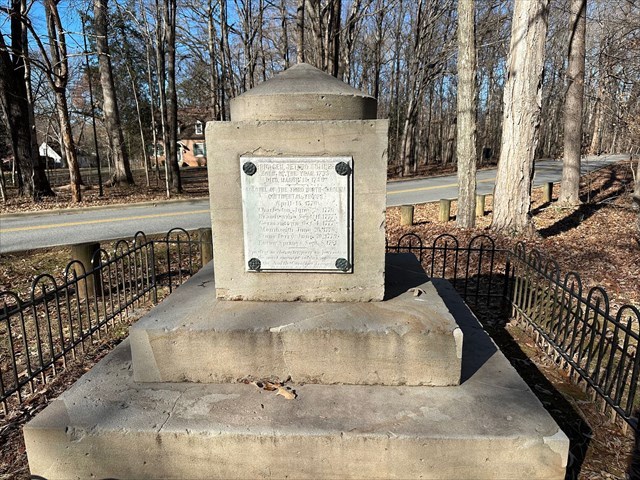
The Jethro Sumner Monument, located in Guilford Courthouse National Military Park, honors Brigadier General Jethro Sumner, a key figure in North Carolina's Revolutionary War efforts. Although Sumner did not participate in the Battle of Guilford Courthouse, his leadership in the Continental Army, particularly during the Southern Campaign, was instrumental in rallying North Carolina’s support for independence. The monument, dedicated in 1823, serves as Sumner’s final resting place, with his reinterred remains placed in a small copper box beneath the structure, accompanied by a bayonet recovered from the Battle of Eutaw Springs.
Constructed from Aquia Creek Sandstone, the monument replicates the Latrobe Cenotaph design created by the Architect of the Capitol. This design was traditionally used for commemorative empty tombs, such as those found in the Congressional Cemetery in Washington, DC. However, in this case, it holds Sumner’s remains, making it unique among similar cenotaphs. The sandstone used in this monument was sourced from the same quarry historically used for Latrobe Cenotaphs and other prominent structures near the nation’s capital.
Aquia Creek Sandstone was formed during the Eocene epoch, approximately 55 to 34 million years ago, in a shallow marine environment. The sandstone began as sediment eroded from surrounding land and carried by rivers to the shore. The material, primarily quartz grains, was then deposited in beach or nearshore settings where wave action sorted the grains by size. Over time, these sediments were buried and subjected to pressure, leading to the cementation of the grains by silica.
Grain size in sedimentary rocks like sandstone is a key indicator of the energy conditions present during their formation. Larger grains (such as gravels and coarse sands) typically suggest a high-energy environment, such as that found near shorelines or riverbeds, where strong currents can transport and deposit coarser materials. Conversely, smaller grains (such as silt or clay) indicate lower energy conditions, such as those in deeper water or quiet environments, where finer particles can settle out of suspension. By analyzing grain size, geologists can infer the dynamic processes and energy levels of the ancient environments in which the sediment was deposited.
In 2012, a car driving on New Garden Road lost control and crashed into the monument. During repairs, Sumner's remains were temporarily removed and reinterred once the work was completed. During restoration, stone from the same Aquia Creek Sandstone quarry as the original were used, and if you look closely, the repairs are still visible. An expert craftsman, known for work on the Congressional Cemetery Cenotaphs and the White House facade, carried out the repairs, with the corners highlighting the quality of the restoration.
Logging Requirements:
- Describe the color, grain size, and any other unique characteristics of the sandstone. Can you observe any veining in the stone? If so, what do you think might have caused it?
- Based on your observations, was the sandstone formed in a high energy or low energy environment? Explain your answer.
- Compare and contrast the newer sandstone in the repairs with that of the original monument. How have the elements affected the original stone? Over time, do you think the repairs will become more or less visible? Explain your answer.
- Upload a photo taken with the Jethro Sumner Monument. You don't have to be in the photo, though it is strongly encouraged.
Sources:
- http://www.virginiaplaces.org/geology/governmentisland.html
- https://www.stonecontact.com/aquia-creek-sandstone/s15504