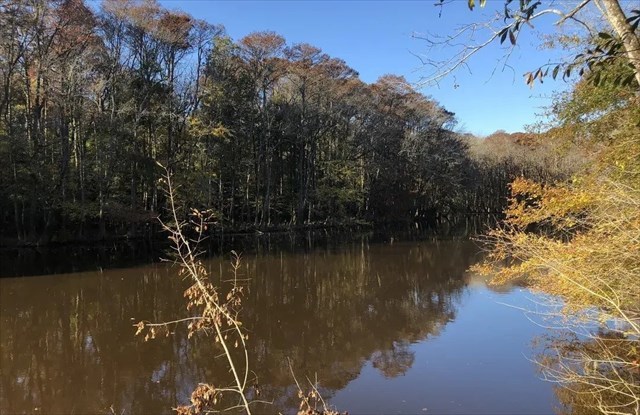
Congaree National Park is located in central South Carolina and protects the largest intact expanse of old-growth bottomland hardwood forest in the United States. This unique ecosystem thrives along the Congaree River and offers a rare glimpse into a biodiverse floodplain where towering trees form a natural canopy. Seasonal flooding replenishes the soil and supports habitats for various plant and animal species.
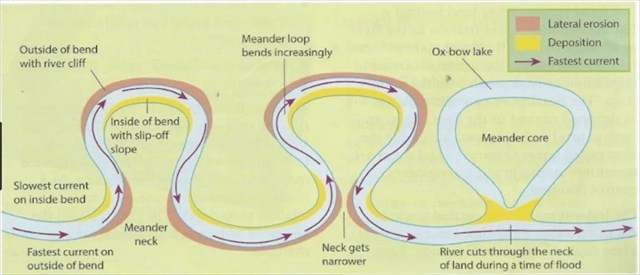
Weston Lake is the largest oxbow lake in Congaree National Park, and the largest permanent body of standing water on the floodplain. Oxbow lakes form when a meandering river creates a loop that becomes cut off from the main channel. This process begins as the river erodes its outer banks and deposits sediment on its inner banks, gradually creating exaggerated curves. During periods of high flow or flooding, the river may break through the narrow neck of a meander, allowing water to flow directly across the loop and bypass the curve. Over time, sediment seals off the abandoned loop, isolating it from the river and forming an oxbow lake. These lakes often appear crescent-shaped and can eventually fill with sediment, becoming marshes or dry land.
What makes Weston Lake unique is its unusual depth and the absence of the shallow clay and silt layer typically found in such formations. Unlike most oxbows, which are relatively young and located near the river, Weston Lake is situated 2.5 miles north of the current river channel. Sediment core analysis suggests the lake formed approximately 2,890 years ago. Adding to its mystique, local folklore claims Weston Lake is 'bottomless'. In 2009, a study conducted by the University of South Carolina revealed that much of the lake's steep sided basin exceeds 20 feet in depth, with its deepest point reaching nearly 25 feet—exceptionally deep for an oxbow lake in a South Carolina floodplain. The lake's bottom is also composed of gravel rather than the mud and organic material typically expected in such lakes. This combination of depth and composition suggests Weston Lake is not filling with sediment as it ordinarily would. Researchers proposed that artesian wells at the lake's bottom might be preventing sediment and debris from accumulating, preserving its unique characteristics.
Logging Requirements:
- Describe the appearance of the water at Weston Lake. Is it relatively clear or murky? Based on this observation, is there any clay or silt suspended in the water?
- Since the clay and silt sediments do not settle at the bottom of Weston Lake as they typically do in other oxbow lakes, where do you think these sediments might end up?
- Upload a photo taken at the Weston Lake overlook. You don't have to be in the photo, though it is strongly encouraged.
Sources:
- https://friendsofcongaree.org/journals/john-cely-congaree-journal/essay-oxbow-lakes/
- https://www.govinfo.gov/content/pkg/GOVPUB-I29-PURL-gpo128601/pdf/GOVPUB-I29-PURL-gpo128601.pdf