In order to log this EarthCache, send me your answers to the following questions either through email or messaging from my profile page.
1: Estimate the average wave height during your visit?
2: Can you see material being moved along the beach? If so, in what direction (east or west)?
3a: How would you expect this long shore drift to compare to one on a smaller inland lake?
3b: How would you expect this long shore drift to compare to one on a larger ocean?
4: Post a pic of you or a personal item with Romar Beach in the background.
If you enjoyed this EarthCache, please consider giving it a favorite point.
Longshore drift
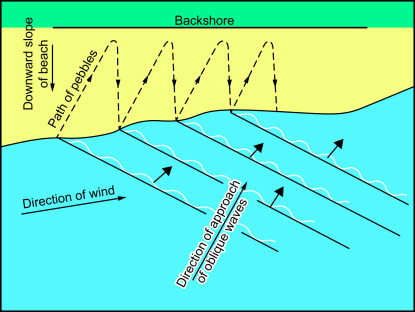
Longshore drift is the movement of material along the shore by wave action. It happens when waves approach the beach at an angle. The swash (waves moving up the beach) carries material up and along the beach. The backwash (water moving down the beach) carries material back down the beach at right angles. This is the result of gravity. This process slowly moves material along the beach and provides a link between erosion and deposition.
Wave Height
The wave height of a surface wave is the difference between the elevations of a crest (top) and a neighboring trough (bottom).
When a wave breaks at a more steep angle on the beach, longshore currents increase in velocity. This causes more material to be moved. A more gentle angle from a lower wave results in a lower velocity and less material moved.
Size Matters
I have two other EarthCaches on the subject of long shore drift. One is on Lake Huron, an inland lake in Michigan. The other is on one of the more popular surfing beaches in Hawaii. The answers between these two are very different. Lake Huron is usually calm to low wave action with only noticeable movement of material. Hawaii, on the other hand, is usually 3-4 ft waves, sometimes much more than that with lots of movement of material. This brings up the question: Does the size of the body of water influence the long shore drift? Let's look into that...
Wave Size and Energy
Larger bodies of water, like oceans, are capable of generating larger and more powerful waves than smaller bodies of water, like inland lakes. These waves possess greater energy and can transport more sediment along the shoreline, leading to stronger longshore drift.
Fetch
The fetch is the distance over which the wind blows across the water's surface. It is also influenced by the size of the body of water. Larger bodies of water provide longer fetches, allowing waves to grow larger and stronger, which in turn, increases the energy driving longshore drift.
Sediment Supply
Larger bodies of water often have larger drainage basins, leading to a greater supply of sediment from rivers and other sources. This abundant sediment supply fuels longshore drift, as there's more material to be transported along the coast.
Coastal Configuration
The shape and features of the coastline also play a role, and these can be influenced by the size of the body of water. For example, a large ocean can generate powerful waves that erode coastlines, providing a greater supply of sediment for longshore drift.
references
https://www.internetgeography.net
https://www.wikipedia.org
I have earned GSA's highest level:
 |