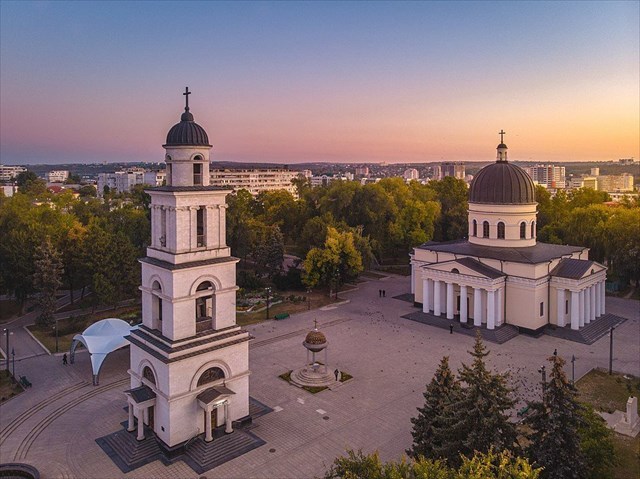
The Metropolitan Cathedral of the Nativity of Christ in Chisinau is one of the most important and representative religious buildings in the Republic of Moldova. Located in the city center, this Orthodox cathedral is the main place of worship for the Orthodox community in Chisinau and a symbol of the spirituality and religious traditions of the country.
Composition:
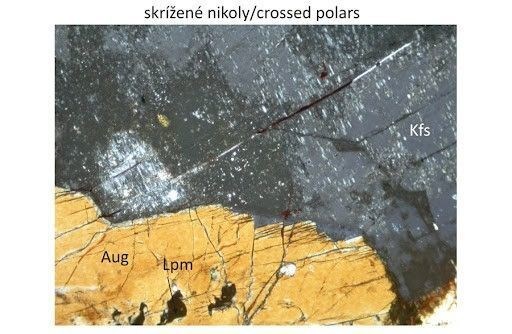
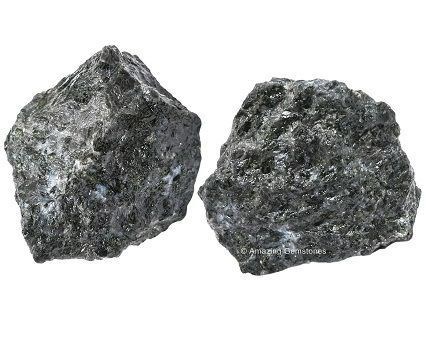
Larvikite is an igneous rock, specifically a variety of monzonite, characterized by the presence of miniature feldspar crystals. These feldspars are known as ternary feldspars because they contain important constituents of all three feldspar endmembers. At the microscale, the feldspar is partially unmixed to form perthite, and the presence of alternating layers of alkali feldspar and plagioclase gives it a characteristic silvery-blue luster. (Schiller effect, labradorescence) on polished surfaces. Olivine may be present along with apatite and locally quartz. Larvikite is usually rich in titanium, but titanaugite and/or titanomagnetite are also present.
Occurrence:
Larvikite occurs in the Larvik Batholith (aka Larvik Plutonic Complex), a set of 10 volcanic plutons located in the Oslo Graben, surrounded by ~1.1 billion year old Sveconorwegian gneisses. The Larvik batholith is Permian in age, approximately 292–298 million years old. Larvikite also occurs in the Killala Lake Alkaline Complex near Thunder Bay, Ontario, Canada. The name comes from the town of Larvik in Norway, where this type of igneous rock is found. Many quarries mine larvikite in the area around Larvik.
Appearance:
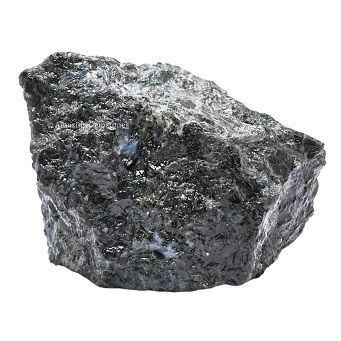
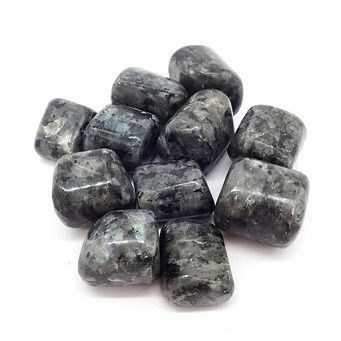
Larvikite has a dark gray to black color with a granular texture. It is characterized by the presence of small crystals of feldspar that reflect light in different colors, such as silver, blue, green, or purple. This phenomenon is called labradorescence or schiller effect, and it occurs when the light is diffracted by the thin layers of feldspar within the rock. The intensity and color of the labradorescence depend on the angle of the light and the orientation of the rock. This makes larvikite a favored choice for countertops, tiles, and decorative stone surfaces, adding a touch of elegance and natural beauty to interiors.
Formation:
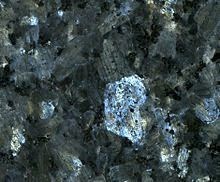
The Larvikite intrusions in Norway are part of a complex of igneous rocks emplaced during the Permian period, which are associated with the formation of the Oslo Rift. The crystallization of ternary feldspar indicates that this rock began to crystallize under lower crustal conditions.
Uses:
Larvikite is prized for its high luster and labradorescence of feldspar crystals and is used as a dimensional stone, often covering the facades of commercial buildings and corporate offices. It is unofficially called Blue Pearl Granite, although this is not an accurate description. Larvikite has been declared a World Heritage Stone Resource by the International Union of Geological Sciences.
Physical Phenomena:
The captivating iridescence observed in larvikite is primarily the result of a physical phenomenon known as labradorescence. Labradorescence occurs when light interacts with the fine layers and inclusions within minerals, causing the colors to shift and shimmer as the angle of observation changes. In larvikite, labradorescence is a consequence of the arrangement and composition of the plagioclase feldspar crystals. These crystals exhibit a unique twinning pattern, scattering light and creating the mesmerizing play of blue and silver-gray colors that distinguishes larvikite.

How to log this cache:
To log this cache, take a picture of Cathedral made from the larvikite at the coordinates. You also need to answer the following questions and answers send me to email in the profile:
1, Describe the color of the plates, its hardness and surface. Is it rough or polished?
2, Look at the larvikite plates on the Bell tower of the Cathedral of the Nativity of the Lord on stage 1
and tell me if the larvikite is the same or has a different color?
3, Walk around and watch the play of light. What colors are you able to observe?
4, In your own words, describe why the color changes. How is it called?
5, Please post a photo of yourself, or GPS with the larvikite.
Feel free to log this cache. You do not need to wait for permission to log. If your answers are not correct, incomplete, I will contact you by e-mail. But if your e-mail is not coming to me within 3 days from your log, I will delete your log without notice.

Cum să înregistrezi această cache:
Pentru a înregistra această cache, fă o fotografie a Catedralei realizate din larvikit la coordonatele date. De asemenea, trebuie să răspunzi la următoarele întrebări și să trimiți răspunsurile la adresa de e-mail din profil:
1, Descrie culoarea plăcilor, duritatea și suprafața lor. Este aspră sau lustruită?
2, Uită-te la plăcile de larvikit de pe turnul clopotniței Catedralei Nașterii Domnului la etapa 1 și spune-mi dacă larvikitul este la fel sau are o culoare diferită?
3, Plimbă-te în jur și observă jocul de lumini. Ce culori poți observa?
4, Te rog, descrie în cuvintele tale de ce se schimbă culoarea. Cum se numește acest fenomen?
5, Te rog să postezi o fotografie cu tine sau cu GPS-ul tău lângă larvikit.
Simte-te liber să înregistrezi această cache. Nu trebuie să aștepți permisiunea pentru a înregistra. Dacă răspunsurile tale nu sunt corecte sau complete, te voi contacta prin e-mail. Dar dacă e-mailul tău nu ajunge la mine în termen de 3 zile de la înregistrare, voi șterge înregistrarea ta fără notificare.
Used sources: