
Orangevale Community Park is a 76-acre park with about every activity avaible you could think of! A large disc golf course (with pro shop) sits among natural open space, hiking trails, paved walking paths, fitness equipment, soccer field, tennis and pickleball courts, picnic areas, playground, and a horse-riding arena. Among the oak woodland nature area are rare vernal pools.
Vernal Pools:
Webster defines vernal as “of, relating to, or occurring in the spring,” and “fresh or new like the spring.” The first definition is the reason these unique geologic features are called vernal pools (they are hardly new as the second definition describes, being thousands of years old and formed as a result of soil that is possibly millions of years old!).
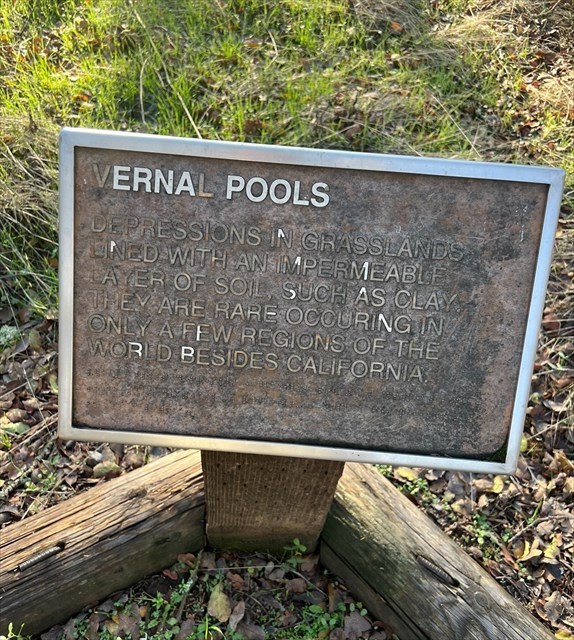
Thus, vernal pools are pools of water that only appear in the springtime or wet season of a region. The pools are identified as a shallow depression in the landscape that easily dries up when there is no water available. Unlike other points in the soil matrix that allow rainwater to drain through the soil and into the groundwater supply, water collects in vernal pools due to the presence of an impermeable layer underneath known as hardpan. This means that the water eventually dries up through evaporation, not infiltration (draining into the groundwater). Hardpan is not rock, but a very dense rock-hard layer of soil itself. It prevents the internal drainage of the soil and can limit the depth to which plants are able to extend their roots (Frey & Davis, 1981). Hardpan is normally composed of clay soils, which have a very high surface area and very small gaps in between tiny particles, making penetration difficult. The clay is easily compacted once it is first deposited in an area like this. This cement-like layer results in rainwater collecting and sitting in the small basin during the rainy months (roughly November to February).
Underlying Soil:
The formation of these soils here in Orangevale Community Park is the result of weathering of the metamorphic rocks found in the granitic Sierra Nevada mountains. This rock was weathered (eroded) and then transported down into the low-lying valley by the American River long ago (Shakal, 2010).
Vernal pools are rare around the world, but here in the Sacramento region there are actually quite a few (along with Earthcaches at the sites)! One such location is not too far away, at The Vernal Pools of Phoenix Park. The soil underlying those pools is called the Redding Series. The soil underlying the vernal pools we observe here at Orangevale Community Park is (aptly) named the Orangevale Series. This makes this vernal pool site unique since there is a different makeup of soil resulting in a similair natural phenomenon. The Redding Series is classified as moderately deep and moderately well-drained over the hardpan, while the Orangevale Series is deep and well-drained over the hardpan. This is important to note as you consider how the depth and shape of the vernal pools may differ here from the other local sites. While the Redding Series typically sees its hardpan layer 20-40 inches under the soil, Orangevale Series soils can have their harpan layer as many as 50 inches deep. The clay content in Orangevale Series soils which form the underlying hardpan is measured at 18-27% (USDA). The Orangevale Series also has an average slope of 2-5% in its area. This is realtively flat, which contributes to the rainwater remaining in the area it falls rather than running off into another area into a creek or other soil type. With such flat terrain, the rainwater experiences the effects of the soil it lands on.
Vernal pools experience 3 distinct phases:
The Wet Phase is when water is present in the pools. For us here, the Wet Phase is generally November to February (this can be impacted by periods of drought or abnormal rainfall). The Wet Phase allows small aquatic life (amphibians) to hatch, grow up, and lay more eggs before the water dries up. These eggs lie dormant in the soil during the dry months, and accumulation of water allows the eggs to hatch.
Next is the Flowering Phase, which is the quickest period from March to May. This is when the plant seeds that have been buried in the topsoil layer are finally able to grow due to the return of water to the pools during the Wet Phase. They may initially sprout during the Wet Phase, but remain stunted because they quickly become submerged in water. When the water subsides but the topsoil above the hardpan is still saturated, the plants can thrive and grow taller than just the few inches they may have grown in the Wet Phase. However, due to the shallow soil, these plants still largely remain under 6 inches high.
Last in the Dry Phase, lasting from June to September. The pools lie largely devoid of activity, save for other animals wandering in to eat the dying plants of the previous phase. During these dry summer months, seeds of plants and eggs of amphibians lie buried in the soil, awaiting life-giving water to come back.
To log this Earthcache, please send a note with the following:
- The name of this Earthcache and the number of people in your group.
- At the time of your visit, what Phase are the pools in front of you in?
- Looking around at the whole area, why do you think these natural depressions formed at this specific location?
- The Orangevale Series is a distinctly different soil type that others found in the greater Sacramento region. Considering the differences, how does this influence the pools you see before you? (think about the depth of pools)
- Do you think a well-drained soil will allow water to reach the hardpan quicker than a moderately well-drained soil? How will this impact how quickly the pools form each Wet Phase?
Sources:
-https://sacsplash.org/learning-resource/vernal-pool/#geology
-https://sacmg.ucanr.edu/files/163130.pdf
-https://cms.capitoltechsolutions.com/ClientData/EffieYeaw/uploads/Acorn_Spring_2010.pdf
-https://sacsplash.org/explore-splashs-learning-resources/#vernal-pools
-https://forpd.org/508/Vernal-Pools
-https://archive.org/details/usda-general-soil-map-of-sacramento-county-california/page/188/mode/2up?q=orangevale
-https://www.citrusheights.net/DocumentCenter/View/526/Section-48-Geology-and-Soils-Analysis-PDF?bidId=
-https://en.wikipedia.org/wiki/Duripan