GZ for this cache places you right outside one of the most photographed locations in Belfast. Most people will wander past these columns, perhaps you've even taking a selfie outside here without noticting them, but I noticed the distinctive colours and thought they warranted further attention.
Have a look at the two marble columns outside the entrance.
1) Look at the bottom band of the column, nearest the ground. What are the main colours on this section. What minerals cause this?
2) Describe the colours in the next section. What minerals are responsible for this?
3) Lastly, the largest, top section is mainly white. What mineral is responsible for this colour?
4) Please add a photograph or identifying item such as your GPS, please don't include the statue in the photo so as not to reveal the answers.
If logging as a group, all members of the group must be in the photo - if you don't want to be in the photo, you need to upload your own unique photo showing a personal item or your caching name. The person sending answers must mention in their message the cachers they are sending answers for.
Please use the email option on my profile,or the geocaching messaging facility to send your answers to me. Once you have sent your answers, you don't need to wait for a response before logging the cache.
Initially, limestone, primarily composed of calcium carbonate sediment deposited on ancient ocean floors, undergoes profound geological forces. Tectonic movements thrust the limestone deep beneath the Earth's crust, subjecting it to immense pressure from overlying rock layers and heat from the planet's interior. Under these conditions, the calcium carbonate crystals within the limestone recrystallize, forming the tightly interlocking structure characteristic of marble.
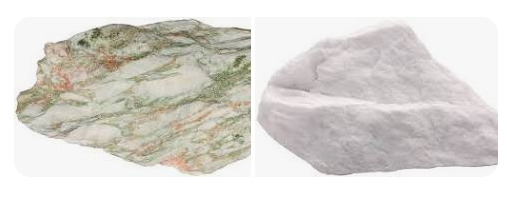
The marble on the left has green and orange impurtities formed during metamorphism. The marble on the right has no impuritues.
In the process of marble formation, impurities play a significant role in imbuing the stone with varying colors. These impurities, which are comprised of minerals such as clay, silt, sand, and iron oxides, infiltrate the limestone during its metamorphic transformation under immense pressure and heat. They introduce pigments that manifest as different colours within the marble. For instance, the presence of iron oxides may produce shades ranging from red to orange, other minerals can cause the colours below.
Iron Oxide - Red or Orange
Iron and Feldspar - Pink or Red
Serpentine - Green
Chlorite - Green
Graphite - Black/Grey
Muscovite - Specks of silver
Biotite - Specks of black