To log this earthcache, send me an email with the answer
to the following questions:
At the indicated coordinates, in the middle of the river,
at the top of a block, downstream from the lagoon
( it is necessary to go through the water ):
1) What material are the "drops" made of ? What is the
origin of this material?
2) Ple
3) What is the name of the process that created these
"drops"?
4) Add a photo to your local, another one that you can see
an object, or one nick in a piece of paper
If you believe you have
successfully completed this Earth Cache goals and has
already sent to me all the requirements as requested,
Please, feel free to log it as found. Later i will
verify the requirements sent and, if necessary, contact
you in order to make the necessary corrections to your
log. |
Local
In the Canto
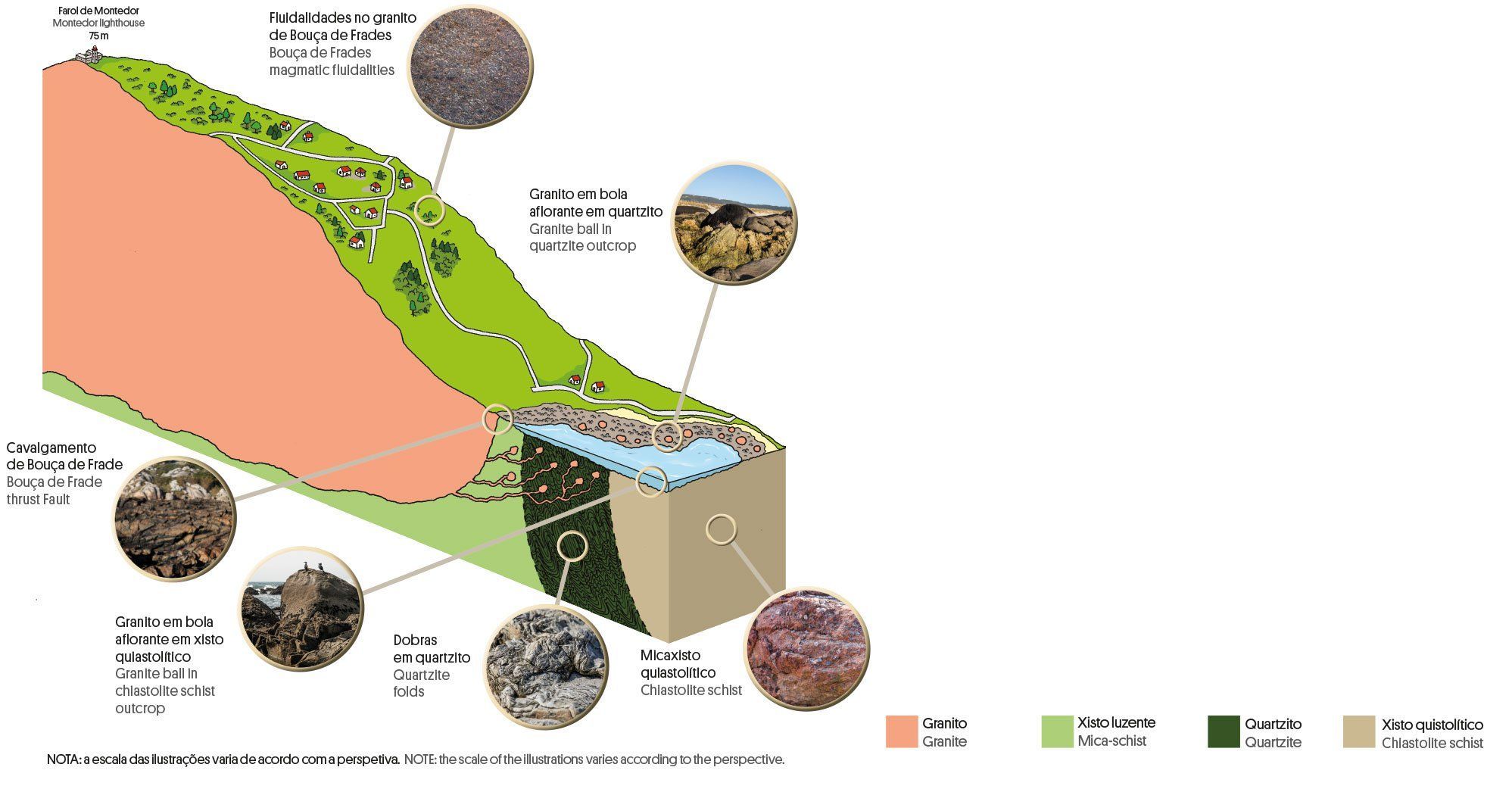
Marinho Local Natural Monument, the occurrence of typical
paragenesis of medium-grade contact metamorphism, such as garnet
and staurolite, can be observed, and which are exclusive to this
area of the Viana do Castelo coast. They were generated from
the heat transfer from the Bouça de Frade Plutonite installation
and enabled the formation of minerals typical of medium-grade
metamorphism, such as garnet and staurolite, and the growth of
chiastolite crystals.
Pervasive
migration, consolidation in a ball
The occurrence of granite
blocks in a ball is noteworthy, and they constitute an excellent
example of one of the mechanisms of regional magmatic
installation, namely the pervasive (diffuse) migration of magma.
In terms of mineralogical interest, the occurrence of typical
parageneses of medium-grade contact metamorphism, such as garnet
and staurolite, which are exclusive to this area of the Viana
do Castelo coast, stands out. Together with those of tectonics -
the occurrence of folds with very steep axial planes - they are
indicators of the pressure and significant heat transfer
resulting from the proximity of the intrusion of the Bouça de
Frade plutonite (main coastal outcrop on the Montedor Cliff).
The crenulations and folds,
also in sheaths, which give a sinuous wavy shape to the
whitish-yellow rocks that make up a large part of the local
substrate (quartzite) were generated in the marginal terrains,
right from the first phase of collision of the primitive
continents, by shortening of space, heating and dragging.
With the new impulses, the amalgamation caused the fusion of
rocks and the formation of magma whose cooling, several
kilometres deep, gave rise to the granites that currently make
up the Serra de Sta. Luzia and Arga, but also the elevation of
the coastal hills of Montedor and Gelfa.
Migrating like hot air balloons between the quartzites, giant
drops of magma flowed from the main magma chamber that gave rise
to Montedor (MNL Alcantilado de Montedor), and through fractures
they consolidated here, at around 700 m. After around 300
million years of erosion processes and tectonic uplift, minerals
bearing witness to the hot contact of magma (contact
metamorphism) can be observed, such as garnet and staurolite,
and granite balls, some weighing more than 10 tons, which have
been interpreted as a deposit (tsunamite) generated by the
oldest tsunami recorded in Portuguese seismic catalogues, from
66 BC.
|