To log this earthcache, send me an email with the answer
to the following questions:
At the indicated coordinates you can see a stone, look up,
in the gray area:
1) Look at the rock and tell me the average size of the
granules and their color. Are they shiny?
2) Does it indicate the temperature and pressure
conditions under which the grenades were formed? What type
of rock do garnets form in?
3) What type of metamorphism is behind garnets?
4) Add a photo to your local, another one that you can see
an object, or one nick in a piece of paper
If you believe you have
successfully completed this Earth Cache goals and has
already sent to me all the requirements as requested,
Please, feel free to log it as found. Later i will
verify the requirements sent and, if necessary, contact
you in order to make the necessary corrections to your
log. |
Geological
Context
The Local Natural
Monument Alcantilado de Montedor is the most
diversified one in terms of preserved geomorphic interests,
specifically residual, tectonic and coastal interests. Fluvial,
aeolian, periglacial and geocultural interests have also been
identified.
Montedor hill
constitutes a gap in the littoral platform, geologically
explained by the extrusion of magma from the main plutonic
rock in Bouça de Frade, in a western direction, towards our
present ocean.
This granitic mass
constitutes, along with the plutonic rocks in Santa Luzia and
Afife, the Viana do Castelo-Caminha massif (Pamplona et al,
2006). The peraluminous magma on the genesis of this massif was
created when the supercontinents Laurentia and Gondwana
collided, between the Devonian and the Carboniferous (Paleozoic
Era). This process resulted in closure of the Rheic Ocean (Nance
et al., 2012). The magma produced by the collision travelled
through the sediments of this ocean, metamorphosing them (more
than 5 km deep) into schist and metaconglomerates - Desejosa
Formation (Schist-Greywacke Complex - Lower Cambrian), into
quartzites -Sta. Justa Formation (Arenigian, Lower Ordovician)
and into schist -Valongo Formation. (Landeilian, Lower
Ordovician).
In terms of
mineralogical interest, it is worth noticing the occurrence of
typical parageneses of contact metamorphism (medium grade) -
garnet and staurolite - which are restricted to this coastal
area of Viana do Castelo. They reveal (as well as the tectonic
evidences such as folding occurrences with a very high angle
dip)
the pressure and the
very significant heat transfer resulting from the proximity to
the plutonic rock in Bouça (main coastal outcrop at Alcantilado
de Montedor)
Garnet is an index
mineral, this type of minerals document the temperature and
pressure conditions under which recrystallization occurred.
The recognition of a given paragenesis allows the degree of
metamorphism to be identified. The paragenesis of garnet,
andalusite, cordierite and sillimanite identified in the
outcropping schists of this Natural Monument is the result of
low pressure/high temperature contact metamorphism,
conditioned by syn-orogenic granitic intrusions
This mineral is part of many metamorphic rocks, in which it
does not always visibly crystallize, but when it does, it
takes the form of prismatic crystals with a simple habit, with
a square base, or crystals
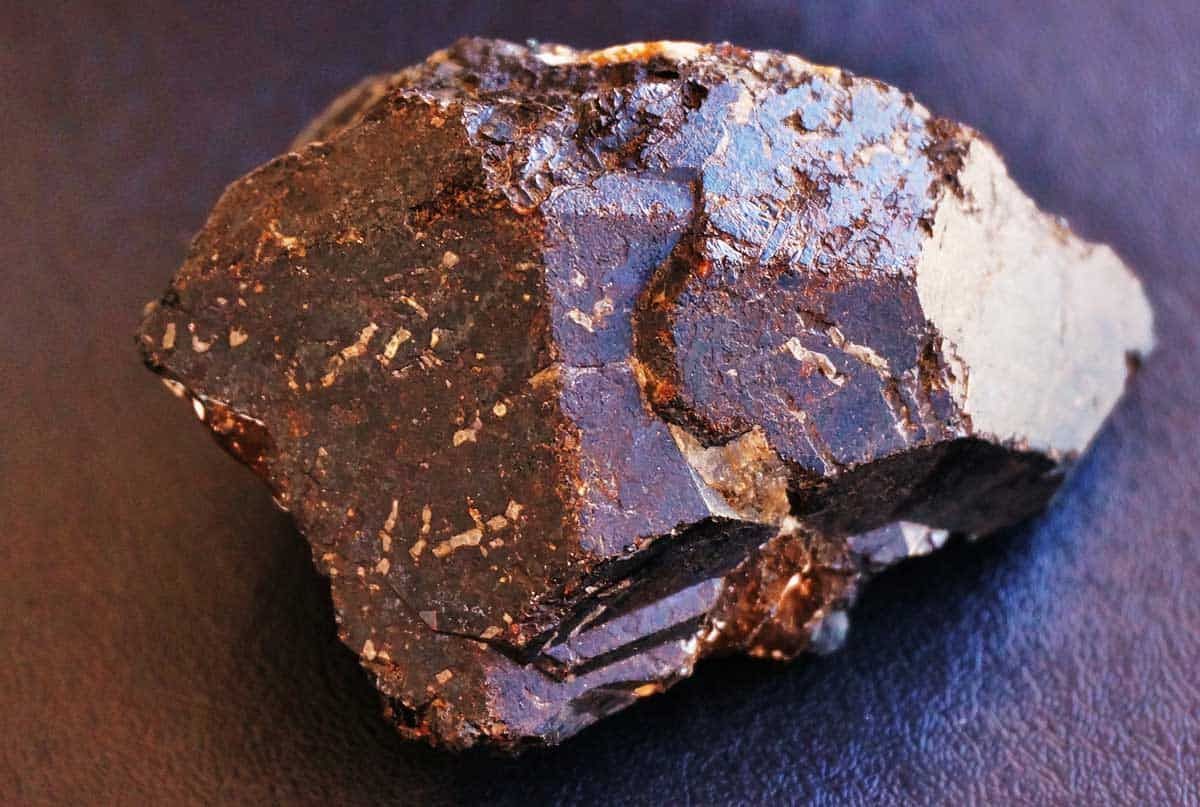
Garnet or granate
(from the Latin granatus, a grain) is the general name for
members of a group of minerals with a crystalline habitus
consisting of dodecahedra and trapezohedrons. They are
nesosilicates with the general formula, A3B2(SiO4)3. The
different varieties of garnet can incorporate different chemical
elements in their structure, mainly calcium, magnesium,
aluminum, iron2+, iron3+, chromium, manganese and titanium.
Garnets do not show cleavage but do show dodecahedral
partitioning. The fracture is conchoidal to unequal; some
varieties are very tough and are valuable for abrasive purposes.
The hardness of garnets is in the range of 6.5-7.5 and the
density (specific weight) is between 3.1 and 4.3. The shine
varies between vitreous and resinous, and can also be
transparent or opaque, depending on the presence or absence of
inclusions. Garnets can come in the following colors: red,
yellow, brown, black, green, or clear.
|