
Welcome to my Earthcache! An Earthcache is a special type of geocache where there is no container to find - instead you are looking for a unique geological feature of the area and need to answer questions, as well as posting a picture, in order to claim the find. The goal of this Earthcache is to educate visitors about Pegmatite, what makes it unique from other forms of granite, it's development, and where it comes from. All observations can be made from the cemetery roadway nearf the entrance of St. George United Cemetery. Parking is available in the immediate vicinity of the location.
EARTHCACHE REQUIREMENTS
As with all of my ECs, I am not looking for PhD thesis level responses, but I am hoping that you take some time to enjoy the area and learn something new. Please include a list of all cachers with your answer, if answering for more than one caching name. There is no need to send individual answers.
To claim a 'find' for this Earthcache you must answer the following questions and send your answers in a message or email to the owner using the link at the top of the page. You can log your find with a photo at GZ. Send your answers to the tasks. I will be in contact if there is a problem, no need to wait for a response as long as the required photo is included in your log.
Observational Task
At GZ, you will be standing in front of a large unique-looking gravestone marker for the Howell family. Notice the size of the crystals that make up this unique monument. For more information about Captain Howell, and his historical significance, click HERE. You do not need to visit the associated link to answer the questions below.
Questions to Answer
1. Observe the various colours of the monument. What colour are the largest crystals you see, and how big is the largest one you see?
2. Have a look at 2-3 other granite monumnets in the immediate vicinity of this monument. Compare the crystal sizes and colours. Are there any other noticable differences that set this prophyritic monument apart from the rest of the nearby granite stones?
3. Based on the information in the cache page and your observations, do you feel that this is a good example of phenocrysts? Why or why not?
4. Mandatory: Include a photograph of yourself, your GPS, a signature item, thumbs up, etc at the monument. You do not need to show your face in the photo, but your photo must be unique to you. If you are caching with a group you can use the same photo, but each log must upload a photo.
Geology Lesson:
The word Porphyritic describes igneous rocks with a noticable difference in the size of the crystals that form the rock, when compared to a regular granite. The larger crystals known as phenocrysts. Most porphyritic rocks have bimodal size ranges, meaning the rock is composed of two distinct sizes of crystal. Typically one mineral contained within the rock will develop much larger crystals than all of the other minerals that compose that rock, although some examples have shown multiple phenocrysts in the same rock.

Porphyritic rocks are made through a process called igneous differentiation, and are generally formed when a column of rising magma is cooled in two stages: In the first stage, the magma is cooled slowly deep in the crust, creating the large crystal grains, with a diameter of 2mm or more. In the final stage, the magma is cooled rapidly at relatively shallow depth or as it erupts from a volcano, creating small grains that are usually invisible to the nakes eye, typically referred to as the matrix or groundmass.
The formation of large phenocrysts is due to fractional crystallization. As the magma cools, it begins crystallizing the highest melting point minerals closest to the overall composition first. This forms large, well-shaped phenocrysts. If these phenocrysts are different in density to the remaining melt, they usually settle out of solution, eventually creating something called cumulates. However, when this is interrupted by sudden eruption of the magma as lava, or when the density of the crystals and remaining melt remains similar, they become trapped in the final rock.
The term porphyritic now refers to a certain texture of igneous rock regardless of its chemical and mineralogical composition or its color. Its chief characteristic is a large difference in size between the tiny matrix crystals and the much larger phenocrysts. Porphyries may be aphanites or phanerites, that is, the groundmass may have microscopic crystals as in basalt, or crystals easily distinguishable with the eye, as in granite.

Porphyry can also form even from magma that completely solidifies while still underground. The groundmass will be visibly crystalline, though not as large as the phenocrysts. The crystallization of the phenocrysts during fractional crystallization changes the composition of the remaining liquid magma, moving it closer to the eutectic point, with a mixed composition of minerals. As the temperature continues to decrease, this point is reached, and the rock is entirely solidified. The simultaneous crystallization of the remaining minerals produces the finer-grained matrix surrounding the phenocrysts, as they crowd each other out.
The significance of porphyritic texture as an indication that magma forms through different stages of cooling was first recognized by the Canadian geologist, Norman L. Bowen, in 1928.
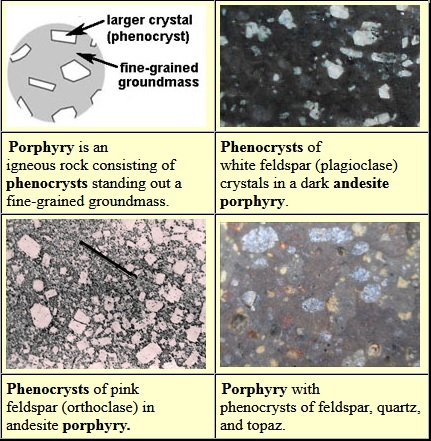
Rocks can be classified according to the nature, size and abundance of phenocrysts, and the presence or absence of phenocrysts is often noted when a rock name is determined. Aphyric rocks are those that have no phenocrysts, or more commonly where the rock consists of less than 1% phenocrysts (by volume); while the adjective phyric is sometimes used instead of the term porphyritic to indicate the presence of phenocrysts. Porphyritic rocks are often named using mineral name modifiers - in the case of the stone before you, this would likely be federred to as Potassium Feldspar granite.