Ichnofossils or trace fossils
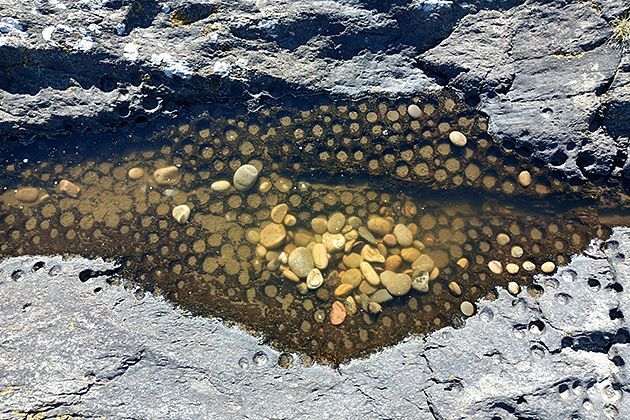
A trace fossil, also called an ichnofossil, is a fossil record of biological activity by lifeforms, but not the preserved remains of the organism itself. Trace fossils contrast with body fossils, which are the fossilized remains of parts of organisms' bodies, usually altered by later chemical activity or by mineralization. The study of such trace fossils is ichnology - the work of ichnologists.
Trace fossils may consist of physical impressions made on or in the substrate by an organism. For example, burrows, borings (bioerosion), urolites (erosion caused by evacuation of liquid wastes), footprints, feeding marks, and root cavities may all be trace fossils.
The term in its broadest sense also includes the remains of other organic material produced by an organism; for example, coprolites (fossilized droppings) or chemical markers (sedimentological structures produced by biological means; for example, the formation of stromatolites). However, most sedimentary structures (for example those produced by empty shells rolling along the sea floor) are not produced through the behaviour of an organism and thus are not considered trace fossils.
The study of traces – ichnology – divides into paleoichnology, or the study of trace fossils, and neoichnology, the study of modern traces. Ichnological science offers many challenges, as most traces reflect the behaviour – not the biological affinity – of their makers.
.
Classification
Trace fossils are generally difficult or impossible to assign to a specific maker. Only in very rare occasions are the makers found in association with their tracks. Further, entirely different organisms may produce identical tracks. Therefore, conventional taxonomy is not applicable, and a comprehensive form of taxonomy has been erected. At the highest level of the classification, five behavioural modes are recognized:
1 - Domichnia, dwelling structures reflecting the life position of the organism that created it;
2 - Fodinichnia, three-dimensional structures left by animals which eat their way through sediment, such as deposit feeders;
3 - Pascichnia, feeding traces left by grazers on the surface of a soft sediment or a mineral substrate;
4 - Cubichnia, resting traces, in the form of an impression left by an organism on a soft sediment;
5 - Repichnia, surface traces of creeping and crawling.
What is available on site?
This location contains several fossil specimens of Paracentrotus lividus, which occupied these levels 125,000 years ago.
Paracentrotus lividus is a species of sea urchin distributed on the rocky bottoms of the Mediterranean and eastern Atlantic coasts, being typical of the coast of Viana do Castelo. They are marine aquatic organisms present in the infralittoral zone (zone below the lower limit of the tide) and cannot survive for very long out of the water. They are generally located between the lowest tide line and the -3 meter mark, as well as in tide pools.
The alveoli of P. lividus are marks left on the rocks by sea urchins, which, when attached to the rock, end up acting as an erosion agent, wearing it down and forming cavities in it.
These characteristics make the sea urchin an excellent indicator of the lowest tide level, whether it is the current level with the presence of live sea urchins, or lower tide levels in more remote times with the presence of alveoli.
Along the coast of Viana do Castelo and in the various Local Natural Monuments, several groups of P. lividus ichnofossils are visible, dating back approximately 124,000 years, indicating that the sea level was 5 meters higher than it is today.
Sources:
wikipedia, Geoparque Litoral de Viana do Castelo |