Logging Requirements:
- Examine the limestone closely and describe its physical characteristics (color, texture...etc) and anything else that you might find unique. Are these characteristics consistent throughout the stone?
- How would you classify the limestone using the Grabau system? What can this tell us about the environment where this limestone was formed?
- Upload a photo taken either near the listed coordinates, or at your favorite spot in the castle. You don't have to be in the photo, though it is strongly encouraged.
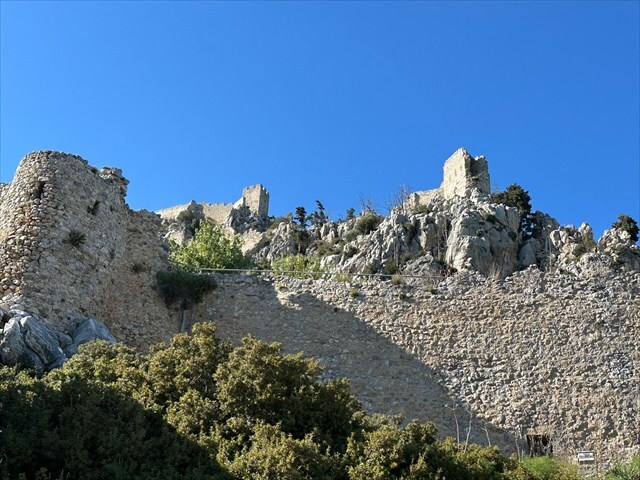
St. Hilarion Castle is locate high in the Kyrenia mountain range. Originally built as a monastery in the 10th century, it was later fortified by the Byzantines and expanded by the Lusignans, becoming one of the island’s most important defensive strongholds. With its steep walls, winding staircases, and panoramic views of the coastline, the castle is often associated with fairy tale imagery and is said to have inspired Walt Disney’s design for the castle in Snow White.
The castle and surrounding bedrock in this area are limestone which is part of the Hilarion Formation. This limestone was originally formed in a marine environment and is made up of beds (layers) that range from medium thickness to very thick, solid layers. Over time, the rock was slightly changed by heat and pressure (a process called low-grade metamorphism) but it still kept many of its original features. Later, due to movements in the Earth’s crust the Hilarion Formation was pushed southward on top of younger layers of softer marine sediments known as the Lapithos Formation. This kind of stacking of older rocks on top of younger ones is evidence of strong tectonic forces at work in the region’s geologic past.
Limestone can be classified based on the size of its grains, similar to how sandstones and other similar rocks are grouped. Grabau (1903, 1904) proposed three main types. Calcirudite contains coarse carbonate grains larger than 2 mm, much like a conglomerate. Calcarenite is made up of sand-sized grains between 0.0625 mm and 2 mm. Calcilutite is the finest, with grain sizes smaller than 0.0625 mm, and is often referred to as lime mud. It is important to note that this classification focuses only on grain size, not how the limestone originally formed, but it can still reveal a lot about the environment of deposition.
Calcirudite usually forms in high energy settings like beaches or reef fronts, where strong currents can move larger particles. Calcarenite forms in moderate energy areas such as shallow marine shelves or sand bars. Calcilutite, on the other hand, forms in calm, low energy environments like deep lagoons or offshore marine settings, where only fine particles can settle.