A common stone
Limestone is the most common sedimentary rock. Together with dolomite, which is essentially also limestone, only enriched with magnesium, it makes up about a 4/5 of all sediments on the Earth's surface. In Slovakia, limestones are mainly of Mesozoic age, from the Triassic to the Cretaceous, and form entire mountain ranges.
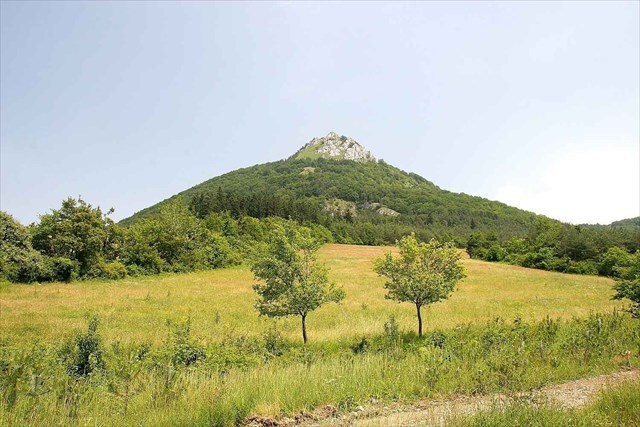
Vápeč hill (955 m) in the Strážovské vrchy moutains. The peak, a nappe slag of Hronicum unit, is formed by light gray Triassic Wetterstein limestones.
From a chemical point of view, limestone is predominantly (over 80%) calcium carbonate CaCO3; in the case of dolomite, it is magnesium-calcium carbonate CaMg(CO3)2. The rest consists of various impurities, depending on the environment of formation, such as clays, quartz and iron minerals. Calcium carbonate is practically insoluble in water, but dissolves in water containing CO2, which is the cause of karst phenomena such as caves, sinkholes, scratches...
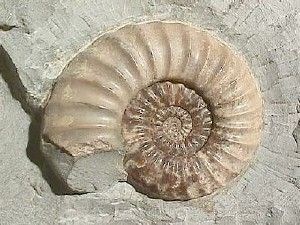
Ammonite shell in Mesozoic limestone.
Calcium carbonate is a basic component of the shells of most marine organisms, such as corals, algae, plankton, gastropods... They take calcium from seawater and after death, the empty shells are a source for the formation of limestone. Most limestones are therefore formed by deposition in the marine environment, from shallow coastal zones to extensive deep-sea basins with a depth of 3 - 3.5 kilometers. A smaller part of limestones is of freshwater origin, formed, for example, by precipitation of CaCO3 from mineral waters.
Bad place for life
Gutenstein limestones, named after the Austrian village of Gutenstein, are dolomitic limestones of dark gray to black color (this is better observed on fresh fragments, weathered ones have rather faint gray shades), which were created in the Triassic period, i.e. about 250-240 million years ago. In addition to the color, they are characterized by a typical smell of oil, which is again felt mainly on fresh fragments. The rock itself is fine-grained, with occasional veins of white calcite crystals.
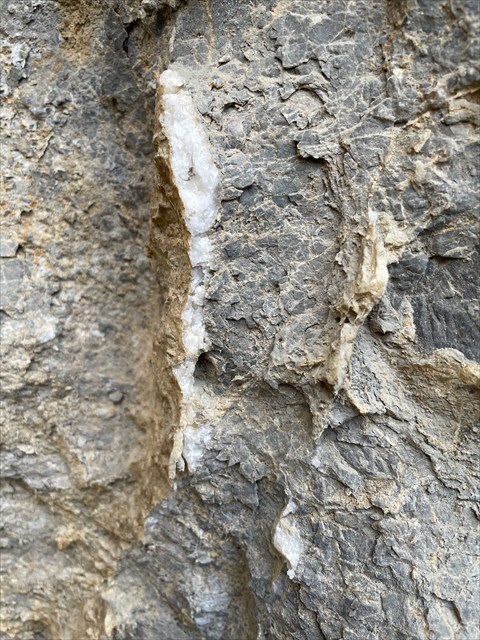
Gutenstein limestone with a calcite vein from the quarry Srdce (Heart).
The environment in which the Gutenstein limestones were deposited was marine. Marine and not too deep, which is evidenced by sporadic finds of fossils of ostracodes (Crustacea), otherwise these rocks are relatively poor in the occurrence of fossils. The practically non-existent fossil record and the presence of bituminous components thus point to an environment where life did not thrive very well.
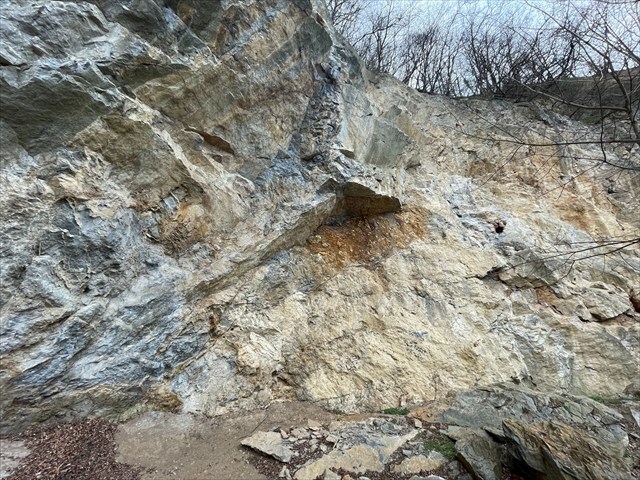
Limestone wall of Srdce quarry.
It was an anoxic (less oxygen) zone, similar to the bottom of today's Black Sea. And given the occurrence of Gutenstein limestones in the territory of today's Austria, Slovakia, but also Hungary, this shallow, poorly "ventilated" lagoon from the Triassic was quite extensive.