Logging Requirements:
- Compare and contrast the marble used for 'Artemis' versus the marble used for 'Elephants for Photo'. Which type of cut was used for each stone? Explain.
- Which types of veining is found in 'Artemus' and at 'Elephants for Photo'? Explain. What can this tell us about how each type of marble was formed?
- Upload a photo with either yourself or a personal item at Artemis.
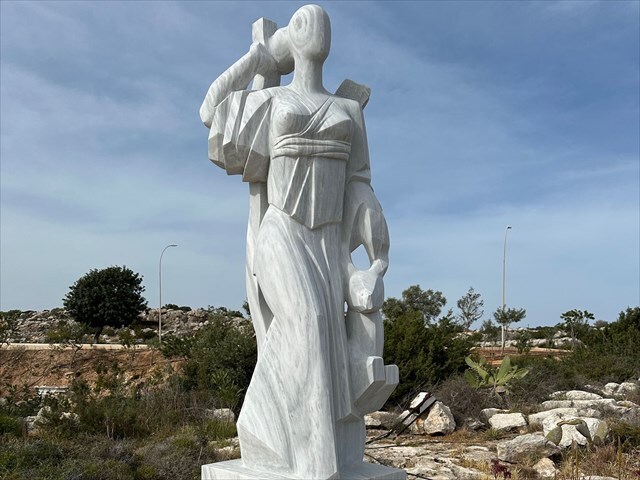
Ayia Napa Sculpture Park is located on the southeastern coast of Cyprus, near Cape Greco. Established in 2014, the park spans over 20,000 square meters and features a diverse collection of sculptures created by artists from around the world. Over 200 works are spread across the rocky landscape, placed among low brush, limestone outcrops, and winding footpaths that lead visitors through the space.
We will be focusing on two sculptures in particular, 'Artemis' and 'Elephant for Photo', which were carved from marble, and specifically some of the unique characteristics of the stones. Veining refers to the streaks, swirls, or lines of color that run through the stone, and often contrast its base color. These veins form when mineral rich fluids move through the rock during metamorphism, depositing materials like quartz, graphite, or iron oxides along fractures or layers. Over time, heat and pressure cause these minerals to recrystallize within the marble, which results in the distinctive patterns seen. Some common minerals and the colors they produce include:
- Quartz – Typically appears as light gray or white veining.
- Graphite (carbon) – Creates dark gray to nearly black streaks.
- Iron oxides – Produce red, orange, yellow, or brown veins depending on the specific oxide.
- Chlorite – Adds greenish tones to the veining.
- Pyrite – Can leave behind subtle gold or metallic flecks.
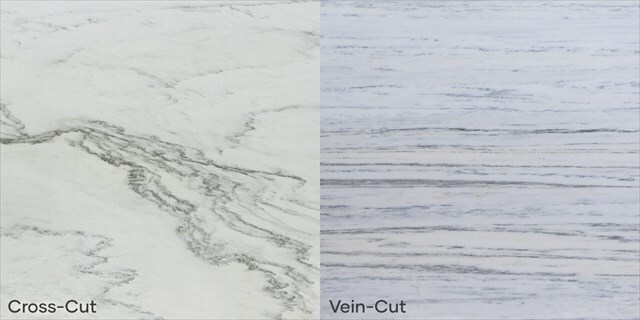
One important factor that affects the appearance of veining is how the stone is cut. A cross cut (also known as a fleuri cut) slices along the same direction as the stone’s natural layers formed during metamorphism. This breaks up the veins and results in swirls, waves, or cloudy patterns that feel softer and more irregular. In contrast, a vein cut is perpendicular to the natural layers, exposing the veining as long, parallel lines that run cleanly through the stone, which gives the stone a more structured and linear look.
It is also important to mention how veins can form in different ways depending on how the rock fractures and how minerals move through those spaces. Crack seal growth veins form when a small crack opens and allows mineral-rich fluids to enter. As these fluids evaporate or react with the rock, thin layers of minerals like calcite are deposited. Over time, the crack may reopen slightly and reseal, repeating the process and sometimes compressing the minerals inside. This can strengthen the marble in that area. Visually, crack seal veins often show up as distinct bands or stripes, sometimes with subtle steps or shifts where the crack moved during each phase of growth.
In contrast,open space fill veins, form when minerals are deposited into open cavities within the stone. These spaces tend to be under lower pressure, which allows larger crystals to grow more freely. As a result, these veins can be softer or less durable than the surrounding marble. They usually appear more diffuse or irregular, and may have a radiating or blocky structure rather than the layered look of crack seal veins.