The Background:
Sometimes one action leads to a chain of other actions. For instance, consider that on May 2, 2000, the so-called “Blue Switch" was flipped and GPS accuracy was no longer restricted. This event occurred because the US Government had previously moved to discontinue the restrictions, which were originally in place due to national security concerns, however, ever-improving technology easily thwarted the restrictions anyway, so it seemed right just to allow all citizens to enjoy the accuracy of what the global positioning system could provide.
As a result of the "Blue Switch" flip, Dave Ulmer decided to test out the possibilities of GPS location, and he hid a bucket in Beaver Creek, Oregon, and posted his measured coordinates to an online newsgroup just the day after the "Blue Switch" flip (May 3, 2000). Within days, people were reading about this "stash" and some came out to find it and wrote about it online. After a week, others started hiding their own containers. The first finder of Ulmer's bucket, a man named Mike Teague, started collecting these different coordinates to other such hidden containers on his own website.
And as the spring and summer of 2000 wore on, soon a website, www.geocaching.com was set up to more formally keep track of all these hidden containers. Jeremy Irish, a web developer for a Seattle company, had stumbled upon Teague's website in July, went out and found his own "first cache", and decided that the new hobby could use some upgrades to the cache-hunting experience with a new website. Irish had the web developer experience which was paired with Teague's input from creating the first online site, and this led to geocaching.com which premiered on September 2, 2000. Between May 3 and September 2, there were now 75 known caches around the world listed on the site.
This Cache:
Fast-forward 25 years from the "Blue Switch" flip, and now 25 (plus one) more caches in JAGA-land (along with many others all around the state, country, and world) will be published this summer, on that same site (where you are now reading this), adding to the now millions of available worldwide caches. All of this started from just one simple "flip of the switch".
So starting in the Beaverdam Reservoir, can you locate this "Blue Switch", hidden in a 50-cal green metal ammo box somewhere within 2 miles of the "?" ... This year geocaching.com is likening the "Blue Switch" flip to a Rube Goldberg-like event with that first action leading to more actions that eventually lead to you, the geocacher, getting a souvenir this weekend between May 2 and May 4. Of course, you could find this cache for the souvenir, or you could find another one, either in the 25-for-25 series or elsewhere on the map. And even if you find this cache after May 4, souvenir or not, you still get to push this version of the "Blue Switch"!
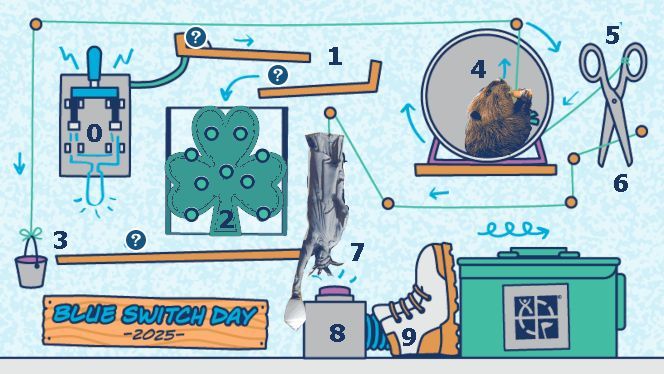
Let's follow the chain of events the "?" ball takes part in to get to the coordinates of this cache...
Assuming the "Blue Switch" sits at the coordinates N 40° AB.CDE′ W 78° VW.XYZ′, consider the following notes:
TOWN = The nearby village northeast of the "?" on the map which has a two-word name, the first word of which matches the color of the "Switch"
STREET = The name of the street if you follow the road northward out of TOWN right before it becomes a Catfish
SYMBOL = Either the name of STREET or the green plant associated with the country whose demonym matches that of the geocaching.com developer's last name.
ANIMAL = The name of the Reservoir in which sits the "?" on the map minus the three-letter sub-word that describes what those ANIMALS tend to build
CACHECONTAINER = What Dave Ulmer hid
A = The point at which the "?" passes through the pegs at SYMBOL
B = The point where the item whose color is shared with that of TOWN gets flipped
C = The point at which the carrot gets taken from ANIMAL by the string pulling up on it
D = The point at which ANIMAL starts spinning the wheel to try to get his carrot back
E = That same point from earlier that gets flipped to put this whole thing into motion
V = The "?" falls into CACHECONTAINER at this point
W = Take a drive past TOWN (either in person or Google street view) and you'll see this replica that falls onto the button in the image above when lowered down by the rope at this numbered point (not the point of the button itself)
X = The point at which ANIMAL is still trying to get that carrot!
Y = The point at which CACHECONTAINER pulls down on a string
Z = See W for what is getting lowered down...
Note that some numbers are used more than once and some not at all...

The Series:
This 25-for-25 Series was placed as a collaboration of local geocachers in the Johnstown-Altoona Geocaching Association (JAGA) area and surrounding counties. We wanted to place a series of 25 geocaches to celebrate 25 years of geocaching. We hope you enjoy the various types of hides, all across JAGA-land: Micro, Small, Regular, Large; Traditionals, Multi-Caches, Letterbox-Hybrid, Wherigo, and those pesky Mysteries. Happy 25th Birthday, Geocaching!
On May 3, 2000, Dave Ulmer, a computer consultant, wanted to test the accuracy of GPS by hiding a navigational target in the woods near Beavercreek, Oregon. He called the idea the "Great American GPS Stash Hunt" and posted it in an internet GPS users' group. The idea was simple: Hide a container out in the woods and note the coordinates with a GPS unit.
The finder would then have to locate the container with only the use of his or her GPS receiver. The rules for the finder were simple: "Take some stuff, leave some stuff."
On May 3, Dave placed his own container, a black bucket, in the woods, taking the location's coordinates to be N 45 17.460 W 122 24.800. Along with a logbook and pencil, he left various prize items including videos, books, software, and a slingshot. He shared the waypoint of his "stash" with the online community on sci.geo.satellite-nav.
THE REST IS HISTORY!
(Historic text taken, mostly as-is, with minor edits, from www.geocaching.com/about/history.aspx)
Throughout the spring and summer of 2025, look for various caches of this series to publish most weekends, with a "series final cache" to conclude the series on or around International Geocaching Day in August of 2025. That's one new JAGA-land cache for each year of geocaching's history, plus "one to grow!"
Be sure to write down or take photos of code words provided in some of the series caches (for caches that have them) that will help you get the coordinates for the series final when it is available at the end of the series.
See the entire 25-for-25 series list at 25for25.jaga.group
As the geocache owner, I ensure that the above link is to a local geocaching group site that is active in the community and contributing to geocaching in positive ways. This link has not been checked by Geocaching HQ or by the reviewer.
Acknowledgements:
Many thanks to dave bear for this cache container, received at the 2024 "Christmas Bison Exchange" event in December. Thanks to littleEEE for riding along for the cache hide and hanging out at the parking with me while I prepared the cache for hiding. She also was responsible for spotting the swag being sold at Staples while I was in there for some of the cache supplies, and that also led to us both spotting that blue button (switch) that became part of this cache. Thanks to the fellow COs on the 25-for-25 series for assisting this summer with all of the caches to be hidden. Thanks to our local volunteer reviewer, Keystone, for reviewing and publishing all of them as they come in. And of course thanks to all of you, the finders, for taking the time to go and track down the caches as you have the time and interest. Happy 25th anniversary of geocaching!
Note that the built-in geochecker is provided for changing the coordinates to the solved ones. See the third-party geochecker in the puzzle above if you want parking info, hide hints, and a spoiler photo to help locate the cache container.
A congratulations on FTF goes to Doe-Ra, ted28285, and r.e.s.t.seekers. Happy 25th year of Geocaching! Thanks for coming out to get that Blue Switch souvenir this weekend.