Oignons de granite de l'île Jaouen
Contexte géologique local
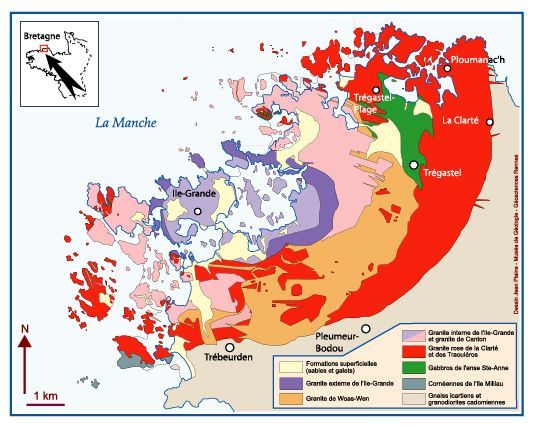
La cartographie détaillée du complexe granitique de Ploumanac’h, réalisée en 1976 par Michel Barrière, révèle une organisation remarquable des formations lithologiques, disposées en auréoles concentriques. Cette structuration résulte de l’intrusion successive de trois corps magmatiques, formant ce que l’on appelle un « complexe centré », comparable à ceux observés dans certaines régions du globe.
L’auréole la plus externe, en contact direct avec les roches plus anciennes, est composée des célèbres granites roses. Le faciès le plus représentatif, à grain plurimillimétrique et d’un rouge éclatant, est désigné sous le nom de granite de type La Clarté. Un autre faciès, plus sombre et marqué par une texture porphyroïde, est appelé granite de type Traouiéros. Ces deux variantes sont regroupées sous l’appellation « granites à gros grains externes ». Leur extension géographique va de Pors Rolland, à l’est de Ploumanac’h, jusqu’à l’île Milliau, à Trébeurden.
La seconde auréole, plus variée, est constituée de granites à grain moyen, parfois légèrement porphyroïdes, aux teintes allant du gris au rose. Ces roches sont identifiées sous les noms de types Canton (ou Agathon), Woas Wen et Saint-Samson (à texture saccharoïde), et sont qualifiées de « granites à grain moyen intermédiaires ». Cette auréole s’intercale entre les deux autres, depuis la plage de Toul Bihan à Trégastel jusqu’à celle de Goas Trez à Trébeurden.
Enfin, le centre du massif présente des granites à grain fin, de teinte claire (gris, blanc ou bleuté), désignés comme les granites gris de l’Île-Grande. On y distingue un granite interne, assez proche du type intermédiaire Canton, et en périphérie, un granite très clair, riche en muscovite : le leucogranite de l’Île-Grande.
Granite à grain intermédiaire de l’île Jaouen
L'île Jaouen est constituée d'un granite clair de type Canton, au grain millimétrique à plurimillimétrique et qui est de couleur rose à gris-rose. Il est constitué de quartz, microcline, plagioclase et biotite (monzogranite). Il est relativement homogène montrant cependant des enclaves sombres de minéraux ferro-magnésiens. Il est recoupé de petits filons aplitiques plus clairs.
Altération du granite
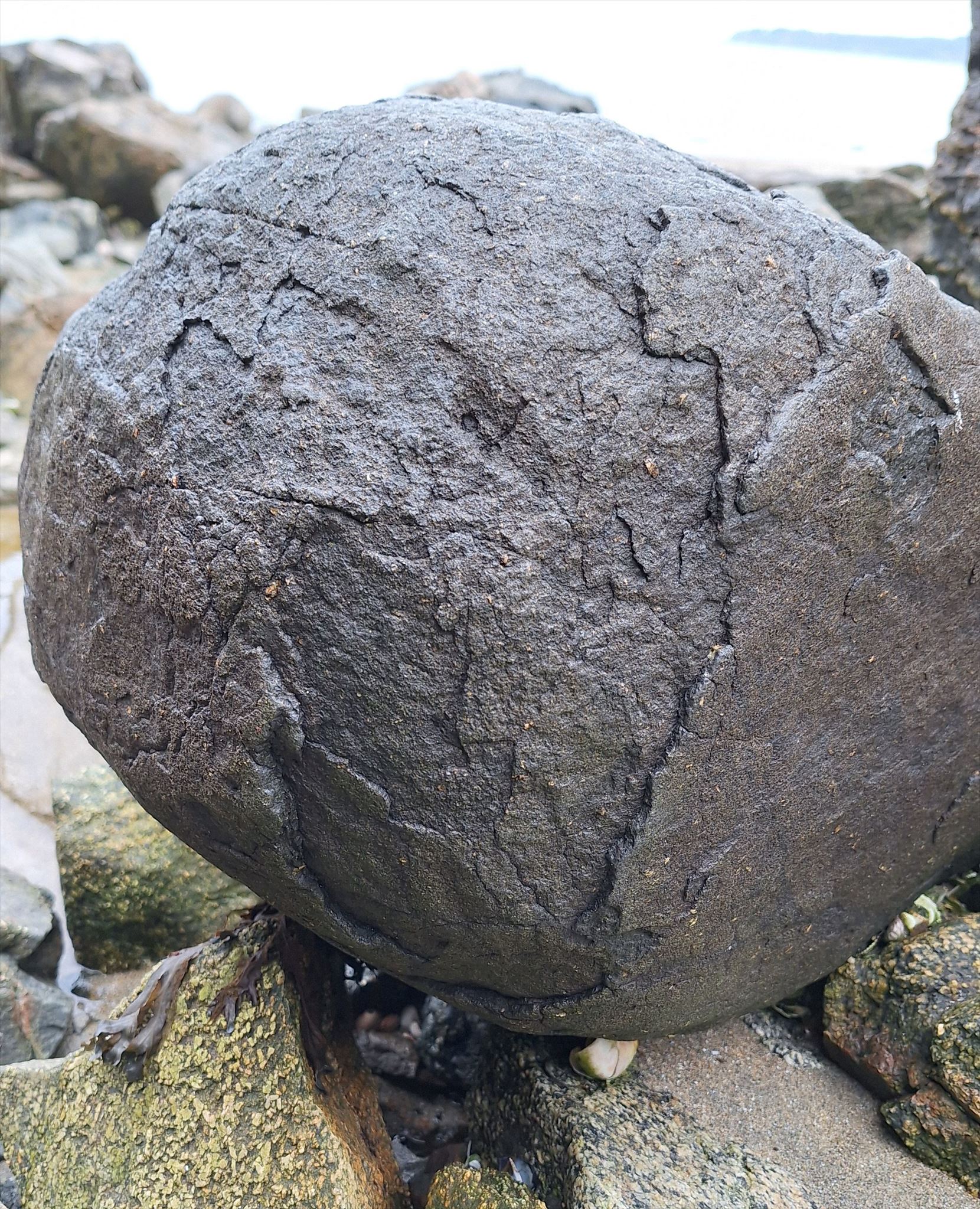 L'altération mécanique et chimique du granite est favorisée par la présence de diaclases et de fissures, plus ou moins larges, qui facilitent la pénétration de l’eau ou des racines végétales dans la roche. Le granite présente en effet une porosité liée à des fissures ouvertes (dans le cas d’une roche en décompression) ou fermées (dans le cas d’une roche sous compression). En climat tempéré, cette altération progresse de manière périphérique, selon un motif d’écailles concentriques rappelant des pelures d’oignon. Elle aboutit à la formation de blocs et de boules granitiques, donnant naissance à un chaos granitique.
Questions
Rappel concernant les Earthcaches :
Il n'y a pas de conteneur à rechercher ni de logbook à signer. Après avoir été sur les lieux pour chercher les réponses aux questions, loguez cette cache "Found it" et envoyez-moi vos propositions de réponses, en précisant le code GC de la cache, soit via mon profil, soit via la messagerie geocaching.com (Message Center), et je vous contacterai en cas de problème.
Attention, l'earthcache n'est pas forcément accessible à marée haute ! Pensez à consulter les horaires de marées avant de venir sur place.

Questions :
1- Quel est le type de granite à l’île Jaouen ?
2- Que pouvez-vous observer sous la zone A ?
3- Que pouvez-vous observer sous la zone B ? Quel est le nom de cette altération ?

Granite onions from Ile Jaouen
Local geological context
Detailed mapping of the Ploumanac'h granite complex, carried out in 1976 by Michel Barrière, reveals a remarkable organization of lithological formations, arranged in concentric aureoles. This structuring results from the successive intrusion of three magmatic bodies, forming what is known as a “centric complex”, comparable to those observed in certain regions of the globe.
The outermost halo, in direct contact with older rocks, is made up of the famous pink granites. The most representative facies, multi-millimetre-grained and bright red, is known as La Clarté granite. Another facies, darker and marked by a porphyroid texture, is called Traouiéros-type granite. These two variants are grouped together under the name “external coarse-grained granites”. They extend from Pors Rolland, east of Ploumanac'h, to Ile Milliau, in Trébeurden.
The second, more varied aureole is made up of medium-grained granites, sometimes slightly porphyritic, with hues ranging from gray to pink. These rocks are known as Canton (or Agathon), Woas Wen and Saint-Samson (with a saccharoid texture), and are referred to as “intermediate medium-grained granites”. This halo lies between the other two, from Toul Bihan beach in Trégastel to Goas Trez beach in Trébeurden.
Finally, the center of the massif features fine-grained, light-tinted granites (gray, white or bluish), known as Île-Grande gray granites. Here we can distinguish an internal granite, fairly close to the Canton intermediate type, and on the periphery, a very light granite, rich in muscovite: the Île-Grande leucogranite.
Ile Jaouen intermediate-grained granite
Île Jaouen consists of light Canton-type granite, with a millimeter to multi-millimeter grain size and a pink to pink-gray color. It consists of quartz, microcline, plagioclase and biotite (monzogranite). It is relatively homogeneous, with dark enclaves of ferromagnesian minerals. It is intersected by small, lighter-colored aplitic veins.
Granite alteration
The mechanical and chemical weathering of granite is favored by the presence of diaclases and fissures, of varying widths, which facilitate the penetration of water or plant roots into the rock. Granite has a porosity linked to open cracks (in the case of a rock undergoing decompression) or closed cracks (in the case of a rock undergoing compression). In temperate climates, this weathering progresses peripherally, in a pattern of concentric scales reminiscent of onion skins. It leads to the formation of granite blocks and balls, giving rise to granite chaos.
Questions
Reminder concerning the Earthcaches:
There is no container to search for or logbook to sign. Once you have been on site to search for answers to the questions, log this cache "Found it" and send me your answers, specifying the cache’s GC code, either via my profile or via the Geocaching.com (Message Center) messenger, and I will contact you in case of a problem.
Please note that the earthcache is not necessarily accessible at high tide! Be sure to check the tide tables before you arrive.
Questions:
1- What type of granite is found on Île Jaouen?
2- What can you see under zone A?
3- What can you see under zone B? What is the name of this alteration?