Ore
The definition says that ore is a rock that contains certain chemical elements in such concentrations that it is economically viable to mine it industrially. In Slovak, the term ore, or mineral raw material, refers only to ores containing metals, such as iron ore, nickel ore, antimony ore, etc. The English term also includes non-metallic raw materials, such as graphite deposits, gypsum, etc.
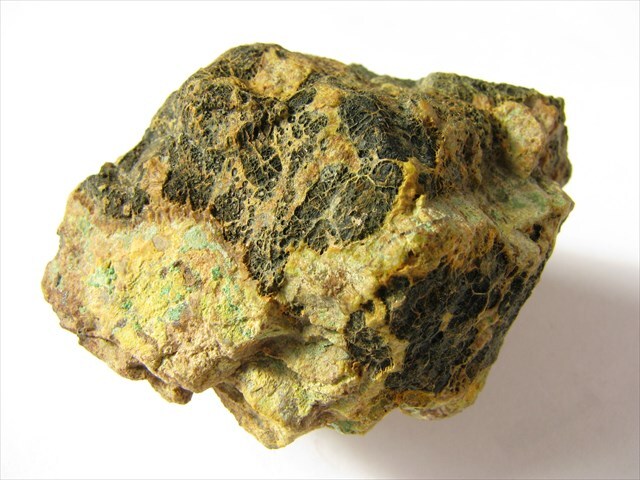
Pitchblende is uranium ore covered by secondary uranium minerals (yellow in colour).
The desired metal in the ore can occur in the form of a mineral compound (e.g. iron in the form of hematite (Fe2O3), as a significant impurity in minerals of another element (e.g. increased silver content in galena, a lead ore), or as a pure metal (e.g. gold, silver or platinum)...
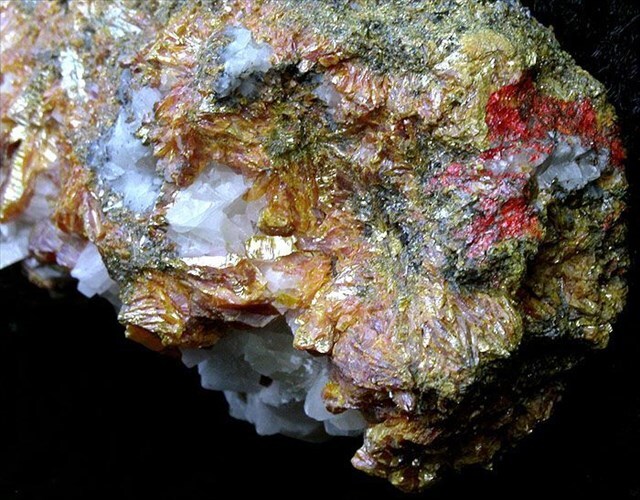
Ores containing arsenic minerals include golden orpiment and red-coloured realgar.
Sometimes, in addition to the primary mined metal, by-products are also obtained from the ore. For example, gallium does not occur on Earth in economically significant concentrations, but it is obtained during aluminium production from bauxite. Similarly, the products of so-called polymetallic ores can be lead, zinc, copper, silver... Other components of ores include various minerals such as carbonates (calcite and/or dolomite), quartz, sulphides, oxides, phosphates, silicates, etc. The mineral composition of ores varies greatly depending on how they were formed.
Hydrothermal deposits
One type of ore deposit is hydrothermal deposits, or hydrothermal ore veins. These were formed by the accumulation of economically interesting minerals through crystallisation from supersaturated hot water solutions in cracs and fissures in rock massifs.
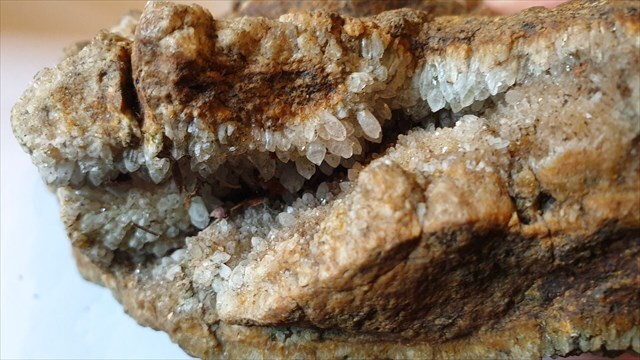
Hydrothermal vein with quartz crystals from Pukanec.
They are usually directly related to volcanic activity (but crystallisation does not occur directly from magma) and, based on the mechanism of their formation, they are divided into deposits:
- Porphyritic - directly related to porphyry intrusions, i.e. rocks with an increased quartz content. The economically important elements of porphyritic deposits are mainly copper and gold.
- Skarn - is formed by contact transformation (direct contact) of magma with sedimentary, mainly carbonate rock. These deposits are not extensive, but the concentration of desired elements is usually high. They are a source of tungsten, molybdenum, tin, but also iron.
- Sedimentary exhalative – formed in shallow sea basins by the penetration of fluids into sea floor sediments. These deposits are uncommon, and the main elements present are lead and zinc.
- Epithermal – associated with slowly cooling plutons shallow beneath the surface. They are a source of gold, silver, lead, zinc and copper.
- Volcanogenic massive sulphide deposits (VMS) - are formed by volcanism at mid-ocean ridges. They contain significant amounts of copper, lead, silver, tin...
Pukanec - free royal mining town
Gold and silver mining in Pukanec has a long history. The first mention of gold mines dates back to 1270. In 1323, Charles Robert granted it town privileges, and in 1388, Pukanec became a founding member of the association of free royal mining towns in central Slovakia.
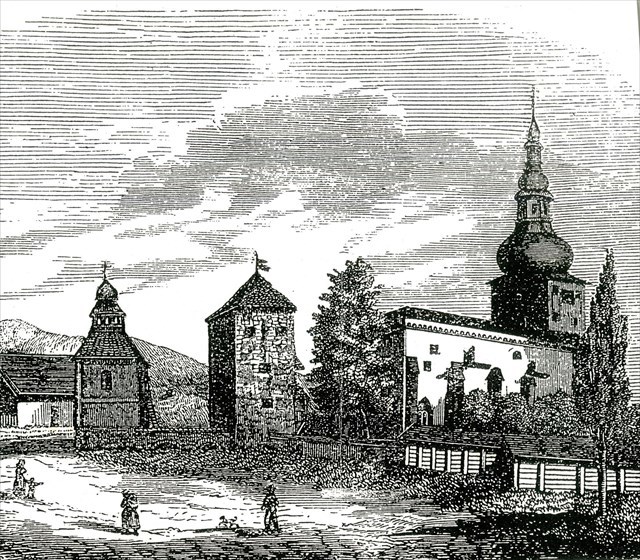
Pukanec on a postcard from the mid-19th century.
During the Ottoman occupation of the Kingdom of Hungary, Pukanec was burned down twice: in 1640 and 1664. Due to the low yield of precious metal deposits, mining gradually declined and the last mine was closed in 1891.
Pukanec minig field
The ore deposit in Pukanec is directly related to volcanic activity, with the intrusions of diorite and granodiorite porphyry in the peripheral parts of the Štiavnica stratovolcano, the associated penetration of hydrothermal solutions into fissures and the subsequent crystallisation of minerals in the form of veins. This vein zone runs from the border of the village with Devičany, across the Štiavnické vrchy Mountains, to Rudno nad Hronom, which is located on the opposite side of the ridge.
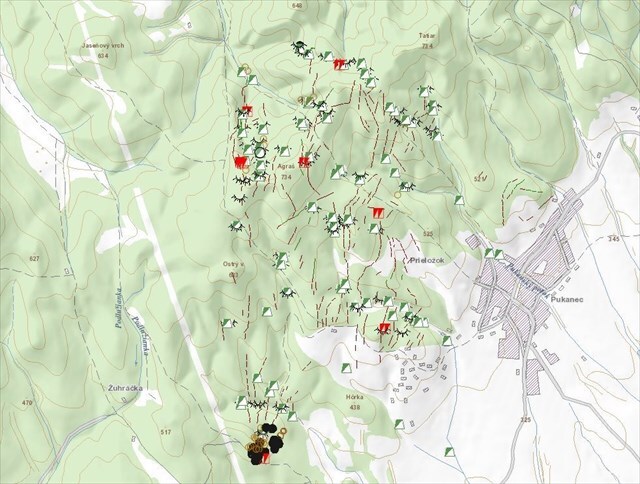
Map of mining works in the vicinity of Pukanec. Legend:
 - shaft/ventilation chimney
 - adit
The Juraj drainage adit (Gregor, Ergištôlňa), over 1,000 metres long, has been preserved from the mining works and is currently used as a water source. Nearby is another adit which is used as a wine cellar. If it is open, the owner can take you on a tour of the interior by arrangement.
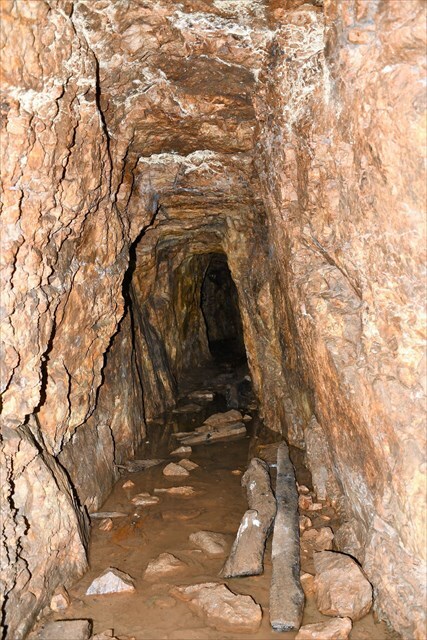
Dorota adit in Pukanec.
Several other inaccessible, collapsed adits can be found on both sides of the Chorvátova dolina valley, as well as one that is open to the public: the Dorota adit. The slopes of the Chorvátova dolina valley are dotted with numerous pings (exploration pits). Other mining works are located higher up on both sides of the ridge between the Agraš and Ťatiar hills.
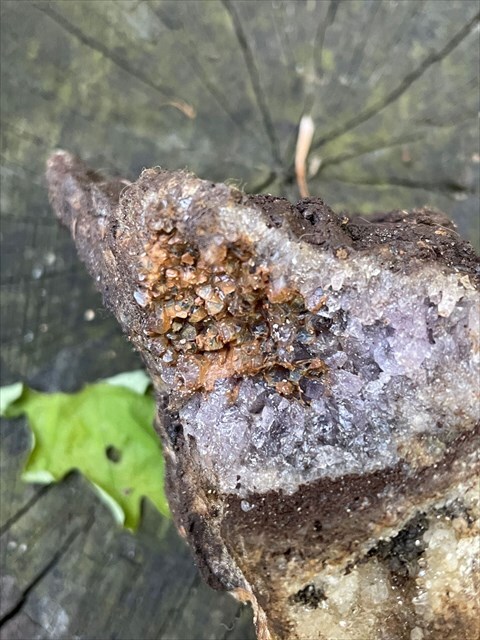
Quartz vein with amethyst from Pukanec.
Ore veins in Pukanec are mainly composed of quartz and carbonates (calcite, dolomite and ankerite). The predominant ore minerals are galena, sphalerite and pyrite. The surface of veins is often covered with secondary iron minerals - limonite. Gold and silver, the main objects of mining, were bound to pyrite and galena/sphalerite respectively. An interesting mineral found in Pukanec is amethyst, a purple variety of quartz that forms beautiful crystals in the cavities of veins.