Logging Requirements:
- Examine the calcarenite closely. Describe the color, texture, grain size, and any other other unique characteristics of the stone.
- Based on your observations and the description, would you classify this as marine or meteoric calcarenite? Explain.
- Upload a photo of either yourself or a personal object at Othello Castle. If caching in a group, the photo must prove each person visited GZ.
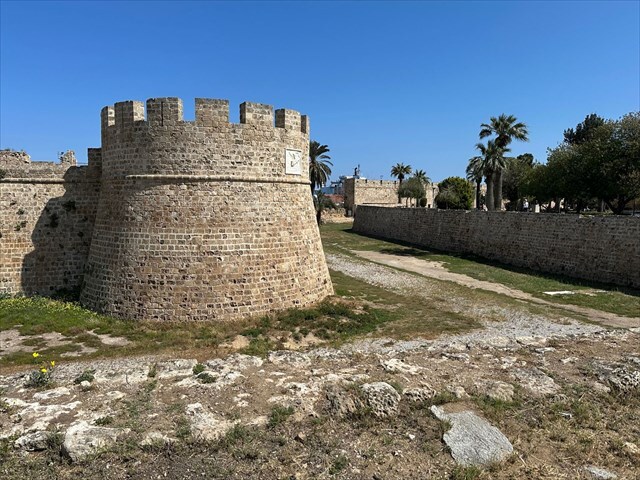
Othello Castle was built in the 14th century by the Lusignans and later modified by the Venetians. It served as a key defensive structure guarding the city's harbor and played an important role in protecting the coastline from attack. The castle gets its name from Shakespeare’s tragedy Othello, as it was believed to have inspired the setting of the play.
Othello Castle was constructed from blocks of local calcarenite, which is a soft, easily carved stone common along the coast of Cyprus. Calcarenite is a type of limestone that is primarily made up of sand sized grains of calcium carbonate, usually between 0.0625 mm and 2 mm in diameter. It forms in shallow marine environments such as lagoons, beaches, and nearshore shelves, where biological activity is high and water movement is strong enough to break down shells, corals, and other skeletal fragments into smaller pieces, which accumulate as loose carbonate sand on the sea floor. Over time as new material is deposited, it increases pressure on the lower layers, which compacts the grains and reducing pore space. At the same time, calcium carbonate dissolved in seawater or groundwater begins to precipitate between the grains, which gradually cements them together in a process known as lithification. The result is a sedimentary rock that often preserves visible shell fragments and displays a granular texture. Its softness and porosity depend on the degree of cementation and the composition of the original material.
Calcarenite can be classified into two types, depending on the type of environment where they were formed. Marine calcarenite forms near the coast, where waves deposit shell fragments and sand that get cemented together underwater. This creates a dense, tightly packed rock with grains often coated in thin layers of marine cement. In contrast, meteoric calcarenite gets altered later by rainwater or groundwater flowing through the rock. This freshwater can dissolve parts of the stone, change the original cement, and leave behind larger crystals or open pores. The result is often a looser, more porous stone with signs of weathering.
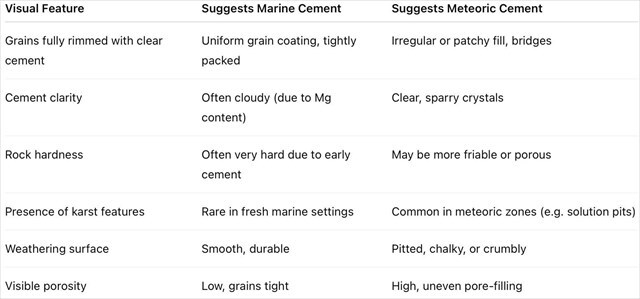
The two types of calcarenite can often be distinguished visually. Marine calcarenite often looks more solid and tightly cemented, with grains that are evenly coated and little visible pore space. It tends to feel harder and may have a smoother, more uniform surface. In contrast, meteoric calcarenite usually shows signs of weathering, such as pitting, uneven cement, or larger crystal growths in open spaces. It also appears more porous and crumbly, with irregular textures and has a less compact feel.