Fossiler på Kalmar Slott
Svenska
Detta är en Earthcache. Det innebär att det inte finns någon fysisk gömma på platsen, för att få logga denna så måste du svara på ett antal frågor och skicka svaren till cache-ägaren, via mail eller message center.
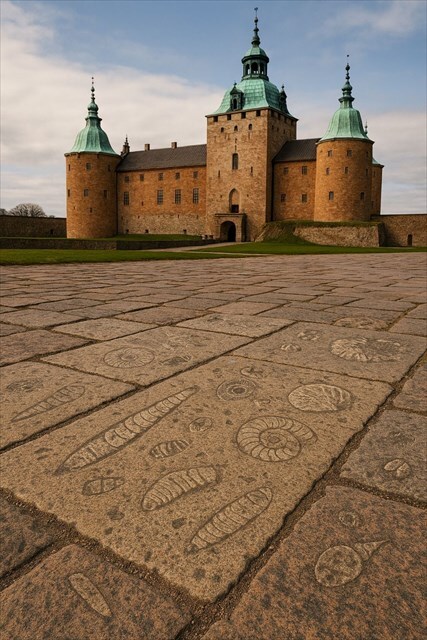
När du står vid ingången till Kalmar slott går du bokstavligen på geologisk historia. Markplattorna här är gjorda av ordovicisk kalksten, och i dem kan man med blotta ögat se fossil från de djur som levde i det hav som en gång täckte området.
Just därför är platsen perfekt för en earthcache: fossilen ligger helt öppet och lättillgängligt, och det går att studera både stenens struktur och fossilens former utan att behöva leta eller gräva.
Samtidigt som du kommer att får se fossilerna här på plats kommer du kunna njuta av utsikten, både från det öppna havet och av det fina slottet.
När man tittar närmare ser man hur organismerna en gång begravdes i bottensedimenten och hur deras hårda delar bevarats när sedimenten pressades ihop till kalksten. Det gör entrén till slottet till en ovanligt tydlig och lättillgänglig plats att uppleva hur geologiska processer faktiskt ser ut i verkligheten.
Lokal geologi vid Kalmar slott
Kalkstenen du står på vid slottsingången har inte bara en imponerande ålder – den berättar också något om hur området kring Kalmar såg ut när den bildades. Under ordovicium låg dagens sydöstra Sverige nära ekvatorn och täcktes av ett varmt, grunt hav. Just här, vid Kalmarsund, avsattes tjocka lager av kalkslam och skalrester från de organismer som levde i detta tropiska hav.
När landet senare höjdes genom långsam geologisk upplyftning hamnade dessa havsbottnar ovan jord och kunde brytas som byggnadssten. Kalkstenen vid slottet är därför inte bara dekorativ – den är ett direkt utsnitt av den lokala berggrunden och visar exakt vilken typ av miljö som en gång fanns där du står idag.
Ordovicium – en period av liv och förändring
Ordovicium är den geologiska period som sträcker sig från cirka 485 till 444 miljoner år sedan. Under denna tid förändrades både klimatet, havsnivåerna och livet på jorden dramatiskt. De flesta kontinenter låg fortfarande på det södra halvklotet och var samlade i superkontinenten Gondwana. I slutet av perioden hade Gondwana förflyttat sig mot sydpolen och delvis täckts av stora inlandsisar. Detta ledde till att havsnivån, som tidigare varit hög, började sjunka i takt med att vatten bands i ismassorna. Andra kontinenter, som Laurentia (nuvarande Nordamerika), Baltica (som omfattar Nordeuropa) och Sibirien, låg däremot närmare ekvatorn där klimatet var varmt och havsrikt.
Bildning och avlagring av sediment
Under ordovicium bildades omfattande mängder sediment. Sediment kan vara oorganiska, som sand, lera och vulkanaska, men också organiska, till exempel torv och kalkrika skal från döda organismer. Färgen på sedimentlagren påverkas ofta av järnoxider, vilket gör att vissa lager är röda medan andra är grå. Sediment transporteras vanligtvis med vatten och avlagras i olika miljöer som flodbottnar, sjöar, havsbottnar, stränder, deltan och våtmarker. I dessa miljöer begravs ofta döda organismer under nya sedimentlager.
Med tiden utsätts de nedre lagren för ett ökande tryck, och ibland också högre temperatur. Detta leder till att sedimenten packas samman och omvandlas till fasta bergarter som lersten, lerskiffer, sandsten, kalksten, förstenad torv och tuff. Vid rätt förhållanden kan delar av begravda organismer omvandlas till fossiler, vilket ger oss en unik inblick i det forntida livet.
Fossilbildning – från havsbotten till berggrund
Fossiler uppstår främst när hårda delar av organismer – som skelett, skal eller tänder – bevaras i sedimenten. Mjuka delar bryts oftast snabbt ner av bakterier eller asätare och bevaras mycket sällan. Det är ovanligt att hela djur fossiliseras, och ännu mer ovanligt att mjukvävnad finns kvar. För att en organism ska bli till fossil krävs det att den snabbt täcks av bottenslam i en vattenmiljö, där nedbrytningen fördröjs.
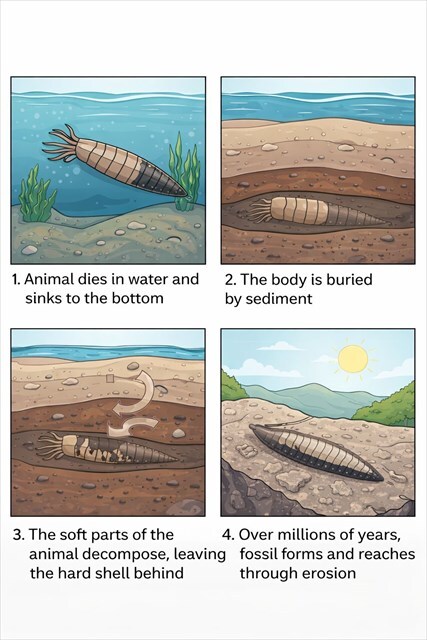
Efter att ett djur dött sjönk det ofta till havsbotten. Mjuka delar förmultnade eller åts upp, medan hårda delar som skal eller ben blev kvar. Sediment fortsatte att samlas ovanpå och begravde djuret djupare och djupare. Det ökande trycket, i kombination med kemiska processer, ledde till att materialet förstenades. Genom långsam geologisk upplyftning kan dessa fossilrika berglager sedan hamna vid jordytan, där vi idag kan hitta och analysera fossilen.
Djurlivet under Ordovicium
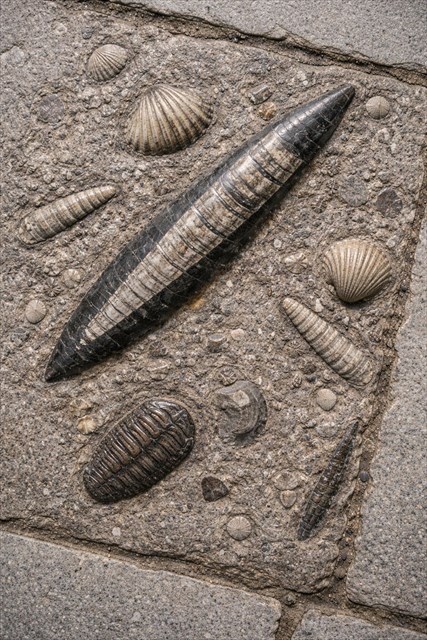
Ordovicium var en period av snabb biologisk utveckling med stor artrikedom, ännu större än under föregående kambrium. Många arter utvecklade hårda skal som skydd. Trilobiter, en typ av leddjur, var vanliga och kunde bli upp till 30 cm långa. Även ortoceratiter – konformade bläckfiskar – levde i stora mängder i haven och deras skal är vanliga fossiler. Andra vanliga fossiler från perioden är brachiopoder (musselliknande djur) och snäckor.
Tack vare dessa fossilerna kan forskare återskapa miljöerna och djurlivet som fanns för hundratals miljoner år sedan, och få en bättre förståelse för jordens historia.
1. Vid startkoordinaterna finns det plattor med synliga fossiler. Uppgiften är att studera plattornas utseende och identifiera vilka olika fossiler som förekommer. Beskriv plattornas färg och yta samt ange observerbara kännetecken hos fossilen, såsom form, färg, struktur och eventuell segmentering.
2. Plattorna är tillräckligt hårda för att kunna beträdas utan att slitas ned i någon större utsträckning, vilket visar att materialet har hög hållfasthet. Gör en jämförande bedömning av vilket material som är hårdast, fossilernas skal eller den omgivande stenen, och motivera resonemanget utifrån er observation.
3. Ur ett geologiskt perspektiv spelar det roll att materialet runt fossilerna är relativt hårt. Förklara varför detta är en fördel, till exempel hur det påverkar fossilernas bevarande, hur väl materialet står emot erosion och varför fossilen kan förbli synliga under mycket lång tid.
4. Beskriv om fossilerna är lika stora eller om deras storlek varierar. Ge även en möjlig förklaring till varför det är så.
5. Beskriv den största fossilen du kan hitta och resonera kring varför vissa fossiler är större än andra.
6. Ladda upp en bild någonstans runt slottet med en del av er själva eller ert nickname.
Fossils at Kalmar Castle
English
This is an EarthCache. This means that there is no physical container at the site. To be able to log this cache, you must answer a number of questions and send your answers to the cache owner via email or the message center.
When you stand at the entrance to Kalmar Castle, you’re literally walking on geological history. The paving stones here are made of Ordovician limestone, and in them you can clearly see fossils from the creatures that once lived in the sea that covered this area.
This makes the spot ideal for an EarthCache: the fossils are completely exposed and easy to examine, allowing you to study both the structure of the stone and the shapes of the fossils without having to search or dig. When you look more closely, you can see how these organisms were once buried in seafloor sediments and how their hard parts were preserved as the sediments were compressed into limestone.
While you get to see the fossils here on site, you will also be able to enjoy the view, both of the open sea and the beautiful castle.
The castle entrance is therefore an unusually clear and accessible place to experience what geological processes actually look like in the real world.
Local Geology at Kalmar Castle
The limestone beneath your feet at the castle entrance is not only ancient; it also reveals what the Kalmar area looked like when the rock was formed. During the Ordovician period, what is now southeastern Sweden lay close to the equator and was covered by a warm, shallow sea. Here along the present‑day Kalmarsund, thick layers of calcareous mud and shell fragments accumulated from the organisms living in this tropical marine environment.
As the land slowly rose through geological uplift, these former seafloors were brought to the surface and later quarried as building stone. The limestone at the castle is therefore more than decorative — it is a direct window into the local bedrock and shows exactly what kind of environment once existed where you are standing today.
Ordovician – a period of life and change
The Ordovician is the geological period that spans from approximately 485 to 444 million years ago. During this time, climate, sea levels, and life on Earth changed dramatically. Most continents were still located in the southern hemisphere and were joined together in the supercontinent Gondwana. Toward the end of the period, Gondwana moved toward the South Pole and became partially covered by large continental ice sheets. This caused sea levels, which had previously been high, to begin falling as water became locked in ice masses. Other continents, such as Laurentia (present-day North America), Baltica (which includes Northern Europe), and Siberia, were located closer to the equator, where the climate was warm and the seas were extensive.
Formation and deposition of sediment
During the Ordovician, large amounts of sediment were formed. Sediments can be inorganic, such as sand, clay, and volcanic ash, but also organic, for example peat and calcium-rich shells from dead organisms. The color of sediment layers is often influenced by iron oxides, which can cause some layers to appear red while others are gray. Sediments are usually transported by water and deposited in various environments such as riverbeds, lakes, seabeds, beaches, deltas, and wetlands. In these environments, dead organisms are often buried beneath new layers of sediment.
Over time, the lower layers are subjected to increasing pressure and sometimes higher temperatures. This causes the sediments to compact and transform into solid rocks such as claystone, shale, sandstone, limestone, fossilized peat, and tuff. Under the right conditions, parts of buried organisms can be transformed into fossils, providing us with a unique insight into ancient life.
Fossil formation – from seafloor to bedrock
Fossils primarily form when hard parts of organisms – such as skeletons, shells, or teeth – are preserved in sediments. Soft parts usually decompose quickly due to bacteria or scavengers and are very rarely preserved. It is uncommon for entire animals to fossilize, and even more unusual for soft tissue to remain. For an organism to become a fossil, it must be rapidly covered by bottom sediment in an aquatic environment, where decomposition is slowed.
After an animal died, it often sank to the seafloor. Soft parts decayed or were eaten, while hard parts such as shells or bones remained. Sediment continued to accumulate on top, burying the animal deeper and deeper. Increasing pressure, combined with chemical processes, caused the material to fossilize. Through slow geological uplift, these fossil-rich rock layers can eventually reach the Earth’s surface, where we can find and study the fossils today.
Animal life during the Ordovician
The Ordovician was a period of rapid biological development with great biodiversity, even greater than during the preceding Cambrian period. Many species developed hard shells for protection. Trilobites, a type of arthropod, were common and could grow up to 30 cm long. Orthoceratites – cone-shaped cephalopods – also lived in large numbers in the seas, and their shells are common fossils. Other common fossils from the period include brachiopods (clam-like animals) and snails.
Thanks to these fossils, researchers can reconstruct the environments and animal life that existed hundreds of millions of years ago and gain a better understanding of Earth’s history.
1. At the starting coordinates, there are tiles with visible fossils. Your task is to examine the appearance of the tiles and identify the different fossils present. Describe the color and surface of the tiles, and note any observable characteristics of the fossils, such as their shape, color, texture, and any segmentation
2. The tiles are hard enough for us to walk on them without being severely worn. The tiles are therefore quite hard. The fossils are present in the tiles. Which one of the materials do you think must be the hardest? The fossils or the surrounding tile? Justify your answer.
3. Why, from a geological point of view, is it good that the surrounding material is reasonably hard?
4. Are the fossils the same or different in size? Can you give a possible explanation for why this is?
5. Describe the largest fossil you can find, why do you think some fossils are larger than others?
6. Upload a picture in the area with part of yourself or your nickname.