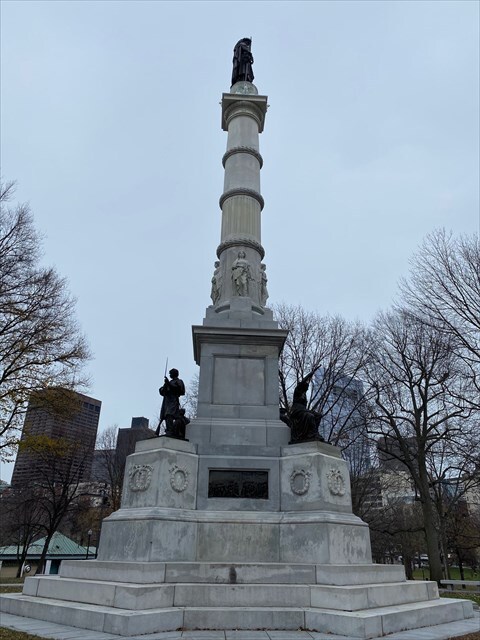
The Soldiers and Sailors Monument on Boston Common was dedicated in 1877 to honor Massachusetts soldiers and sailors who died in the Civil War. Designed by sculptor Martin Milmore, the 126-foot granite column is topped by a bronze allegorical figure of America. Around its base are bronze reliefs depicting wartime scenes and carved figures representing different regions of the reunited nation.
The Soldiers and Sailors Monument was constructed from Hallowell White Granite, which was quarried in Hallowell, Maine (just south of Augusta). Hallowell White Granite formed deep within the Earth’s crust roughly 400 to 450 million years ago, during the Silurian to early Devonian periods. It originated as molten magma that intruded into surrounding rock layers and slowly solidified under intense heat and pressure over millions of years. As the granite formed, tectonic forces slowly compressed and deformed the surrounding rocks. Over time, the overlying rocks were gradually eroded, and tectonic forces brought the granite closer to the surface where it could be quarried.
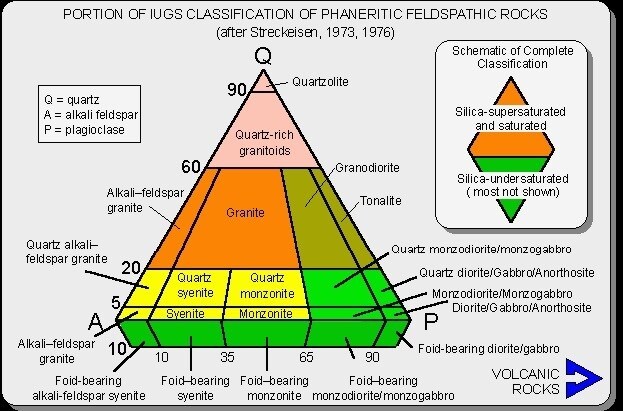
The chart above is used to classify igneous rocks based on their mineral composition. The three corners of the triangle represent the proportions of quartz (Q), alkali feldspar (A), and plagioclase (P). Quartz is usually clear, gray, or milky, and has a glassy look along with smooth, irregular breaks. Alkali feldspar is often pink, reddish, or light tan, and sometimes shows faint parallel lines called striations. Lastly, plagioclase feldspar is typically white, gray, or bluish, and often displays fine striations and has a more blocky, rectangular appearance.
To read the chart, you plot the relative proportion of each mineral. In essence, you really only need the relative proportion of two of the minerals, since we know the total will add up to 100%. The interior of the triangle is divided into fields labeled with rock types, such as granite, syenite, or monzonite, so once the composition is plotted, the corresponding rock classification can be found. For example if you have a rock which contains 50% quartz and 35% plagioclase (15% would be alkalai feldspar), then it would be classified as granite.
The colored regions indicate whether the rock is undersaturated, silica-saturated, or oversaturated. Rocks that are silica-undersaturated will crystallize silica poor minerals like feldspathoids (minerals chemically similar to felspars but with less silica) or olivine. Rocks that are silica-saturated have just enough silica and contain neither quartz nor feldspathoids. Lastly, rocks that are silica-oversaturated have extra silica, which appears as quartz among the minerals.
Logging Requirements:
- Describe the color, texture, and grain size of the stone. Next, estimate the relative proportion of quartz, alkalai feldspar, and plagioclase. Using the chart, is this stone a "true" granite? Explain.
- Based on your classification, what would be the silica saturation of this stone?
- Upload a photo with either yourself or a personal object with the Soldiers and Sailors Monument.
Sources:
- https://en.wikipedia.org/wiki/Soldiers_and_Sailors_Monument_(Boston)
- https://historichallowell.mainememory.net/page/1506/display.html
- https://digitalmaine.com/cgi/viewcontent.cgi?referer=&httpsredir=1&article=1366&context=mgs_publications
- https://www.maine.gov/dacf/mgs/explore/bedrock/historical/feb08-map.pdf
- https://earthsci.org/mineral/rockmin/petrology/igneous_petrology/igneous_petrology.html
- https://www2.tulane.edu/~sanelson/eens212/igrockclassif.htm
An AI tool was used to assist in the preparation of this cache page.