ABOUT THIS EARTHCACHE
A good friend of mine once told me: "Water always wins." Whether it be a seal on a geocache container, a sand hill or solid rock, water always wins. Water is very patient, it may take years, decades or even longer to wear something down, but it eventually will. Yes... Water always wins.
This EarthCache will bring you to a perfect example. These sequoia trees are hundreds of years old. Some are over a thousand years old. They are enormous. They have survived centuries of weather cycles, freezing winters, hot summers and plenty of forest fires. But a small trickling spring, over many many years, eroded enough of the ground around this one to cause it to fall and die. Water always wins!
LOGGING REQUIREMENTS
In order to log this EarthCache, send me your answers to the following questions either through email or messaging from my profile page.
1: In your own words, describe the flow of water from the spring.
2: List at least two examples of erosion (other than the huge fallen sequoia :) ) that you can see here.
3: Do you think the erosion is still happening and if so, why?
4: Post a pic of you or a signature item with the Michigan Tree in the background. Bonus points if you climb inside and pose (see example below). You don't need to include your face in the pic if you don't want to. You can also send me the pic through messenger if you don't want to post it with your log.
If you enjoyed this EarthCache, please consider giving it a favorite point.
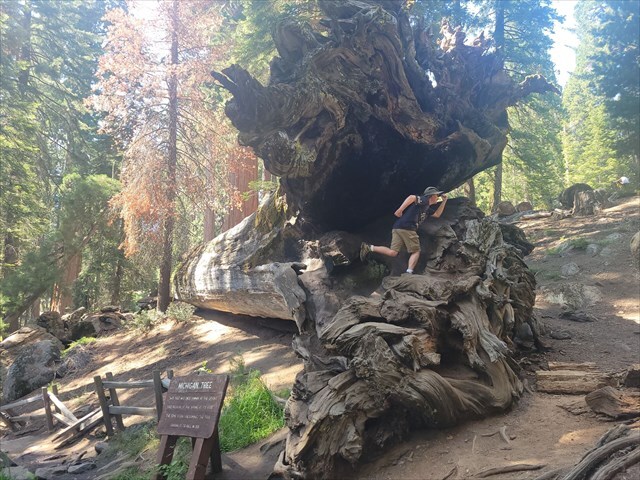
THE MICHIGAN TREE
The Michigan Tree is a fallen giant sequoia located in Grant Grove, Kings Canyon National Park. It was a towering tree once named the Spring Tree due to the spring at its base. The spring beneath it weakened its base, causing it to fall in 1931.
SPRING
A spring is a natural location where water flows to the Earth's surface from an aquifer. It's where groundwater, which has been stored underground, finds an opening and emerges as a stream or pool. Springs can vary in size, flow rate, and temperature, and their water quality depends on the surrounding geology.
GRANT GROVE
Grant Grove sits at an elevation where it receives significant precipitation, primarily as snow. This precipitation infiltrates the ground and is stored in underground rock formations or aquifers.
The geology of the Sierra Nevada, where Grant Grove is located, consists largely of granite, with interspersed sections of volcanic and sedimentary rocks. These varying rock types, particularly the presence of granite, and other formations like marble, create opportunities for springs to emerge.
FLOWING SPRING EROSION
Flowing springs, where groundwater emerges naturally onto the Earth's surface, can contribute significantly to erosion, particularly in areas with certain geological characteristics and land management practices.
How flowing springs cause erosion
Dissolution of rock: As rainwater infiltrates the ground and moves through cracks and pores in rocks like marble, it can absorb carbon dioxide and become slightly acidic carbonic acid. This acidic water is highly effective at dissolving rocks.
Enlargement of cracks and channels: Over time, the continuous flow of groundwater along small cracks and channels dissolves and carries away the rock material, gradually enlarging these pathways.
Cave and sinkhole formation: In some cases, this erosional process can lead to the formation of extensive underground cave systems. When the ceiling of a cave collapses due to continued erosion and weakening of the overlying rock and soil, it creates a sinkhole on the surface.
Effects of flowing spring erosion
Landscape alteration: The erosional forces of groundwater can dramatically reshape the landscape, creating caves, sinkholes, and other karst features.
Loss of land and structures: Sinkholes, in particular, can be large enough to cause the loss of land, infrastructure, and even homes in residential areas.
Water quality impacts: The dissolved minerals carried by groundwater can be deposited elsewhere, forming speleothems like stalactites and stalagmites in caves. However, eroded sediment and dissolved materials can also be carried into surface water bodies, impacting water quality and ecosystems.
Agricultural and economic impacts: Erosion, including that potentially linked to springs and runoff, can reduce soil fertility and depth, impacting crop yields and agricultural productivity. Soil erosion can also lead to increased sedimentation in waterways, potentially causing flooding and damaging infrastructure.
Factors influencing spring-related erosion
Geology: Areas with soluble rocks like limestone are more prone to groundwater erosion and related features like caves and sinkholes.
Rainfall and runoff: High rainfall and surface water runoff can exacerbate erosion, particularly in combination with permeable soils and slopes.
Vegetation cover: A lack of dense vegetation cover allows for greater raindrop impact and increased surface runoff, making the soil more vulnerable to erosion, says Oklahoma State University Extension.
references
https://www.nps.gov/
https://en.wikipedia.org/
https://www.fs.usda.gov/
I have earned GSA's highest level:
 |