The listed coords will bring you to a Granite Fountain out side the entrance to the Church of St James Bermondsey.
The learning element of this cache is to appreciate the effect of Pottassium to the colour of Granite.
First of all a bit about the Church:
St James's Church, Bermondsey, is a Church of England Parish Church in south London. Designed by James Savage, it was one of the churches built as a result of the Church Building Act It was completed and consecrated in 1829 and given a separate parish in 1840. In 1949 it was designated a Grade II listed building.
****************************************************
If you would like to add to the Church Micro series yourself then please visit
http://churchmicro.co.uk/
There is also a Church Micro Stats & Information page that can be found at
http://www.15ddv.me.uk/geo/cm/index.html
*******************************************************

The Church
What is Granite?:
Granite is a common type of felsic intrusive igneous rock that is granular and phaneritic in texture. Granite s can be predominantly white, pink, or grey in color, depending on their mineralogy. The word "granite" comes from the Latin granum, a grain, in reference to the coarse-grained structure of such a holocrystaline rock. By definition, granite is an igneous rock with at least 20% quartz and up to 65% alkali feldspar by volume.

Feldspar in Granite.
What is Feldspar?
Feldspar in simple terms is any of a group of aluminosilicate minerals that contain calcium, sodium, or potassium. Feldspars make up more than half of Earth's crust.


Plagioclase feldspar:
Each plagioclase grain is made up of stacks of thin crystal with their molecules arranged in opposite directions. This causes the cleavage planes to have fine parallel line across them called striations. This is sometimes plagioclase’s most diagnostic feature.
Another diagnostic feature is the feldspars colour range. In this case, the colour typically ranges from white to gray. The main feldspars in this grouping include:
- Oligoclase
- Andesine
- Labradorite
- Bytownite
- Anorthite
Orthoclase feldspar:
Unlike plagioclase, orthoclase does not have striations across its cleavage plane. Cleavage faces will appear smooth. Orthoclase also typically has a colour range between white and pink, which is different than that of plagioclase. Feldspars which are in this grouping include:
- Microcline
- Sanidine
- Orthoclase
So we have established above that Feldspar comes in many colours and that Feldspar makes up around 65% of Granite. Below are a couple of examples of UK Granite where the colour of the Felspar controls the colour of the Granite.

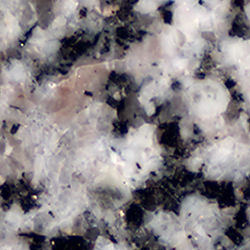
Top Above: Granite from Corrennie quarry in Aberdeenshire showing distinctive salmon-pink (potassium Feldspar) colour. Polished surface. Image approx 12cm high.. Below Above: Criffel Granite from Dalbeattie quarry in southwest Scotland showing typical grey colour with Sodium-Titanium feldspar crystals. Polished surface. Image approx 12cm high.
Essentially there are two main colours of Feldspar which in turn influence the colour of granite.. The pinky salmon colour is influenced by Potassium and the white by Sodium.
Questions:

Please send me the answers to the following question. One may log the Cache on doing so. I will contact you if the answers are poor.
1. Granite is predominantly made up of the following 3 components: Quartz, Feldspar and Mica. Which of the 3 has the main responsibility for the colour of Granite? Please explain your answer.
2. Looking at the fountain it is obvious that not all the pieces of granite are the same in Colour. Please put the 4 numbers on the fountain above in order of Potassium content. 1 being the least and 4 the most. Please explain your answer.
3. Again looking at the numbers on the pieces of Granite...... which numbered piece do you think comes from South West Scotland?
4. Finally post a photo of yourself or a piece of paper with your caching name against one of the pillars at the front of the Church.
Thanks for visiting.