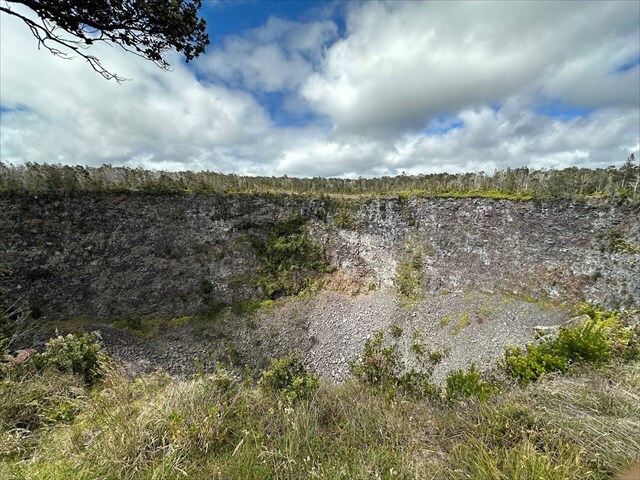
Puhimau Crater is a pit crater located along Chain of Craters Road in Hawai‘i Volcanoes National Park. It formed as part of the East Rift Zone of Kīlauea, where magma movement beneath the surface caused sections of ground to collapse, and is thought to have formed sometime between 1500 and 1800 AD. Steam vents can often be seen around the crater which serve as a reminder of the underground heat still present in this active volcanic system.
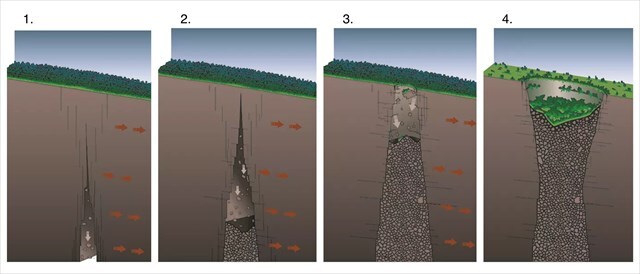
Pit craters are defined as steep sided depressions that form when the ground collapses into an empty space created by shifting or draining magma beneath a volcano. They begin to form as magma shifts or erupts, which causes the surrounding ground to settle and deep internal cracks to develop within the volcano. These cracks gradually work their way upward, weakening the overlying rock. As the roof becomes unstable, blocks of rock fall into the cavity below, which enlarges the hollow space. Eventually, the cavity extends all the way to the surface, and the ground above collapses which results in the steep sided depression that is characteristic of a pit crater. After formation, the crater continues to evolve and they continue to widen as the walls collapse and erode. Also vegetation may start to grow on the crater floor.
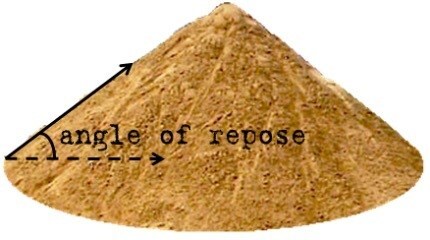
Lastly, it is worth mentioning angle of repose, which is the steepest angle at which loose, unconsolidated material (like sand, gravel, or volcanic ash) can remain piled without sliding down under the force of gravity.
It reflects a balance between downslope pull of gravity and the resisting forces of friction and cohesion between the grains. The angle of repose is important because it affects the stability of the crater walls. Over time, loose rock and debris will collapse downward until the slope reaches a stable angle near the natural angle of repose. This process of wall collapse and readjustment continues until an equilibrium is reached (when the walls are no longer actively failing and the crater maintains a stable form).
Please remain on the trail at all times to help preserve this spot for future generations.
Logging Requirements:
- Describe the physical characteristics of the crater (diameter, depth...etc). The pit craters in Hawai‘i Volcanoes National Park range from 26-3740 feet wide, and 20-610 feet deep. How does Puhimau Crater compare, and what can this tell us about the volume of magma movement beneath the surface?
- Next estimate the angle of the walls and compare it to the angle of repose of basalt (between 20-28 degrees). Do you see any signs of recent wall collapses, or steam in the crater, which would indicate that heat from volcanic processes are still influencing the crater? Based on your observations, do you think the walls are done sloughing, and why?
- Upload a photo with either yourself or a personal object with the Puhimau Crater.
Sources:
- https://irma.nps.gov/DataStore/DownloadFile/425531
- https://www.nps.gov/havo/learn/nature/pit-craters.htm
- https://www.shakaguide.com/tours/big-island/hawaii-volcanoes-national-park-tour/stops/puhimau-crater
- https://volcano.oregonstate.edu/pit-craters
- https://www.nps.gov/havo/learn/nature/pit-craters.htm
- https://www.scribd.com/document/434942361/Angle-of-Repose