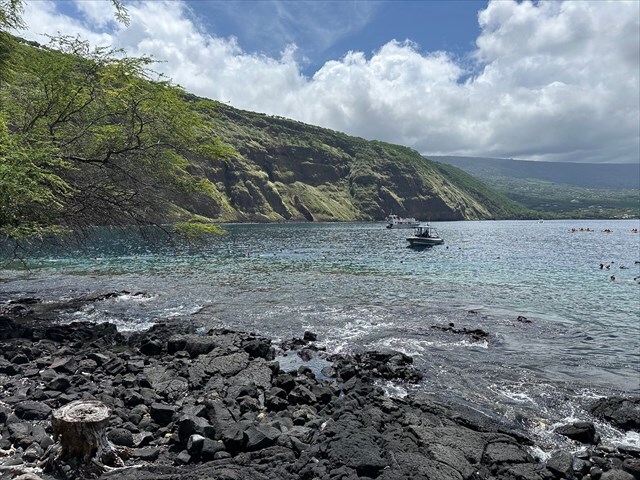
Kealakekua Bay State Historical Park, located on the west coast of Hawai‘i Island, encompasses a sheltered bay formed by the collapse of an ancient volcanic crater. Its deep, clear waters and vibrant coral reefs make it one of the island’s most popular snorkeling destinations, home to a wide variety of marine life. The surrounding area also holds significant cultural history, including the site where Captain James Cook first landed in Hawai‘i and where he was later killed in 1779.
Limestone is a sedimentary rock composed mainly of calcium carbonate and is typically formed in warm, shallow marine environments where biological activity is high. Much of it originates from the accumulation of shell fragments, coral skeletons, and the microscopic remains of plankton, all of which are rich in calcium carbonate. In some settings, it can also form through chemical precipitation, when dissolved calcium and carbonate ions in seawater combine and settle out as solid minerals. Over time, continued deposition, compaction, and cementation turn these sediments into solid rock.
This process of limestone formation is closely tied to environments like Kealakekua Bay, where calm, protected waters support coral reefs and abundant marine life that produce large amounts of calcium carbonate. These biological materials accumulate on the seafloor as carbonate sediments that eventually lithify into limestone. In contrast, parts of the island exposed to stronger wave action and with fewer coral reefs tend to be less favorable for limestone formation due to reduced accumulation of carbonate material.
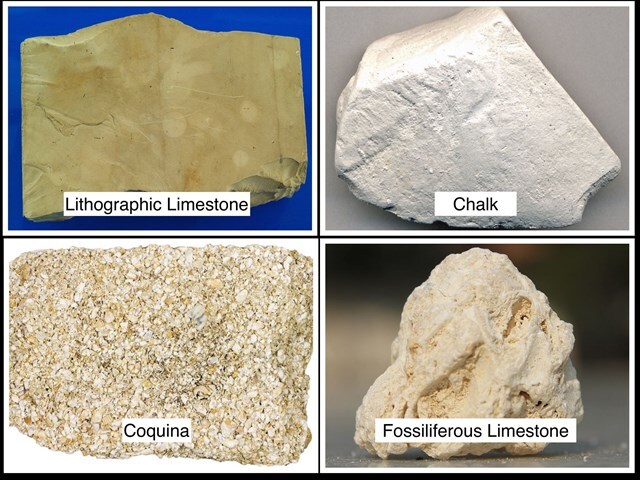
There are four main types of limestone, each distinguished by its texture, composition, and the environment in which it forms.
- Chalk: Chalk is a soft, fine grained limestone and is composed primarily of microscopic calcium carbonate plates from coccolithophores, a type of plankton. It forms in deep marine settings where these tiny organisms accumulate over long periods. Chalk is typically white or light gray in color.
- Coquina: Coquina is a coarse, poorly cemented limestone made almost entirely of visible shell fragments and broken skeletal remains of marine organisms. It forms in high energy environments such as beaches or shallow marine shorelines where wave action accumulates and sorts shell debris. Coquina is porous and loosely consolidated compared to other limestones.
- Fossiliferous Limestone: Fossiliferous limestone contains abundant, well preserved fossils that are embedded within a finer carbonate matrix. It forms in marine environments rich in life, where the remains of shells, corals, and other organisms accumulate and are cemented together. This type of limestone provides valuable paleontological information due to its fossil content.
- Lithographic Limestone: Lithographic limestone is an extremely fine grained, dense limestone with a very uniform texture and composition. It is valued for its ability to be split into thin, even layers, and has historically been used in lithography printing. This limestone forms in calm, low energy marine environments with slow sedimentation rates, and often preserves fine details of fossils.
This earthcache can be completed either by land or by boat.
Logging Requirements:
- What type of biological material(s) can you find along the shoreline or underwater? Are there visible differences in the texture or composition of rock or sediment along the shoreline or underwater? Could these differences reflect different types of limestone formation?
- How would you describe the depth and energy of the marine environment? Based on your observations, what type of limestone do you think will form here?
- Upload a photo with either yourself or a personal object taken within Kealakekua Bay.
Sources:
- https://pubs.usgs.gov/mf/0986/plate-1.pdf
- https://www.britannica.com/science/chalk
- https://geology.com/rocks/coquina.shtml
- https://geologyscience.com/rocks/sedimentary-rocks/non-clastic-sedimentary-rock/fossiliferous-limestone/
- https://en.wikipedia.org/wiki/Lithographic_limestone
- https://www.geocaching.com/geocache/GC5DZ6B