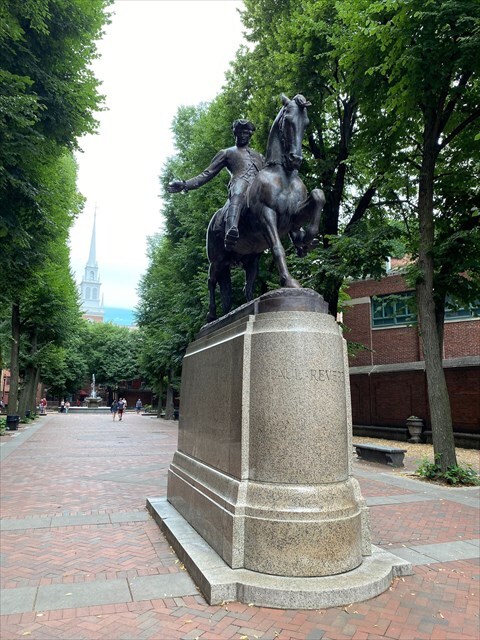
The Paul Revere statue in Boston, located in the North End’s Paul Revere Mall, depicts the patriot on horseback during his famous midnight ride of 1775, when he rode to warn colonial militias of advancing British troops. Created by sculptor Cyrus Edwin Dallin and unveiled in 1940, the bronze monument captures Revere in motion, with his arm outstretched as if calling for vigilance and urgency. Positioned along the Freedom Trail with the Old North Church in the background, it is a popular stop for visitors and a familiar landmark in the city.
The base of the Paul Revere Statue is constructed from Milford Pink Granite, which is found in Milford, Massachusetts. It was formed approximately 600 million years ago when molten rock pushed its way into older crust and slowly cooled underground. This process created a large granite body, or pluton, that was part of a broader episode of continental growth in the region. At that time shifting tectonic plates caused sections of the Earth’s crust to collide, which created heat and pressure that generated magma deep below the surface. That magma rose upward and crystallized into solid rock. Millions of years later, erosion stripped away the overlying layers, exposing the rock at the surface.
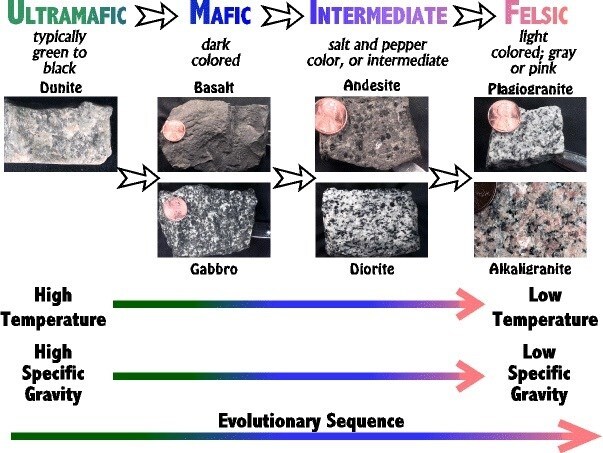
Mafic and felsic are often used to describe the chemical composition of igneous rocks. Mafic rocks are rich in magnesium and iron, tend to be darker in color, and form at higher temperatures. They also have higher densities and specific gravities (ratio of density of rock compared to density of water). In contrast, felsic rocks are richer in silica and lighter elements, which gives them a lighter color such as gray or pink. They form at lower temperatures and have lower densities.
As magma cools, it often changes chemically in a series of steps called the evolutionary sequence. Initially magma usually starts out hotter and richer in iron and magnesium, and produces ultramafic and mafic rocks. As certain minerals crystallize and settle out, the remaining magma becomes depleted in those elements but enriched in silica. This gradual change drives the magma toward more intermediate and eventually felsic compositions, with rocks becoming lighter in color, lower in density, and forming at lower temperatures. The size of the crystals can also tell geologists a lot about where the stone was formed. Larger crystals indicate a rock formed deeper underground, where slower cooling allowed the minerals more time to grow. In contrast, smaller crystals form when magma or lava cools quickly near the surface, preventing large crystals from developing.
Logging Requirements:
- Describe the color, texture, and grain size of the stone. Did the stone form deep underground or close to the surface? Explain.
- Based on your observations, how would you classify the stone? How does this help us understand the conditions under which the stone was formed? Explain.
- Upload a photo with either yourself or a personal object with the Paul Revere Statue.
Sources:
- https://en.wikipedia.org/wiki/Equestrian_statue_of_Paul_Revere
- https://en.wikipedia.org/wiki/Milford_pink_granite
- https://www.milfordfreepress.com/2024/12/08/516013/milford-pink-granite-helped-shape-town-s-character
- https://www.geo.umass.edu/stategeologist/Products/Bedrock_Geology/Milford_Draft/mil_bedrock_sheet1.pdf
- https://pubs.usgs.gov/of/1977/0285/report.pdf
- https://csmgeo.csm.jmu.edu/geollab/fichter/platetect/igprimer.html
An AI tool was used to assist in the preparation of this cache page.