

click
on the flag to reach the translation
Une
Earthcache
Il ne s’agit pas d’une cache
physique. Pour loguer cette cache, vous devez dans un premier temps
prendre connaissance de sa description éducative en
matière de géologie, puis d’observer le
site sur lequel vous êtes, et enfin de répondre
aux questions qui vous seront posées.
Vous pourrez alors loguer en "Found it" sans attendre mais vous devez
me faire parvenir vos réponses en même temps en me
contactant soit par mail dans mon profil, soit via la messagerie
geocaching.com (Message Center), et je vous contacterai en cas de
problème. Les
logs enregistrés sans
réponses, sans photo individuelle, seront
supprimés.

La
formation des roches magmatiques (ignées)
◊
Intrusives / extrusives
Les roches magmatiques proviennent de la fusion partielle des roches en
profondeur. Elles se forment quand un magma se refroidit et se
solidifie.
- Ces roches sont dites intrusives
(ou plutoniques)
lorsqu'elles se forment en profondeur. Ce refroidissement lent permet
la formation de gros cristaux visibles à l'œil nu.
- Elles sont dites extrusives
(ou volcaniques)
lorsqu'elles sont par exemple crachées par un volcan
(basalte). Le refroidissement rapide de la roche ne permet pas la
formation de beaux cristaux.
Ce sont des roches essentiellement silicatées.
Elles sont formées de cristaux étroitement
enchevêtrés.
La texture traduit la vitesse et le milieu de cristallisation.
La nature des minéraux traduit la composition chimique du
magma.
Ces conditions peuvent se ramener, par une simplification
extrême, à deux facteurs principaux, la pression
et la température.
La "croûte" terrestre est essentiellement composée
de roches ignées intrusives.
On connaît surtout le granite qui est la roche
ignée la plus fréquente sur terre. Cette "classe"
de roche est facilement reconnaissables par la taille (visibles
à l'oeil nu) et la couleur des cristaux qui la compose.
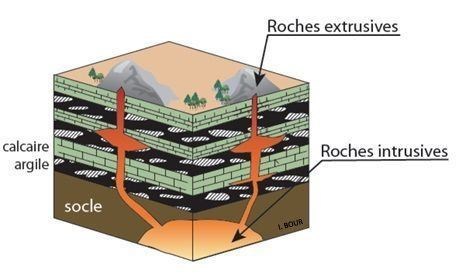 Contexte de
cristallisation des roches magmatiques.
Contexte de
cristallisation des roches magmatiques.
◊
Une cristallisation
fractionnée
Suivant leur composition chimique, les minéraux
n’ont pas tous la même température de
fusion.
Au cours du refroidissement d’un magma, les
minéraux ayant la température de fusion la plus
élevée cristalliseront en premier et auront tout
l’espace disponible.
Les minéraux cristallisent donc successivement par
cristallisation fractionnée. Au fur et à mesure
de cette cristallisation, la chambre magmatique se
différencie également.
◊
Une texture
différenciée
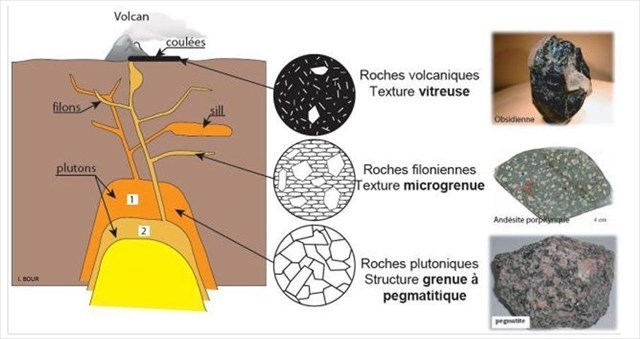
- Grenue
: tous les cristaux sont grands et également
développés (phénocristaux). Cela
témoigne d'un refroidissement lent en profondeur
- Microgrenue
: quelques grands cristaux (phénocristaux) dans une masse de
petits cristaux. Cela témoigne d'un refroidissement plus
rapide à profondeur moindre
- Microlithique
: quelques cristaux (phénocristaux possibles) dans une masse
homogène. Cela témoigne d'un refroidissement en 3
temps :
- En profondeur pour les gros cristaux
- Au cours de l’ascension du magma à
moyenne profondeur : cristallisation des microlithes
- En surface avec refroidissement brutal et consolidation
de verre
- Vitreuse
avec aucun cristal, refroidissement très brutal

FOCUS -
Les microgranites, une roche intermédiaire
◊
Introduction au granite
Le granite est
une roche magmatique plutonique à texture grenue,
c'est-à-dire entièrement cristallisée
et composée de minéraux bien
développés et visibles à
l'œil nu.
Celle-ci est le résultat du refroidissement lent, en
profondeur,
de grandes masses de magma qui formeront des plutons, ces derniers
étant actuellement en surface grâce au jeu de
l'érosion qui a décapé les roches
sus-jacentes.
Ces magmas, acides (c'est-à-dire relativement riches en
silice)
sont essentiellement le résultat de la fusion partielle de
la
croûte terrestre continentale.
Certains granites (plagiogranites) rencontrés en petits
plutons
dans la croûte océanique sont, quant à
eux le
résultat de la différentiation ultime de magmas
basiques.
Les granites sont formés de minéraux en grains
(cristaux), tous visibles à l'œil nu ; cette
apparence
leur vaut leur nom dérivé du latin granum, grain.
Ces
minéraux sont principalement du quartz, des micas (biotite
et/ou
muscovite), des feldspaths potassiques (orthoses) et des plagioclases.
Ils peuvent contenir également de la hornblende, de la
magnétite, du grenat, du zircon et de l'apatite.. En tout,
on
dénombre aujourd'hui plus de 500 couleurs de granites
différentes.
Le granite regroupe les leucogranites et les granitoïdes:
- leucogranites (du
grec leukos, blanc) : roches granitiques claires.
- granitoïde
: ce terme désigne
l'ensemble des roches de la famille des granites (granites, granites
monzonitiques, granodiorites) et aussi, parfois, l'ensemble des roches
magmatiques plutoniques saturées et à feldspaths
alcalins, dans ce cas, les granitoïdes comprennent alors, non
seulement les roches de la famille des granites, mais
également,
les syénites, les monzonites et les tonalites.
◊
Les microgranites
Les microgranites sont des roches ignées acides avec la
même composition minérale que les granites, mais
avec des cristaux beaucoup plus petits.
Le microgranite a ainsi une position intermédiaire entre le
granite (roche plutonique à structure grenue) et la rhyolite
(roche volcanique à structure microlithique).
Les microgranites ont:
- soit une structure
microgrenue avec des cristaux de dimension
inférieure à 1 mm, dont le grain est difficile
à distinguer à l’œil nu;
- soit fréquemment une structure porphyroïde
(porphyrique), avec de grands cristaux isolés dans une
structure microgrenue.
Les microgranites apparaissent souvent sous forme de filons.
◊
Les porphyres
On appelle porphyre, toute roche magmatique filonienne qui
présente une texture caractérisée par
de grands cristaux de feldspath noyés dans une
pâte aphanitique (sans cristaux visibles)..
Ces roches font souvent partie du groupe des andésites
(L'andésite est la roche volcanique la plus courante
après le basalte).
On dit aussi d'une roche qu'elle a une texture porphyrique
lorsque des
phénocristaux de feldspath sont notablement plus grands que
les autres cristaux qui les entourent.
Bonus:
Certaines variétés de porphyres sont
utilisées depuis l'Antiquité comme pierre
ornementale pour des sculptures, colonnes, vasques, plaques
d'ornements, etc.
Du grec ancien
πορφύρα /
porphýra, terme désignant la pourpre, c'est
à l'origine le nom d'un coquillage, le pourprier,
d'où l'on tire celle-ci. Par métonymie, le terme
de porphyre désigne la variété rouge
de cette roche, qui était la plus connue. Quant au mot
pourpre, il vient du latin purpura, nom de ce coquillage.
Deux variétés ayant été
particulièrement utilisées dans l'histoire,
notamment dans la Rome antique, sont classés dans les
« marbres antiques » :
- Le porphyre rouge
antique (lapis porphyrites, pierre
pourpre) qui est une andésite à faciès
paléovolcanique dont les feldspaths et la pâte
sont colorés par de l'épidote rose
(piémontite). Les carrières se trouvent sur le
djebel Dokhan (nom ancien : Mons Porphyrites ou Mons Igneus), une
chaîne montagneuse située à
l’ouest de Hurghada, en plein désert oriental
égyptien. Il fut essentiellement connu et
exploité durant la période romaine où
il était une roche très prestigieuse, on en fit
de grandes vasques, des sculptures, des colonnes monumentales, des
sarcophages impériaux et des décors de placage.
- Le porphyre vert
antique ou serpentin (lapis lacedaemonius,
pierre de Lacédémone), qui est une
andésite à faciès
paléovolcanique à pâte vert
foncé, avec de nombreux grands cristaux de labradorite
pseudomorphosés par de l'épidote vert pistache,
et de rares pyroxènes noirs. Il est issu des
carrières de Lacédémone (aussi connue
sous le nom de Sparte, dans le Péloponnèse en
Grèce), il était déjà
exploité aux époques minoenne (1700 av. J.-C.) et
mycénienne, il connut une grande diffusion à Rome
à l’époque Flavii et il
était recherché au Moyen Âge et
à la Renaissance. Sa disponibilité en petits
blocs le destinait plutôt vers de petites colonnes, vases,
plaques de revêtement (opus sectile) et mosaïques.

Questions
La lecture de la description de cette earthcache est
normalement suffisante pour vous permettre de réaliser les
observations demandées et de répondre aux
questions posées.
Une cotation difficulté plus élevée de
l'earthcache demandera des observations et des réponses plus
élaborées.
Pour information, au-delà du
repérage réalisé sur place, la
conception d'une earthcache prend en moyenne 1/2 journée
(voire 1 jour pour les plus techniques avec la recherche des
informations géologiques). Merci de respecter ce travail.
Question 0:
Prenez une photo de vous (photo de groupe non acceptée), ou
de votre objet distinctif de
géocacheur, ou de votre surnom écrit sur une
feuille de papier ou à la main... avecle chateau en
arrière-plan,
et joignez-la à votre log ou à vos
réponses
Question 1: Je n'ai pas
compris pourquoi on dit que le microgranite est une roche
intermédiaire, on m'a appris à
l'école qu'il y avait soit des roches volcaniques
qui sont crachées par le volcan, soit des roches plutoniques
qui viennent du centre de la Terre . Peux-tu m'expliquer s'il te plait ?
Question 2:
Ok, j'ai compris. Mais pourquoi alors les microgrannites peuvent avoir
une texture avec des "gros morceaux" dedans ?

Vous
observez maintenant l'affleurement rocheux sur lequel a
été contruit le chateau.
Question 3:
Decrivez cette roche mère, en précisant ses
aspects:
- présence de grains, taille,
homogène ou non
- couleur, homogène ou non
- aspect homogène ou fracturé
- aspect érodé
Question 4:
Quel(s) aspect(s) vous oriente(nt) vers une roche de type
magmatique plutôt que sédimentaire ?
Question 5:
Etes-vous ici plutôt sur un granite (plutonique), un
microganite (intermédiaire) ou une rhyolite (volcanique),
expliquez votre raisonnement ?
An
Earthcache
This is not a physical cache. To log this cache, you
must first read its educational description of geology, then observe
the site on which you are, and finally answer the questions that will
be asked.
You can then log in to "Found it" immediately but you must send me your
answers at the same time by contacting me either by email in my profile
or via geocaching.com (Message Center) messaging, and I will contact
you in case of any problems.
Logs saved without answers, without photo,
will be deleted.
Formation
of igneous rocks
◊
Intrusive / extrusive
Igneous rocks come from the partial melting of rocks at depth. They
form when magma cools and solidifies.
- These rocks are called intrusive
(or plutonic)
when they form at depth. This slow cooling allows the formation of
large crystals visible to the naked eye.
- They are called extrusive
(or volcanic)
when they are, for example, spewed out by a volcano (basalt). The rapid
cooling of the rock does not allow the formation of beautiful crystals.
These are essentially silicate rocks.
They are made up of tightly intertwined crystals.
The texture reflects the speed and medium of crystallization.
The nature of the minerals reflects the chemical composition of the
magma.
These conditions can be reduced, by extreme simplification, to two main
factors, pressure and temperature.
The Earth's "crust" is essentially composed of intrusive igneous rocks.
We especially know granite which is the most common igneous rock on
earth. This "class" of rock is easily recognizable by the size (visible
to the naked eye) and the color of the crystals that compose it.
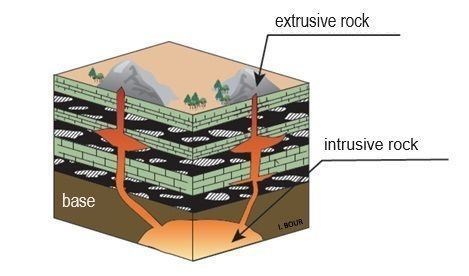 Context of
crystallization of igneous rocks.
Context of
crystallization of igneous rocks.
◊
Fractional crystallization
Depending on their chemical composition, minerals do not all have the
same melting temperature.
As a magma cools, the minerals with the highest melting temperature
will crystallize first and have all the space available.
The minerals therefore crystallize successively by fractional
crystallization. As this crystallization progresses, the magma chamber
also differentiates.
◊
A differentiated texture
- Grainy:
all crystals are large and equally developed (phenocrysts). This
indicates slow cooling at depth.
- Micrograin:
a few large crystals (phenocrysts) in a mass of small crystals. This
indicates faster cooling at shallower depths.
- Microlithic:
a few crystals (possible phenocrysts) in a homogeneous mass. This shows
cooling in 3 stages:
- Deep for large crystals
- During the ascent of magma to medium depth:
crystallization of microliths
- On the surface with sudden cooling and glass consolidation
- Glassy
with no crystal, very sudden cooling
FOCUS -
Microgranites, an intermediate rock
◊
Introduction to granite
Granite is a plutonic magmatic rock with a grainy texture, that is to
say entirely crystallized and composed of well-developed minerals
visible to the naked eye.
This is the result of the slow cooling, in depth, of large masses of
magma which will form plutons, the latter currently being on the
surface thanks to the play of erosion which has stripped the overlying
rocks.
These magmas, acidic (that is to say relatively rich in silica) are
essentially the result of the partial fusion of the continental crust.
Some granites (plagiogranites) encountered in small plutons in the
oceanic crust are, for their part, the result of the ultimate
differentiation of basic magmas.
Granites are formed of mineral grains (crystals), all visible to the
naked eye; this appearance gives them their name derived from the Latin
granum, grain. These minerals are mainly quartz, micas (biotite and/or
muscovite), potassium feldspars (orthoclases) and plagioclases. They
can also contain hornblende, magnetite, garnet, zircon and apatite. In
total, there are now more than 500 different colours of granites.
Granite includes leucogranites and granitoids:
- leucogranites (from the Greek leukos, white): light
granitic rocks.
- granitoid: this term refers to all rocks of the granite
family (granites, monzonitic granites, granodiorites) and also,
sometimes, all saturated plutonic magmatic rocks and rocks with alkali
feldspars; in this case, the granitoids then include not only rocks of
the granite family, but also syenites, monzonites and tonalites.
◊
Microgranites
Microgranites are acidic igneous rocks with the same mineral
composition as granites, but with much smaller crystals.
Microgranites thus occupy an intermediate position between granite (a
plutonic rock with a grainy structure) and rhyolite (a volcanic rock
with a microlithic structure).
Microgranites have
- either a
microgranular structure with crystals smaller than 1 mm,
whose grain size is difficult to distinguish with the naked eye;
- or, frequently, a
porphyritic structure, with large isolated crystals in a
microgranular structure.
Microgranites often appear as veins.
◊
Porphyry
Porphyry is any igneous rock with a texture characterized by large
feldspar crystals embedded in an aphanitic groundmass (without visible
crystals).
These rocks are often part of the andesite group (andesite is the most
common volcanic rock after basalt).
A rock is also said to have a porphyritic texture when feldspar
phenocrysts are noticeably larger than the other crystals surrounding
them.
Bonus:
Certain varieties of porphyry have been used since
antiquity as
ornamental stone for sculptures, columns, basins, decorative plaques,
etc.
From the Ancient Greek
πορφύρα /
porphýra, the term for purple, it is originally the name of
a shell, the purslane, from which it is derived. By metonymy, the term
porphyry refers to the red variety of this rock, which was the best
known. As for the word purple, it comes from the Latin purpura, the
name of this shell.
Two varieties that were particularly used throughout
history,
particularly in ancient Rome, are classified as "ancient marbles":
- Ancient red
porphyry (lapis porphyrites, purple stone),
which is a paleovolcanic andesite whose feldspars and paste are colored
by pink epidote (piedmontite). The quarries are located on Jebel Dokhan
(ancient name: Mons Porphyrites or Mons Igneus), a mountain range
located west of Hurghada, in the heart of the Egyptian Eastern Desert.
It was primarily known and mined during the Roman period, when it was a
highly prestigious rock; it was used to make large basins, sculptures,
monumental columns, imperial sarcophagi, and veneer decorations.
- Ancient green or
serpentine porphyry (lapis lacedaemonius,
Lacedaemon stone), which is a paleovolcanic facies andesite with a dark
green paste, with numerous large labradorite crystals pseudomorphosed
by pistachio green epidote, and rare black pyroxenes. It comes from the
quarries of Lacedaemon (also known as Sparta, in the Peloponnese in
Greece), it was already exploited in the Minoan (1700 BC) and Mycenaean
periods, it was widely distributed in Rome during the Flavian period
and it was sought after in the Middle Ages and the Renaissance. Its
availability in small blocks made it more suitable for small columns,
vases, covering plates (opus sectile) and mosaics.
Questions
Reading the description of this earthcache is
normally sufficient to allow you to make the requested observations and
answer the questions asked.
A higher difficulty rating of the earthcache will require more
elaborate observations and responses.
For information, beyond the identification carried
out on site, the design of an earthcache takes on average 1/2 day (or
even 1 day for the most technical with the search for geological
information). Thank you
for respecting this work.
Question 0:
Take a photo of you, or your distinctive geocacher object, or your
nickname written on a piece of paper or by hand... with the castle in
background,
and
attach it to your log or answers
Question 1: I didn't
understand why microgranite is said to be an intermediate rock. I was
taught at school that there were either volcanic rocks ejected by the
volcano or plutonic rocks that come from the center of the Earth. Can
you explain this to me please?
Question 2:
Okay, I get it. But why then can microgrannites have a texture with
"big chunks" in them?
You
are now looking at the rocky outcrop on which the castle was built.
Question 3:
Describe this source rock, specifying its characteristics:
- Presence of grains, size, homogeneous or not
- Color, homogeneous or not
- Homogeneous or fractured appearance
- Eroded appearance
Question 4:
What aspect(s) point you towards a magmatic rather than a sedimentary
rock?
Question 5:
Etes-vous ici plutôt sur un granite (plutonique), un
microganite
(intermédiaire) ou une rhyolite (volcanique), expliquez
votre
raisonnement ?