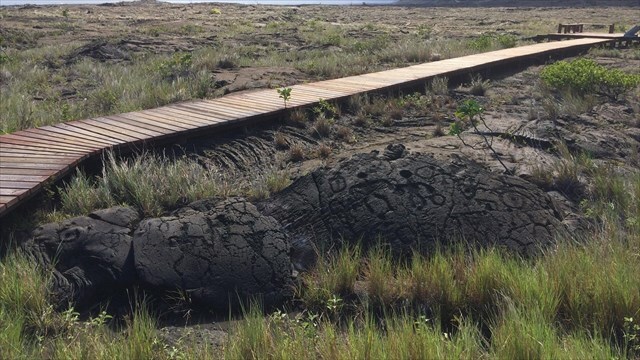
The Puʻuloa Petroglyphs are located in Hawaiʻi Volcanoes National Park and form one of the largest collections of rock carvings in the Hawaiian Islands. More than 23,000 images have been pecked into the hardened lava, depicting human figures, canoe sails, geometric shapes, and cup like depressions. These carvings are believed to hold cultural and spiritual significance, with many of the cup marks traditionally used for placing an infant’s umbilical cord, which symbolizes a child’s connection to the land and community.
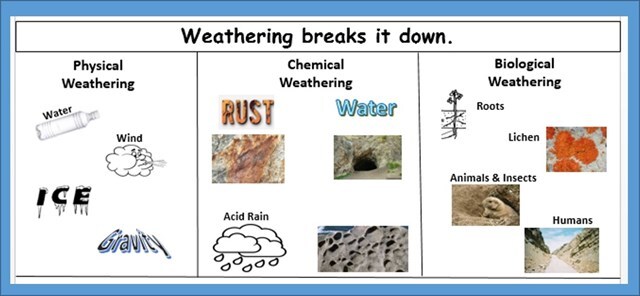
Weathering is defined as the breakdown of rocks and minerals at or near Earth’s surface through physical, chemical, or biological processes. There are 3 main forms of weathering; which involve physical, chemical, and biological processes.
Physical weathering involves the breaking of rocks into smaller fragments without altering their chemical composition. This happens through forces such as temperature changes, pressure release, or the action of moving water, wind, or ice. Frost wedging is a common example, where water seeps into cracks, freezes, and expands, which forces the rock apart. Next there is thermal weathering, which occurs when Hawaii’s dark basalt lava heats up rapidly in the sun and cools quickly at night. The dark basalt heats intensely under the tropical sun, then cools quickly with rain showers or at night. This rapid heating and cooling creates thermal “shock,” and produces stress fractures that cause the rock surface to crack, flake, and gradually break apart. Lastly, there is abrasion is caused by particles grinding against rock surfaces in rivers, glaciers, or deserts, which also can break rock into smaller pieces.
Chemical weathering alters the minerals within rocks through reactions with water, gases, or acids, and as a result either produces new minerals or dissolving existing ones. For example, rainwater which might be slightly acidic from dissolved carbon dioxide, can dissolve carbonate rocks like limestone in a process called dissolution. Feldspar minerals can break down into clay through hydrolysis (reaction involving water), while oxidation causes rocks which contain iron to rust and weaken. Even hydration, which involves minerals absorbing water molecules contributes to weakening and altering the original structure.
Biological weathering results from the activities of living organisms that both physically and chemically affect rocks. For example plant roots can grow into cracks and expand them as they thicken, while lichens, mosses, and microbes produce organic acids that chemically decompose minerals. Also, burrowing animals such as rodents and insects disturb soil, which exposes fresh rock surfaces to air and moisture. Human activities such as mining and construction can also accelerate biological weathering.
Please remain on the boardwalk at all times to help preserve this spot for future generations.
Logging Requirements:
- Describe the appearance of the petroglyphs. What form(s) of weathering do you think is most dominant here? Explain.
- Do all the petroglyphs display a similar degree of weathering or are some more weathered than others? If so, why do you think this might be the case? How do you think the rate of weathering will change in the future (slower, same speed, or faster)? Explain.
- Upload a photo with either yourself or a personal object taken near the Pu'uloa Petroglyphs.
Sources:
- https://www.nps.gov/places/puuloa.htm
- https://www.hawaiiactivities.com/travelguide/puu-loa-petroglyphs/
- https://irma.nps.gov/DataStore/DownloadFile/425531
- https://www.bgs.ac.uk/discovering-geology/geological-processes/weathering/
- https://education.nationalgeographic.org/resource/weathering/