LOGGING REQUIREMENTS
In order to log this EarthCache, send me your answers to the following questions either through email or messaging from my profile page.
Look at all four sides of the chimney to answer these questions. For reference, the historical sign is on the west side.
1: Find the rock with the most tafoni on the west wall. It is about 5.5 feet up and close to the south end of the wall. Estimate the average diameter and depth of the openings.
2: Order the sides from MOST to LEAST tafoni present.
3: Why do you think some sides have more developed tafoni than others?
4: The rock you found for question #1 is sandstone. There is also dark granite rock at the base and bricks higher up. What type of rock seems most prone to have tafoni?
5: Post a pic of you or a signature item with the top section of the chimney in the background (see example below). You don't need to include your face in the pic if you don't want to. You can also send me the pic through messenger if you don't want to post it with your log.
If you enjoyed this EarthCache, please consider giving it a favorite point.

WHY HERE?
This chimney was built in 1858 using local stones. There are some granite rocks at it's base, followed by about 12-15 feet of sandstone and then bricks from there up. All of these have been exposed to the same weather for over 165 years. The chimney is all that is left of the lumber mill built in 1858. Since this is all that is left, we can easily see each side and compare that side to the adjacent side next to it.
TAFONI
Tafoni are rounded, honeycomb-like cavities and hollows that form on the surfaces of rocks through cavernous weathering processes, such as the dissolution of mineral cements and salt crystallization, particularly in arid and semi-arid environments. These formations, often found on vertical or inclined rock faces, can vary from tiny pits to large caves and are a result of the interaction between rock type, moisture, and chemical/physical weathering over time.
HOW TAFONI FORMS
Water, which may be slightly acidic, seeps into the porous rock, dissolving mineral cements like calcite and moving them toward the surface. When the water evaporates, it leaves behind salt crystals or calcium bicarbonate. Salt can accumulate and expand when dry, breaking apart the rock. The repeated cycles of moisture and evaporation, along with salt expansion, weaken the rock's interior while leaving a harder, "case-hardened" outer layer. Physical erosion then breaks down this outer shell, exposing the weaker rock underneath and leading to the progressive enlargement of the cavities into a characteristic honeycomb or sponge-like structure.
WHAT ARE YOU LOOKING FOR?
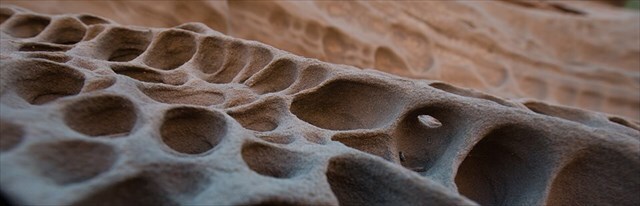
Tafoni are recognized by their rounded, bowl-shaped cavities with smooth interiors, often forming intricate patterns resembling a honeycomb or Swiss cheese.
WHERE TO LOOK
Tafoni typically develops in various rock types, most commonly sandstone and granite, but can also be found in other rocks like limestone. It is found worldwide on various geological features, including cliffs, boulders, and rock formations.
references
https://www.nps.gov/articles/tafoni.htm
https://www.tafoni.com/Welcome.html
I have earned GSA's highest level:
 |