ABOUT THIS EARTHCACHE
This EarthCache will bring you to a nice exhibit of grindstones in Grindstone City. This display has 4 grindstones of different sizes and grades. They are all right here so it is easy to compare them to each other. There is also interesting examples of how they were used as well as a kiosk full of historic information of the history.
LOGGING REQUIREMENTS
In order to log this EarthCache, send me your answers to the following questions either through email or messaging from my profile page.
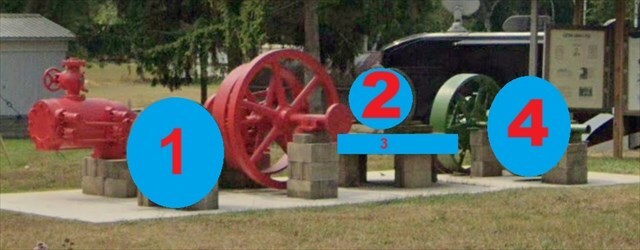
Use the image as an index to answer the following questions:
1: Describe the color of each of the grindstones.
2: Use the color to grade each grindstone (light or heavy) -hint: the lower unit is greenish-grey.
3: Describe any imperfections you see in any of the grindstones that would cause them to be sent to the waste pile.
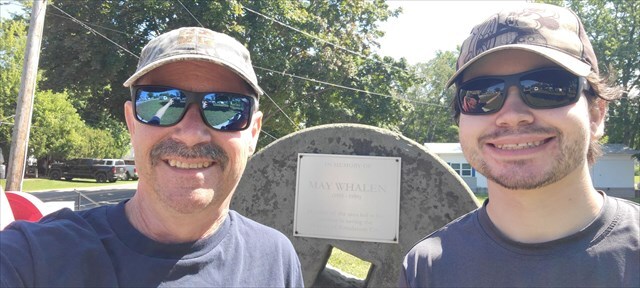
4: Post a pic of you or a signature item with the MAY WHALEN plaque in the background (see example below). You don't need to include your face in the pic if you don't want to. You can also send me the pic through messenger if you don't want to post it with your log.
If you enjoyed this EarthCache, please consider giving it a favorite point.
A BRIEF HISTORY
Captain Aaron G Peer from Ontario, Canada became the founder of Grindstone City somewhat by accident. He was sailing on Lake Huron when a storm came up and forced him and his crew to take refuge in this area. Captain Peer and his men noticed the unusual qualities of the stone along the shoreline and took some pieces back to Detroit where they were used to pave portions of Jefferson and Woodward Avenues. Captain Peer and his men also noted the sharpening qualities of the stone. In 1836 he returned to buy 400 acres, the first land purchase to be registered in Huron County. He brought the necessary tools and equipment to start a quarry, the first business in Huron County. This was the start of the quarrying operations that made Grindstone City world famous for its high quality grindstones that were shipped all over the world, even as far as Africa where they were used to sharpen tools used in the diamond mines.
QUARRYING
Vertical holes, closely spaced, were drilled into the horizontal rock layers. Tabular-shaped blocks were then roughed out by forcing bars and wedges into these holes and along horizontal bedding planes. Explosives were not needed. The rough blocks were lifted by derrick onto flat cars and hauled to the nearby mills. At the mill, blocks were shaped with hand tools into circular slabs having a square hole at the center. Rough grindstones were then mounted on a large lathe and turned to finished size.
Stones with pebbles or other imperfections were sent to the waste pile. These were used to build the two loading docks extending into Lake Huron, build roads or stacked for fences.
GRADES
There were two distinct grades of rock termed light and heavy based on their qualities. The light rock was from 12 to 15 feet deep. The heavy rock was below that another 5 to 10 feet. The rock lay in strata varying from 2 to 3 inches to 6 feet in thickness.
MARSHALL FORMATION
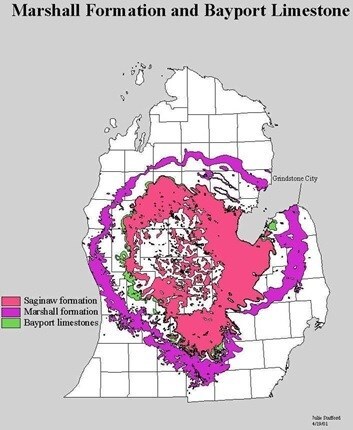
The Marshall Formation formed about 330–340 million years ago when rivers carried quartz-rich sand from the Appalachian highlands into the shallow Michigan Basin. During a regression (sea-level fall), these sands spread across coastal plains, deltas, and shoreface environments, building a broad blanket of sandstone over the deeper-water Coldwater Shale. Waves and currents reworked the sediment, producing well-sorted, cross-bedded quartz sandstone. Later, rising seas covered the formation with marine limestones and shales of the Michigan Formation.
The Marshall Formation rests above the Mississippian Coldwater Shale and reaches a thickness of about 300 feet at its most prominent exposure in southern Michigan. It is primarily composed of sandstone made up of sharply angular quartz grains held together by a softer cement of mica, siderite, and clay. Cross-bedding within the formation is faint, giving the rock an overall uniform appearance. The formation is divided into two parts: the upper Napoleon Sandstone Member and the lower member. The lower unit consists mainly of fine-grained, greenish-gray sandstone with some interbedded siltstone.
references
https://www.michigan.gov/
https://project.geo.msu.edu/geogmich/Grindstones.htm
I have earned GSA's highest level:
 |