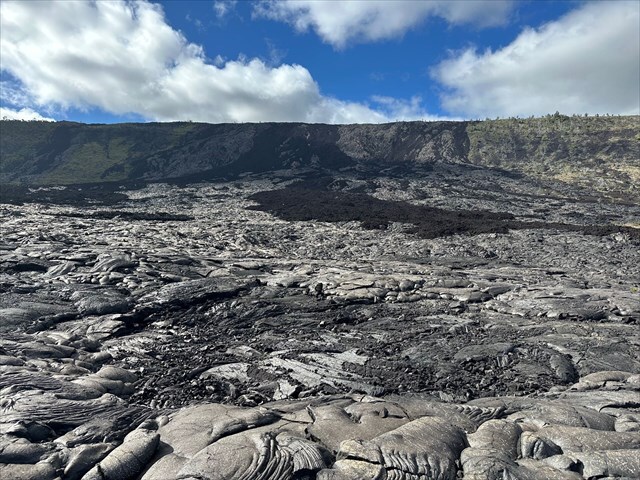
Alanui Kahiko Overlook is a scenic stop along Chain of Craters Road in Hawaiʻi Volcanoes National Park. The name translates to “old road,” which is a reference to a remnant of the original Chain of Craters Road that was buried by lava during the 1972 eruption of Mauna Ulu. From the overlook, visitors can see lava-draped pali (cliffs) created during the 1969–1974 Mauna Ulu eruption. The overlook also provides a great view of Kīlauea which is one of the world’s most active volcanoes and whose eruptions have continuously reshaped the landscape.
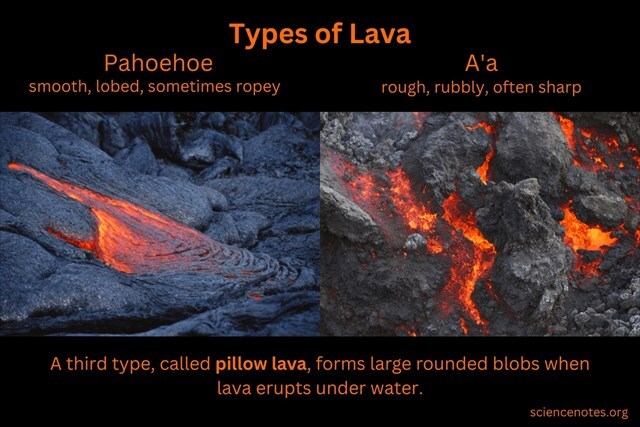
Lava can be classified into two main types, which are pāhoehoe and ʻaʻā. Pāhoehoe lava has a smooth, ropy, or billowy surface. Pahoehoe lava is hotter, less viscous, and flows more steadily. This fluid behavior allows it to spread in thin sheets and inflate into lobes (or toes) as it cools. In contrast, ʻaʻā lava forms a rough, jagged, and clinkery surface. It is cooler, more viscous, and moves turbulently. As it advances, the surface breaks into sharp fragments while molten lava continues to push forward underneath, which creates a thick, blocky flow.
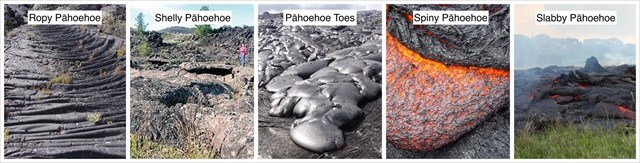
Pāhoehoe lava can be further subdivided into different forms based on variations in texture and surface features.:
- Ropy Pāhoehoe: The most familiar type, with smooth, rope like surfaces formed as lava moving downstream drags the cooling crust along, creating curved ridges.
- Shelly Pāhoehoe: Forms in gas rich lava flows, where open tubes and blisters create thin crusts, or “shells,” at the surface.
- Slabby Pāhoehoe: Made up of jumbled plates or slabs of crust that have broken and overturned. This type is transitional to ʻaʻā, forming when the surface can’t stretch fast enough without tearing.
- Spiny Pāhoehoe: Forms from relatively viscous, gas-rich lava, producing jagged, spiky surfaces. This type is also transitional to ʻaʻā.
- Pāhoehoe Toes: Small, rounded lobes that break out at the edges of an advancing flow. Their surfaces cool quickly, but they can continue to inflate as the lava moves forward, sometimes coalescing into a broader flow front.
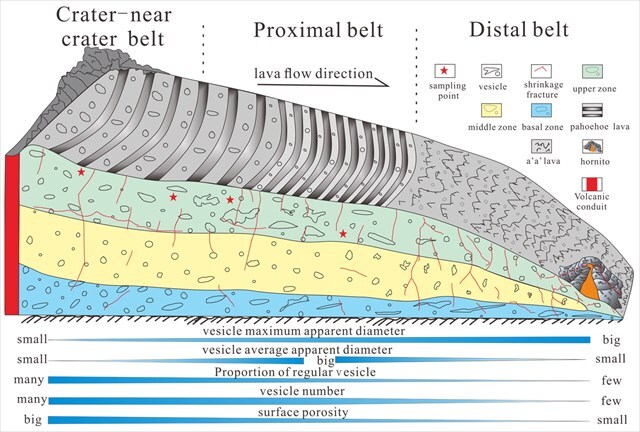
ʻAʻā lava can be further subdivided into proximal and distal types, which differ in thickness, surface and core characteristics, and flow behavior.
- Proximal- This type is usually 1–3 meters thick with a thin clinker layer. The surface is made of spiny clinkers, and the core is vesicular. Proximal flows are fast-moving, their motion is perceptible, and they remain penetrable when active.
- Distal- This type is much thicker, ranging from 3–10 meters, and has a thick clinker layer. The surface clinkers are blocky, while the core is non-vesicular and massive. Distal flows move slowly, often with imperceptible surface motion, and are impenetrable when active. They also generate abundant sand-sized material as fragments are ground down.
Please remain on the trail at all times in order to help protect the site for future generations.
Logging Requirements:
- Estimate the relative proportion of a'a lava to pahoehoe lava. Next, observe the pāhoehoe lava that is visible. Which types can you identify, and what do these textures reveal about the conditions under which the lava formed?
- Describe the a'a lava that is visible. Would you classify it as proximal or distal? Explain.
- Upload a photo with either yourself or a personal object taken at the Alanui Kahiko Overlook.
Sources:
- https://irma.nps.gov/DataStore/DownloadFile/425531
- https://www.nps.gov/places/alanui-kahiko.htm
- https://volcanoes.usgs.gov/observatories/hvo/hawaiian_volcanoes.html
- https://www.nps.gov/subjects/geology/plate-tectonics-oceanic-hotspots.htm
- https://www.soest.hawaii.edu/GG/FACULTY/KJOHNSON/GG103/lectures/Hawaii_evolution.pdf
- https://www.geocaching.com/geocache/GC5CX7Y
- https://volcano.oregonstate.edu/a039a
- https://www.nps.gov/articles/000/lava-flow-forms.htm