ABOUT THIS EARTHCACHE
This EarthCache will bring you to Grindstone County Park where there are several discarded grindstones. They are of different grades and sizes. For this EarthCache, we are going to look at the different effects of weathering on these grindstones.
LOGGING REQUIREMENTS
In order to log this EarthCache, send me your answers to the following questions either through email or messaging from my profile page.
At the posted coordinates, there is a stack of 3 grindstones of different grades and sizes. The bottom two have a greenish tint to them indicating that they are from the lower member and heavy grade. The top grindstone is grey indicating it is from the upper Napoleon Sandstone Member and light grade. Use these grindstones to answer the following questions.
1: Describe the weathering processes you see on these grindstones.
2a: Can you see a difference between the top (light grade) grindstone and the lower (heavy grade) grindstones?
2b: If so, what differences? If not, why do you think they are the same?
Look down by the water to the south of the posted coordinates. Here you will see two grindstones of about the same size and grade. Use these grindstones to answer the following questions. You can make your observations without climbing down to the rocks.
3: There are two clearly different weathering processes present on these grindstones. What are they?
4: Why do you think the weathering on these grindstones is so different?
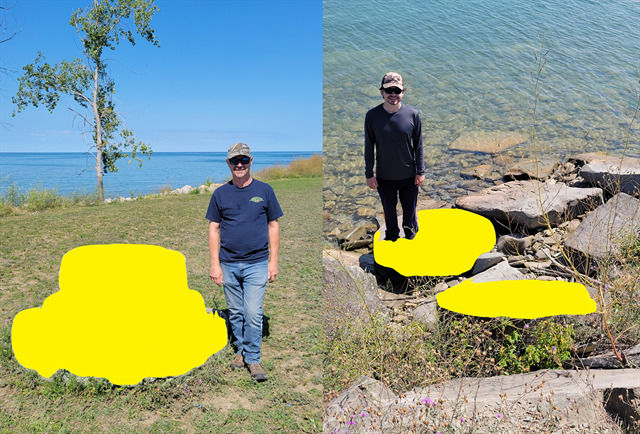
5: Post a pic of you or a signature item with the grindstone near the parking in the background. You don't need to include your face in the pic if you don't want to. You can also send me the pic through messenger if you don't want to post it with your log.
If you enjoyed this EarthCache, please consider giving it a favorite point.
WEATHERING PROCESS (TYPE)
Weathering falls into three types of processes - Physical, Chemical and Biological.
Physical
Physical Weathering breaks apart rocks without changing their chemical composition. Each fragment and particle weathered away by a mechanical process retains the same characteristics as the original rock.
TEMPERATURE - Different minerals expand and contract at varying rates. Temperature changes occur in both day-night and seasonal cycles. Frost shattering or ice wedging is due to the expansion of ice.
WIND - The abrasive action of wind causes separation of rock particles from the parent rock.
WATER - The abrasive action of water also causes separation of rock particles from the parent rock.
GRAVITY - As rocks tumble downward, abrasion causes separation of rock particles from parent rock.
Chemical
Chemical weathering occurs when water, air, and other substances react with the minerals in rock. In chemical weathering, the composition of the rock changes.
WATER - Water dissolves minerals in rocks, producing new compounds.
OXYGEN - Oxygen reacts with rocks, changing the color of rocks.
ACIDS - Produced when water reacts with the atmosphere.
LIGHTNING STRIKES - The immense energy completely changes the rock.
Biological
Living organisms contribute to mechanical weathering through the growth of roots or the burrowing of animals.
VASCULAR PLANTS (larger and grow out from the rocks) - Plant roots and seedlings sprouting in a crevice exert physical pressure as well as providing a pathway for water and chemical infiltration. The evidence that some soil is present is found in the plants which appear to be growing "out" of the rock. In reality, these plants have roots that are growing in soil that is located in the cracks of the rock.
NONVASCULAR PLANTS (smaller and cover surface of rocks) - Lichens and mosses grow on essentially bare rock surfaces and create a more humid chemical microenvironment. The attachment of these organisms to the rock surface enhances physical as well as chemical breakdown of the surface microlayer of the rock.
ANIMALS - There are many animals that break apart rocks, or consume rocks, for a variety of purposes, most of which ends up changing the rock in some way.
LOCAL GEOLOGY
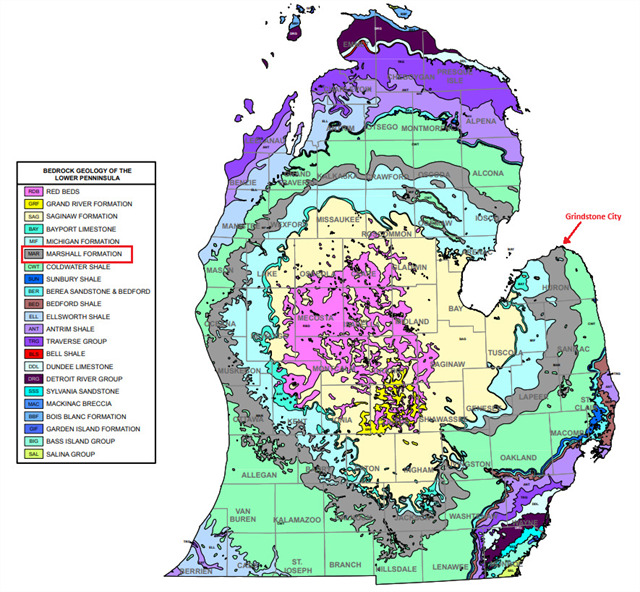
Grindstone City, Michigan, became a famous center for grindstone production due to the accidental discovery of the high-quality Marshall Sandstone formation in the area in 1834. This fine-grained sandstone was perfect for making large grindstones used to sharpen tools and mill grain, leading to a thriving industry in the 1850s and establishing the town as a major supplier. The Marshall Formation is a geologic unit dating back to the Mississippian period, known for its well-sorted sandstone, which can be fine- to coarse-grained and contains mica and clay in its softer cement.
MARSHALL FORMATION
The Marshall Formation originated around 330–340 million years ago, when rivers transported quartz-rich sand from the Appalachian highlands into the shallow Michigan Basin. As sea levels dropped during a regression, these sands spread across coastal plains, deltas, and shoreface areas, creating a widespread layer of sandstone over the deeper Coldwater Shale. Waves and currents then reworked the sediment, resulting in well-sorted, cross-bedded quartz sandstone. Subsequently, rising sea levels submerged the formation, depositing marine limestones and shales from the Michigan Formation on top.
The Marshall Formation lies above the Mississippian Coldwater Shale and reaches a maximum thickness of about 300 feet in its most prominent exposure in southern Michigan. It is primarily composed of sandstone made up of sharply angular quartz grains, bound together by a softer cement of mica, siderite, and clay. The formation exhibits faint cross-bedding, giving the rock a generally uniform appearance. It is divided into two sections: the upper Napoleon Sandstone Member and the lower member. The lower section is predominantly made up of fine-grained, greenish-gray sandstone with some interbedded siltstone.
GRADES
The rock is classified into two distinct grades: light and heavy, based on their properties. The light rock typically occurs at depths ranging from 12 to 15 feet, while the heavy rock is found below that from 20 to 25 feet. The rock layers vary in thickness, ranging from 2 to 3 inches up to 6 feet.
references
https://www.michigan.gov/
https://project.geo.msu.edu/geogmich/Grindstones.htm
https://www.wyorksgeologytrust.org/
https://www.livescience.com/
I have earned GSA's highest level:
 |