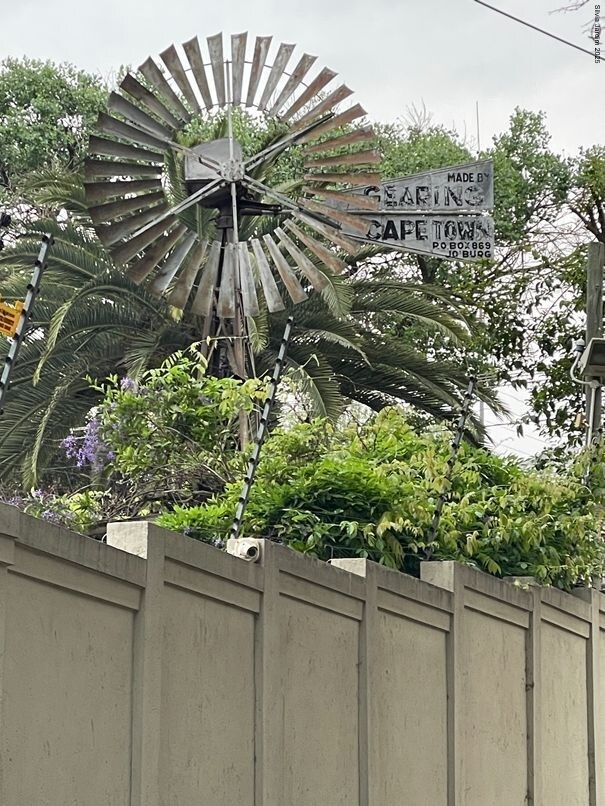
A new discovery of a windpump in the city. If you close your eyes, you can imagine the open space from the farms of yesteryear.
The cache is not hidden at the listed co-ordinates. You will need to work out the puzzle to calculate the final hiding place of this cache.
Please refer to the parking location, as there is no parking at the final hide.
PLEASE BE AWARE FOR YOUR OWN SAFETY AND KEEP AN EYE ON THE SECURITY PATROLS IN THE AREA.
Using the word WINDPUMP:
S26 03.(XXX)
Find the equivalent number for each consonant using a=1, b=2, c=3, etc. and add these all together. Add 4 to that number and add a zero in front - these will form the digits needed for XXX.
E28 03.(YYY)
Find the equivalent number for each vowel using a=1, b=2, c=3, etc. and multiply these numbers together. Add 232 to that number - these will form the digits needed for YYY.
To Confirm your calculation for the final is correct, make use of this handy geo-checker. Acknowledgement: geocheck.org.
I was fascinated to find a number of farm windpumps still standing in what is now developed suburbia. Through geocaching, I share my fascination with you. These Windpumps are a reminder of our farming days of yesteryear.
From South African photographer Chris Myburgh's website:
"The first records found of a windpump in South Africa, is from a painting drawn in 1848. Records were found of windpumps as from 1869 and the first import was in 1874. These were wooden constructions. The first all steel windpump was patented in 1855 in England."
There are a number of types of windpumps manufactured both locally and abroad. Each manufacturer has its own style and branding. You'll notice the Manufacturer's branding on the Wind Vane.
Windpumps (Windmills) are fondly referred to as "steel flowers" especially in the Karoo area where they can be found in abundance, providing much needed water to the farms.
Taken from the website: http://www.dwa.gov.za/groundwater/NORADToolkit/7.2%20Introductory%20Guide%20to%20Appropriate%20Solutions%20for%20Water%20and%20Sanitation.pdf
"What is a wind powered pump and how does it work?
Wind powered pumps use the energy generated by wind to lift groundwater to the surface. A rotor is mounted on top of a tower. The action of the wind turns the rotor, which through a gearbox drives a reciprocating shaft. This in turn drives the pump in the borehole.
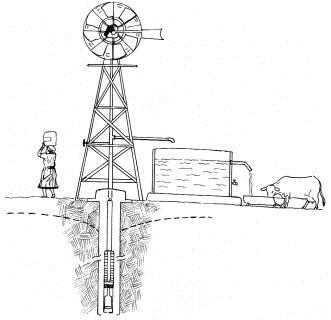
Wind pump adaptations
The air-lift groundwater pump was developed to provide a low-cost pump for use in informal and rural settlements. This pump system can be operated with tyre pumps. It has a wind pack compressor, capable of storing wind energy as compressed air. This provides supplementary power to the pump. All the working parts of this pump are located above ground, making maintenance easy.
Wind pump requirements
The pump requires sufficient wind speeds for significant lengths of time. The wind pump must therefore be placed where there is a clear sweep of wind. Also, the borehole should provide enough water so that continuous pumping does not result in excessive drawdown. Storage for several days must be provided to cater for calm periods when there is insufficient wind speeds to pump water. Further, someone must be delegated to apply the manual brake to avoid damage during storms.