How Hard Can It Be?
Learning Objectives (Specific Requirements Below)
To complete this Earthcache, you will be required to visit two locations. At each location, you will observe the textures, colors, and components of the rocks. Then you will conduct Mohs scratch resistance tests to determine if the rocks display similar hardness results.
Lake Fairfax Rock Formation
Lake Fairfax and its surrounding lands are built upon schist associated with the Western Piedmont Geological Region, with the edge of the Culpeper Mesosoic Basin presenting itself - and probably delivering most of the rocks visible at ground zero and the nearby area. The primary component of this region is schist, a metamorphic rock (rocks formed - morphed - under intense heat, pressure, or a combination of those) and typically well known for its hardness (well, it is a rock!)
Mohs Hardness Scale
In 1812, Friedrich Mohs introduced a 10-point hardness scale. Working from what was available, he designated 1 as the hardness of talc and 10 as the hardness of diamond. As it turns out, his scale comes closer to being a logarithmic scale when compared to more modern and quantitative hardness scales. Fortunately, for the purposes of this geological lesson, Mohs-based comparisons works well.
How Hard is Schist?
Schist typically has a hardness of 4 on the Mohs scale, comparable to marble and calcite. However, the intrusive minerals in schist can raise the local hardness level to the 5-6 range, particularly if feldspar is a primary intrusive mineral. On the other hand, if gypsum or talc are more prevalent, then the schist hardness can lower to closer to 1.
How Do We Know?
Since the Mohs scale is based upon the scratch resistance of materials (its use is not limited to rocks and minerals), you can test hardness by using other materials - rocks, sticks, keys, fingernails - and using their hardness to learn about hardness of the material of interest. In general, if your known material can scratch your test material, then you learn that the test material is softer (lower score) than the known material.
These examples and their hardness scores might be useful to you:
- fingernail (2.5)
- penny (3.5)
- pocket knife (5.0)
- steel nail (6.5)
- quartz (7.0)
- diamond (10)
Science at the Tip of Your Finger(nail)
|
Posted Coordinates
You should be in a rock "valley" with the outcrop exposed on both sides of the trail. Observe the rock wall and note the colors and texture of the schist and its components. Recall that typically schist is harder when it is purer. Once you have made your observations, then attempt to estimate the Mohs hardness of the rock in the wall - using just your finger.
|
 |
|
Rocks and Roots (Waypoint)
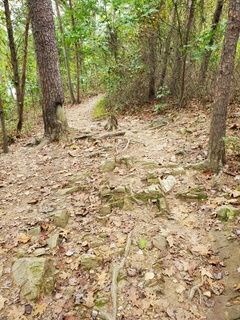
On the main trail, you will be able to observe the rock that serves as the bed of the trail. In one section, the rock is completely exposed. Within a few feet, another section is almost totally obscured by tree roots crossing the trail. Complete the same type of observations on these trail locations as you did in the valley. You are attempting to determine if the hardness of the rock along the trail differs from the valley rock. In particular, how significant is it for determining rock hardness that the root structures are not going through the rock?
|
 |
Logging Requirements
Either by messaging through the site or sending an e-mail to the cache owner, please submit your responses to the following questions. While you can log your find prior to receiving confirmation, the cache owner reserves the right to delete logs that are not supported by a message with good responses.
- At posted coordinates,
(a) Describe the textures and colors of the rock face and its components and what they indicate regarding the hardness of the rock.
(b) determine if the Mohs hardness is less than or greater than 2.5
- At the Rocky Roots waypoint,
(a) Describe the textures and colors of the trail floor and its components and what they indicate regarding the hardness of the rock.
(b) determine if the Mohs hardness is less than or greater than 2.5
- OPTIONAL (extra credit) If your hardness results are different between the two sites,
(a) What is your explanation for almost adjacent rocks having different hardness results?
(b) Would you expect tree roots to penetrate the valley rock wall?
REQUIRED Photo. When posting your log, include a photo at ground zero that indicates you were there.
Permission
The Administrator of Lake Fairfax Park has granted permission for this cache. The Earthcache is only available during park hours (typically sunrise to sunset), so no night caching.
References
- The Geology of Virginia - Piedmont
- Virginia Division of Geology Rocks of Virginia
- Mohs Hardness Scale
