ABOUT THIS EARTHCACHE
This EarthCache will bring you to some Silurian Limestone boulders that were quarried locally, as little as a couple miles down the road. You will be looking at what this limestone is made of, how it formed and what lived in it over 400 million years ago.
LOGGING REQUIREMENTS
In order to log this EarthCache, send me your answers to the following questions either through email or messaging from my profile page.
At the posted coordinates,
1: Does the limestone appear to be more clay/mud (Argillaceous) based or sand/silt (Siliciclastic) based?
2: Describe any fossils you see on any of the boulders.
3: Estimate how many crescent-shaped pits are present per square foot.
4: Based on your answers above, how would you describe the conditions and life present when these boulders were deposited?
5: Post a pic of you or a signature item with the boulders in the background. You don't need to include your face in the pic if you don't want to. You can also send me the pic through messenger if you don't want to post it with your log.
If you enjoyed this EarthCache, please consider giving it a favorite point.
SILURIAN PERIOD
The Silurian Period, part of the Paleozoic Era (443.8 to 419.2 million years ago), was characterized by rising sea levels due to melting glaciers, leading to flooded continental interiors and thriving coral reefs. Earth's climate stabilized, a protective ozone layer developed, and significant mountain-building (the Caledonian orogeny) occurred as continents drifted together to form Euramerica. On land, vascular plants appeared, and terrestrial arthropods like centipedes and spiders emerged, while in the seas, jawed fishes diversified, and Eurypterids (sea scorpions) became dominant.
SILURIAN KEYSER LIMESTONE
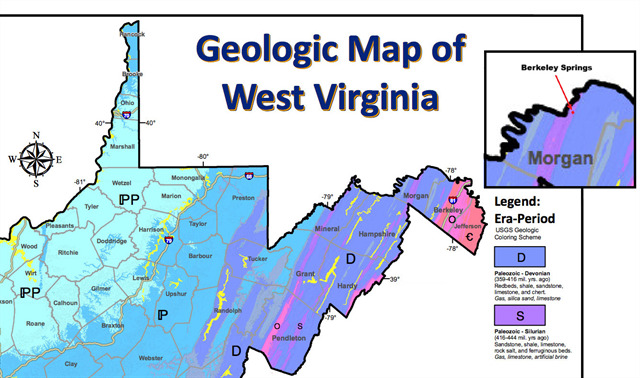
The Silurian Keyser Limestone Formation is a fossiliferous limestone deposit of Late Silurian and Early Devonian age, characterized by various shallow marine sediments like calcarenite and argillaceous calcisiltite. Found in the eastern Appalachian Basin from Pennsylvania to Virginia, it represents patch reef environments and preserves a variety of shallow marine facies, including tidal flats, lagoons, and open marine shelves, indicated by the presence of stromatolites, ostracodes, brachiopods, and crinoids.
The Keyser Limestone is primarily composed of the minerals calcite and dolomite, which are calcium carbonate and calcium-magnesium carbonate, respectively. However, it is also often characterized by its fossil content and includes other materials such as argillaceous (clayey) and sandy (siliciclastic) components, forming different types of limestone, such as calcarenites (sandy limestone), calcisiltites (silt-sized limestone), and argillaceous limestones.
Argillaceous Material: This refers to clay or mud, which can be mixed with the limestone.
Siliciclastic Material: This includes sand-sized or silt-sized particles, which can result in rocks like calcarenites (sandy limestone) or calcisiltites (silt-sized limestone).
Fossils: The Keyser Limestone is known for being fossiliferous, containing abundant fossils such as brachiopods, bryozoans, crinoids, and stromatoporoids, which become part of the rock.
BRACHIOPODS
 |
 |
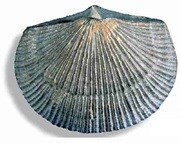
Brachiopods are marine animals characterized by a pair of hinged shells (valves) and a feeding organ called a lophophore, often called "lamp shells" for their appearance. Unlike bivalve mollusks, the two brachiopod shells are symmetrical along a vertical plane but not mirror images, and they have different internal anatomy, with each shell having its own right-left symmetry. They have an excellent fossil record, with their peak abundance in the Paleozoic Era, though a few species still live in deep, cold waters today. |
CRESCENT-SHAPED PITS
The crescent-shaped pits in the Silurian Keyser Limestone are likely bioturbation structures, formed by burrowing marine organisms. These pits represent the preserved traces of ancient animal activity on the seafloor, not the actual fossils of the animals themselves. The pits are associated with trace fossils left by deposit-feeding invertebrates, such as worm-like creatures or other infaunal animals that lived in the muddy sediment. The sediments of the Keyser Limestone were deposited in shallow marine environments, including tidal flats and lagoons. These are common settings for organisms that dig and disturb the soft seafloor sediment. Intense bioturbation can also destroy other sedimentary features, like laminations. In addition to crescent shapes, Keyser Limestone biogenic structures are often described as lumpy, irregular, or nodular. The crescent shape is one common form for burrows, representing a cross-section of a curved or J-shaped burrow tunnel.
references
https://www.ccgms.org/a-walk-through-geologic-history-the-silurian-period/
https://ngmdb.usgs.gov/Geolex/UnitRefs/KeyserRefs_2312.html
https://en.wikipedia.org/wiki/Silurian
I have earned GSA's highest level:
 |