Welcome to this Earthcache, press on this text to continue to read the english version!
Nålsögat på Marstrand – En geologisk betraktelse
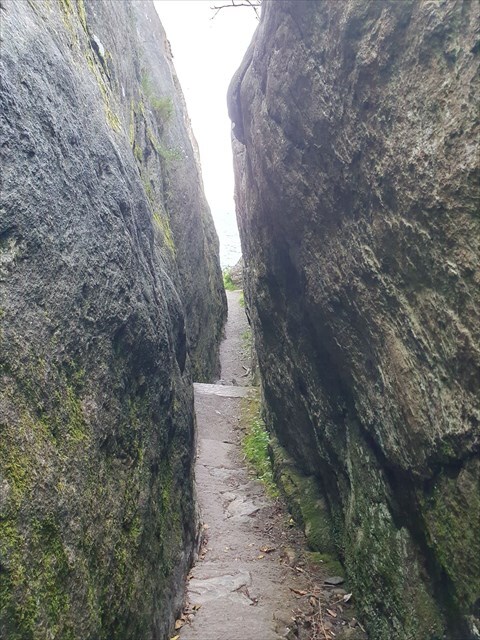
Nålsögat är en smal, naturlig passage i berget på ön Marstrand, belägen i Bohusläns kustlandskap på Sveriges västkust. Platsen är inte bara spektakulär ur ett landskapsperspektiv, utan också av stort geologiskt intresse. Den dramatiska sprickan som utgör Nålsögat skär genom hård, urbergsgnejs och utgör ett tydligt exempel på den geologiska historia som format Bohuslän under mer än en miljard år.
Sprickan som bildar Nålsögat är sannolikt ett resultat av Erosion alternativt tektonisk sprickbildning kombinerat med frostsprängning (nednötning). Efter att de stora urbergsblocken lyftes upp och exponerades vid ytan genom erosion, utsattes de för det nordiska klimatets växlingar. Vatten trängde ner i sprickor i berget, frös under vintern och utvidgades, vilket med tiden vidgade sprickorna, ett typiskt exempel på fysikalisk vittring (nednötning).
Glacial påverkan
Under istiderna täcktes området av inlandsisar som slipade och formade landskapet ytterligare. Isens rörelser följde ofta redan existerande svaghetszoner i berggrunden, som exempelvis sprickor och förkastningar. Nålsögat kan mycket väl ha vidgats ytterligare under denna period, när is och moränmaterial trycktes genom sprickorna, vilket förstärkte dess form och struktur.
Geomorfologiskt värde
Idag utgör Nålsögat en unik landform som visar samspelet mellan berggrundens struktur, klimatets påverkan och glaciala krafter. Det är ett utmärkt exempel på hur sprickor i kristallina bergarter kan utvecklas till dramatiska geomorfologiska formationer. För geologistudenter och naturintresserade är platsen en tydlig illustration av begrepp som sprickbildning, vittring, erosion och tektonik.
Loggnings instruktioner
>
För att kunna logga cachen skall du svara på följande frågor:
1. Beskriv hur sprickan ser ut, är den rak eller sne och bred eller smal? Fundera över vilka naturliga processer som kan ha skapat just denna klyfta i hårda berget.
2. Nu ska vi fundera lite över sprickans uppkomst, vilken orientering har sprickan vid koordinaterna? Hur ser väggarna i sprickan ut, vad kan du dra för slutsats kring bildningen?
För att logga cachen skall du maila svaren till mig via min profilsida (länk.) Alternativt skicka svaren till aa1124aa@outlook.com Vid eventuella fel så kontaktar jag dig.
Du behöver inte vänta på svar från mig för att logga!
[English]
The Eye of the Needle on Marstrand – A geological reflection
The Eye of the Needle (Nålsögat) is a narrow, natural passage in the bedrock on the island of Marstrand, located in the coastal landscape of Bohuslän on Sweden’s west coast. The site is not only spectacular from a scenic point of view but also of great geological interest. The dramatic fissure that forms the Eye of the Needle cuts through hard Precambrian gneiss and provides a clear example of the geological history that has shaped Bohuslän for more than a billion years.
The crack that forms the Eye of the Needle is most likely the result of erosion or tectonic fracturing combined with frost weathering. After the large bedrock blocks were uplifted and exposed at the surface through erosion, they were subjected to the variations of the Nordic climate. Water seeped into cracks in the rock, froze during the winter, and expanded gradually widening the fissures. This is a typical example of physical weathering.
Glacial Influence
During the ice ages, the area was covered by continental ice sheets that further polished and shaped the landscape. The movement of the ice often followed existing zones of weakness in the bedrock, such as cracks and faults. The Eye of the Needle may well have been widened further during this period, as ice and moraine material were forced through the fractures, enhancing its form and structure.
Geomorphological Value
Today, the Eye of the Needle represents a unique landform that illustrates the interaction between bedrock structure, climatic influences, and glacial forces. It serves as an excellent example of how fractures in crystalline rocks can evolve into dramatic geomorphological features. For geology students and nature enthusiasts, the site provides a vivid illustration of concepts such as fracturing, weathering, erosion, and tectonics.
Logging tasks
To log:
1. Describe what the crack looks like, is it straight or slanted, and is it wide or narrow? Consider which natural processes may have created this particular fracture in the hard rock.
2. Now let’s think about how the crack was formed, what is the orientation of the crack at the given coordinates? What do the walls of the crack look like, and what conclusions can you draw about its formation?
To log, send the answer to me from my profile page (link.) Or send your answer to aa1124aa@outlook.com I Contact you if somthing is wrong. You dont need to wait on answer from me to log!