
Welcome to this EarthCache! Unlike traditional geocaches, there is no physical container to find. Instead, you are here to observe a unique geological feature and answer questions about what you see. You will also need to take a photograph to claim the find. This EarthCache focuses on pegmatite, a type of igneous rock related to granite, and will help you understand how it forms, why some of its crystals are unusually large, and what forces influence its development. All observations can be made safely from the roadway - there is no need to walk on any graves. Parking is available nearby.
EarthCache Requirements
As with all EarthCaches, I do not expect technical, PhD-level answers. Your goal is to carefully observe, think about what you see, and enjoy learning something new. If you are completing the EarthCache with multiple caching names, please include all usernames in your responses. Individual submissions are not required.
To claim a find, send your answers to the questions below via the email or Message Center link at the top of this page, and include your required photograph in your online log. I will contact you only if clarification is needed.
Observational Task
At the posted coordinates, you will see a large, distinctive gravestone for the Beaulne family. This monument contains unusually large crystals that make it a striking example of porphyritic texture in granite. Take some time to examine the stone and notice the size, colour, and shape of the crystals embedded in the rock.
Questions to Answer
-
Observe the Beaulne monument and note the colours of the crystals. What colour are the largest crystals, and how large is the biggest one you can identify?
-
Look at two or three other granite monuments nearby (Macleaoud, Schelstrate, MacNab, etc). Compare the crystal sizes, colours, and textures. What differences make the Beaulne monument stand out from the others in the area?
-
Based on your observations and the description below, do you believe the large crystals are phenocrysts? What do you think these are made of? Explain your reasoning (colour, shape, size, etc).
-
Mandatory: Take a photograph of yourself, your GPS, your hand, or a signature item with the monument visible in the background. Faces are optional, but each cacher must upload their own photo.
Geology Lesson: Pegmatite, Granite, and Phenocrysts
Pegmatite is a type of igneous rock closely related to granite, distinguished primarily by its extremely large crystals. These large crystals form under conditions where the magma cools very slowly, usually deep within the Earth’s crust, allowing certain minerals to grow to sizes far larger than those in typical granite. While granite is composed of similar minerals—mainly quartz, feldspar, and mica—pegmatites often have crystals several centimetres or more in length, making them visually striking and scientifically interesting.
Many pegmatites display a porphyritic texture, meaning the rock contains crystals of very different sizes. The largest crystals, called phenocrysts, are embedded in a finer-grained matrix known as the groundmass.

The formation of phenocrysts occurs through a process called fractional crystallization. As magma slowly cools deep underground, minerals with the highest melting points crystallize first, forming large, well-developed crystals. The remaining melt, now enriched in other elements, cools more quickly, producing the smaller-grained matrix that surrounds the phenocrysts. In some cases, if the density of the phenocrysts and the remaining melt are similar, or if the magma is erupted suddenly, the phenocrysts remain suspended in the rock rather than settling, preserving the porphyritic texture.
Not all granite or pegmatite develops phenocrysts. Their presence depends on a combination of factors, including the rate of cooling, the chemical composition of the magma, and the amount of space available for crystals to grow. Slow cooling, high silica content, and low viscosity promote the development of large phenocrysts. In contrast, rapidly cooled magmas or magmas with high water content may produce a finer-grained, aphyric texture with few or no phenocrysts. Large phenocrysts are commonly observed in pegmatites from regions such as Brazil, India, Japan, and parts of North America, where long-lived granitic plutons allow extended cooling periods.
Phenocrysts can be composed of different minerals, and careful observation can help you distinguish them. Potassium feldspar phenocrysts are usually pink, reddish, or salmon-coloured and often have a blocky, tabular shape. Quartz phenocrysts tend to be grey, translucent, and irregular or hexagonal, without cleavage planes. Mica phenocrysts, such as biotite or muscovite, are dark brown, black, or silvery and appear as thin, platy flakes that reflect light. The type of phenocryst you observe can tell you about the mineral composition of the original magma and the conditions under which the rock crystallized.
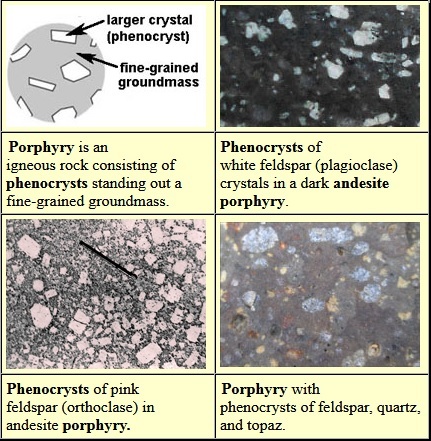
The porphyritic texture seen in rocks like the Beaulne monument is significant because it provides a record of the cooling history of the magma. Large phenocrysts indicate that the magma cooled slowly at depth before the remaining melt solidified more rapidly. The presence of multiple phenocryst types or particularly large crystals indicates that the magma had time to differentiate chemically, allowing certain minerals to concentrate and grow. This texture was first recognized as a key indicator of multi-stage cooling by the Canadian geologist Norman L. Bowen in 1928, who showed that it reflects the sequential crystallization of minerals from magma.
Finally, rocks are often classified based on the type, size, and abundance of phenocrysts. Aphyric rocks have few or no phenocrysts, while phyric or porphyritic rocks have more than 1% phenocrysts. In the case of the Beaulne monument, the rock is likely a potassium feldspar-rich granite, with large feldspar phenocrysts embedded in a finer-grained matrix.

Important Visitor Information
Please remember:
-
The cemetery is closed from dusk until 8:00am. Do not attempt this EarthCache outside of these hours.
-
Be respectful at all times. This is an active burial ground.
-
Stay on established paths, keep noise low, and do not disturb flowers, memorials, or visitors.
-
Follow all posted cemetery rules while completing the EarthCache.
Thank you for treating this space with care and reverence.
AI Content Disclosure
Some of the descriptive text and/or images on this page were created with the assistance of artificial intelligence tools. All information has been reviewed, verified, and edited by the cache owner for accuracy and clarity.
Placed by a Proud Platinum EarthCache Master.
