Duncolm is a hill in Scotland. It is the highest point in both West Dunbartonshire and the Kilpatrick Hills, at an elevation of 401 metres. The most common route to the summit is to use the walkers car park in Old Kilpatrick and follow the reservoir track to Loch Humphrey. From here there is an easy path to the summit, although it is likely to be boggy in places. Hillbaggers can enjoy three subsidiary peaks, on the way up, a small detour to the North allows you to bag Fynloch Hill, whilst Little Duncolm and Middle Duncolm can both be passed over on route to Duncolm summit (they can also be bypassed). Trig enthusiasts can incorporate a visit the 'The Slacks' into a circular route allowing two trigs to be visited on a scenic 9.5 mile walk.

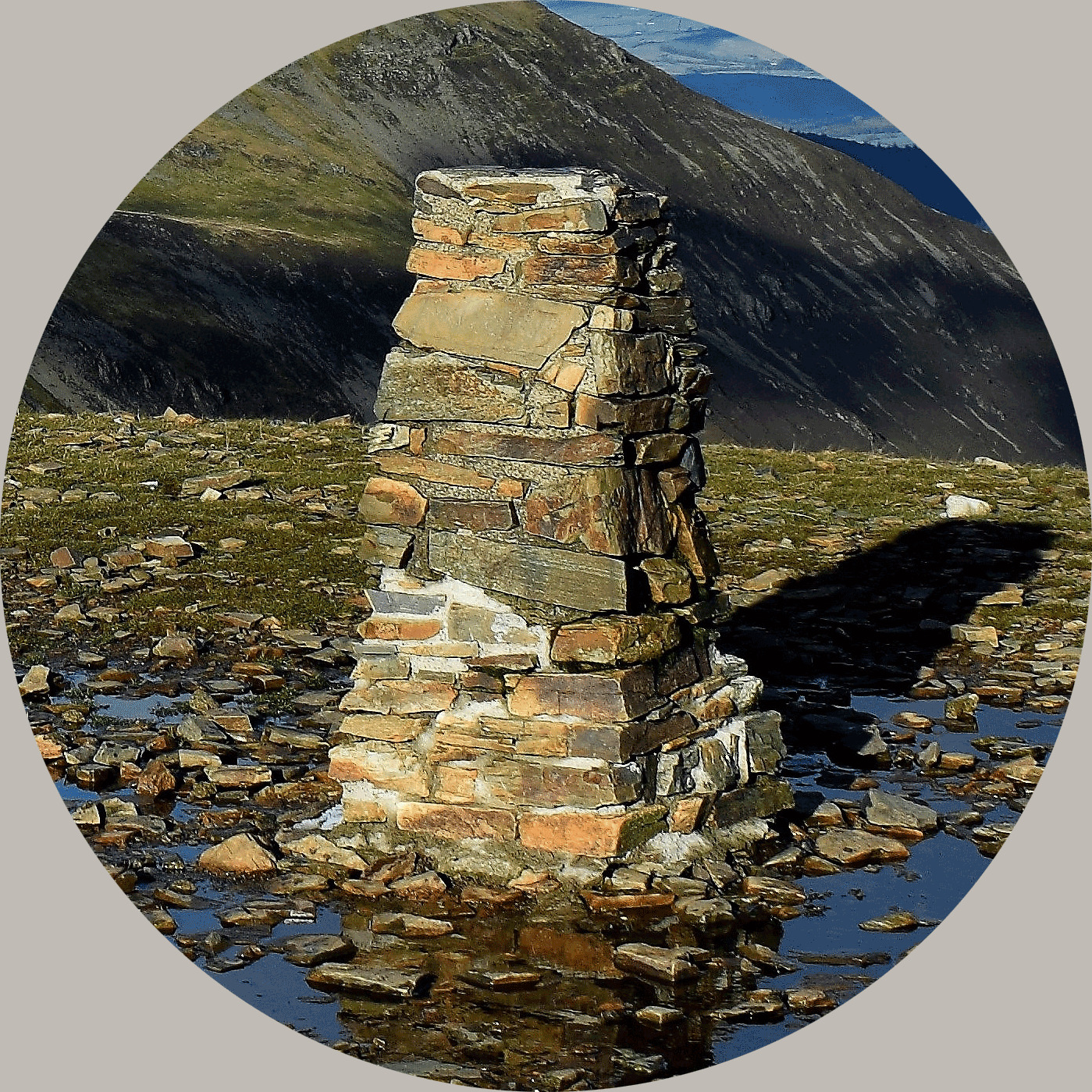
Duncolm is topped by a trigpoint pillar, completed in March 1946 costing £8.8s.6d. It was computed as tertiary triangulation station NS77/T212 in 1947 and was levelled for height in 1952. It was last maintained by the OS in October 1971 and at the time of placing this hide, remained in good condition. The summit offers fine views over the Kilpatrick Hills, and across to Loch Lomond and a direct line of site to the trigpoint on Ben Lomond. You can also look the other way to see Glasgow peeking out from behind the Kilpatrick Hills.
The container itself is found a short distance from the trigpoint. You will need to drop slightly and look for a suitable gap between the rocks for a small clip top container. Be cautious to replace it correctly and don't push it out of reach. Providing the container is carefully replaced as found, wedged into the gap, there is no reason it won't remain here for many years for others to enjoy. Thank you for your help, please enjoy your visit.
About Ye Ole Survey Monuments
|
 |
Ye Ole Survey Monument (YOSM) is a captivating series of caches that pays homage to the remarkable legacy of OutForTheHunt's YSM series (GC45CC).
YOSM caches are strategically positioned at or near Trig Points. These triangulation stations have played a pivotal role as surveying landmarks, contributing to the mapping of expansive territories.
Some of these points, bearing historical significance, might now be situated on private land or have vanished with time. As a result, the caches are artfully placed in close proximity, reverently acknowledging the historical importance of these survey monuments.
|
More information, bookmarks and statistics can be found at the YOSM Website
If anybody would like to expand the Ye Ole Survey Monuments Series, please do.
I would ask that you request a number for your cache first at www.yosm.org.uk
so we can keep track of the numbers and names to avoid duplication.