Glade of Light

The Glade of Light was designed to be a living memorial, commemorating the victims of the 22 May 2017 terrorist attack at Manchester Arena.
A white marble ‘halo’ ring stands at the heart of the memorial, it honours the 22 people whose lives were taken, as well as remembering everyone
who was left injured or affected. A tranquil garden space for remembrance and reflection, its peaceful surroundings are intended as the setting for
commemorative events in the city relating to the attack.
Logging Requirements (Questions to Answer)
Compulsory tasks in order to log a find against this EarthCache, you will need to visit GZ and make some observations and then answer some questions and send answers to me via my Geocaching profile or through the Messenger Centre.
1) Look for Marcin Klis. Describe the bands/band of impurities that run though the surname.
2) What colour are the bands of impurities?
3) What mineral do you think made the impurities appear this colour?
4) Why do you think marble was used for this memorial?
5) Where does marble rate on the Mohs hardness scale
6) Also include in your log a photograph of you, your GPS or another identifiable item near GZ, taking care not to include anything in the photo that may give away your answers.
Marble
Marble is a rock resulting from metamorphism of sedimentary carbonate rocks, most commonly limestone or dolomite. Metamorphism causes variable recrystallization of the original carbonate mineral grains. The resulting marble rock is typically composed of an interlocking mosaic of carbonate crystals.
Pure white marble is the result of metamorphism of a very pure limestone or dolomite protolith. The characteristic swirls and veins of many colored marble varieties, sometimes called striations, are usually due to various mineral impurities which were originally present as grains or layers in the limestone. Green coloration is often due to serpentine resulting from originally magnesium-rich limestone or dolomite with silica impurities, the presence of iron oxides may produce shades ranging from red to orange, other minerals can cause the colours below.
Iron Oxide - Red or Orange
Iron and Feldspar - Pink or Red
Serpentine - Green
Chlorite - Green
Graphite - Black/Grey
Muscovite - Specks of silver
Biotite - Specks of black
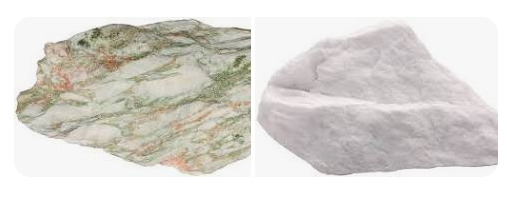
Compare the to two photos above, marble on the left has green and orange impurtities formed during metamorphism. The marble on the right has no impuritues..
Types of vein patterns
- Linear Veins: Long, narrow, and often evenly spaced or randomly distributed.
- Branching Veins: Resemble tree branches or capillaries, spreading out from a single point.
- Wavy Veins: Create a dynamic, zigzag or curved movement across the stone's surface.
- Feathered Veins: Delicate, intricate patterns that look like feathers or fern fronds.
Factors that influence the final pattern
- Intensity of pressure and heat: Turbulent geological conditions create bolder, more dramatic veins, while more consistent conditions may lead to more uniform patterns.
- Impurities: The type and distribution of mineral impurities are major factors in determining the color and shape of the veins.
- Cutting method: How the slab is cut affects how the veins are seen:
- Vein cut (or cross cut): Shows long, stripe-like patterns as the slab is cut lengthwise along the geological layers.
- Cross cut: Produces a less regular, more swirling, and intricate pattern as it is cut perpendicular to the geological layers.
Composed mainly of calcite, marble has a hardness of three on the Mohs hardness scale. This makes marble easy to carve, making it useful for producing sculptures and ornamental objects. The appearance of marble makes it especially attractive for many types of monuments and sculptures.
