
Sedimentäre Enklave im Sandstein des Paderborner Doms
Einleitung:
Der Paderborner Dom (Hoher Dom zu Paderborn) ist eines der bedeutendsten sakralen Bauwerke in Norddeutschland. Seine Wände bestehen überwiegend aus Sandstein, einem Sedimentgestein, das vor Millionen von Jahren durch die Ablagerung von Sandkörnern in Flüssen, Seen oder flachen Meeren entstanden ist. Dieses Material ist nicht nur ästhetisch, sondern auch geologisch faszinierend, da es Spuren uralter Prozesse bewahrt.
Im Sandstein können sich Enklaven befinden – kleine Fragmente anderer Gesteine oder Mineralien, die vor der Verfestigung in das Sediment gelangten. Diese Enklaven sind „Inseln“ aus unterschiedlichem Material, die uns helfen zu verstehen, wie sich das Gestein gebildet hat.
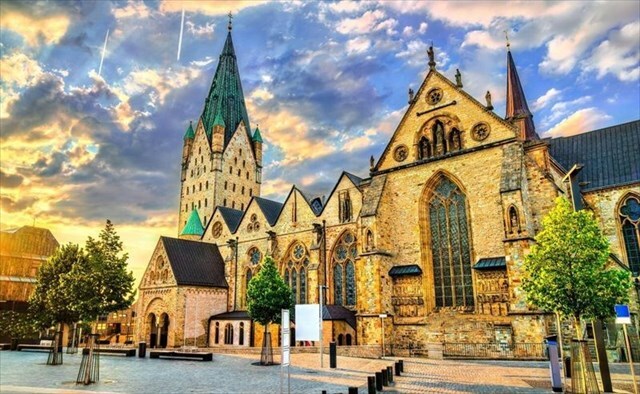
(source of photo: https://www.domradio.de/video/pontifikalamt-mit-udo-bentz-am-libori-sonntag-im-paderborner-dom)
Was ist Sandstein?
- Definition: Sandstein ist ein Sedimentgestein, das aus Sandkörnern (0,063–2 mm) besteht, die durch natürliches Bindemittel (Siliziumoxid, Kalk oder tonige Substanzen) zusammengehalten werden.
- Farbe: Abhängig von der mineralischen Zusammensetzung – von Weiß über Gelb bis Rot (Eisenoxid).
- Entstehung: Ablagerung von Sand in wasserreichen Umgebungen, anschließend Verdichtung und Zementation.
- Fossilien: Im Sandstein können Spuren von Leben (Pflanzen, Tiere) erhalten bleiben.
- Beständigkeit: Sandstein ist fest, aber porös, was ihn für Bauwerke geeignet macht, jedoch anfällig für Verwitterung.
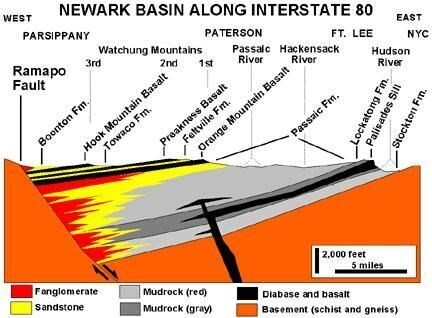
(source of photo: https://sk.wikipedia.org/wiki/S%C3%BAbor:Newark_Basin_Cross_Section.jpg)
Sedimentäres Ablagerungsgestein
Sedimentbecken (Becken) sind Bereiche, in denen sich große Mengen an Sedimenten ansammeln. Während der Sedimentationsprozesse entstehen hier auch Enklaven. Sie entstehen durch verschiedene Mechanismen und werden nach dem tektonischen Umfeld unterteilt in:
- divergente Ränder,
- kollisionsbedingte,
- Transformstörungen,
- intrakontinentale,
- hybride und exotische.
Ihre Größe reicht von einigen hundert Metern bis zu mehreren tausend Kilometern auf dem Meeresboden. Die Entwicklung eines Beckens verläuft in Zyklen, die durch die Tektonik vor und nach der Sedimentation sowie durch die abgelagerten Gesteinssequenzen beeinflusst werden.
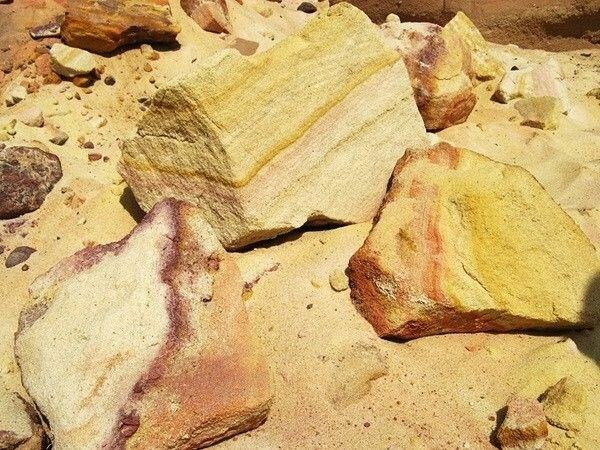
(source of photo: https://sk.wikipedia.org/wiki/Pieskovec)
Parameter des Sedimentationsumfeldes
Das Sedimentationsumfeld wird durch physikalische, biologische und chemische Faktoren beeinflusst.
Die wichtigsten sind:
- Transportmedium – bestimmt die Bewegung der Sedimente:
- Dünnflüssig (z. B. Wasser, Luft)
- Halbflüssig (Gemische mit festen Partikeln)
- Fest (Gletscher, Schuttströme)
- Sedimentationstiefe – Flachwasser-Sedimente werden durch Wellen ständig umgelagert, Tiefseesedimente werden durch gravitative Strömungen beeinflusst. Fossilien helfen, das Umfeld zu bestimmen.
- Wassertemperatur – beeinflusst die Löslichkeit von Mineralien und Gasen (z. B. CO₂ und CaCO₃).
Weitere Faktoren: Wind, Wasserströmung, Sonneneinstrahlung, Relief des Meeresbodens, Corioliskraft.
Was ist eine sedimentäre Enklave?
Eine sedimentäre Enklave ist ein kleiner Block oder ein Fragment eines anderen Materials (z. B. toniges Sediment, Mineralansammlungen), das im Sandstein eingeschlossen ist.
- Wie entsteht sie: Beim Ablagern von Sand gelangt ein Teil eines anderen Materials in das Sediment, das später zusammen mit dem Sand verfestigt wird.
- Wie erkennt man sie: Durch eine andere Farbe, Textur oder Struktur im Vergleich zum umgebenden Sandstein.
- Bedeutung: Sie zeigt den Kontrast zwischen zwei geologischen Umgebungen.
Warum ist das interessant?
- Der Sandstein im Paderborner Dom stammt aus lokalen Lagerstätten und spiegelt die Geologie der Region wider.
- Enklaven und die Textur des Gesteins erzählen uns eine Geschichte über die Umgebung, in der sich das Gestein gebildet hat.
- Die Beobachtung von Enklaven hilft, die Dynamik der Sedimentation zu verstehen – ob sie ruhig oder turbulent war.
Tipps zum Finden von Enklaven im Sandstein des Paderborner Doms:
- Schauen Sie an Stellen, an denen die Steine weniger präzise bearbeitet sind (z. B. untere Teile der Wände oder Ränder).
- Enklaven können wie dunklere oder hellere Flecken aussehen oder kleine „Inseln“ mit abweichender Struktur darstellen.
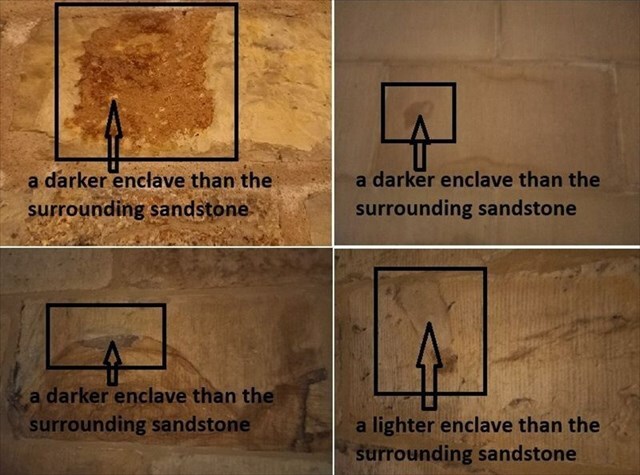
(source of photo: by me)
Wie loggt man diesen Cache:
Um diesen Cache zu loggen, machen Sie ein Foto von sich selbst oder einem persönlichen Gegenstand an den angegebenen Koordinaten. Außerdem müssen Sie die folgenden Fragen beantworten und mir die Antworten per E-Mail über Ihr Profil zusenden:
1. Beobachtung und Identifizierung
Aufgabe: Finden Sie an der Wand des Paderborner Doms mindestens eine Enklave im Sandstein.
Frage: Woran haben Sie sie erkannt?
2. Materialvergleich
Frage: Wodurch unterscheidet sich die sedimentäre Enklave vom umgebenden Sandstein?
a) Farbe
b) Korngröße
c) Mineralzusammensetzung
d) Alle genannten Möglichkeiten
3. Entstehungsprozess
Frage: Wie gelangte die Enklave in den Sandstein?
a) Entstand durch Verwitterung des Sandsteins
b) War Teil des Sediments vor der Verfestigung
c) Entstand bei der Bearbeitung des Steins
d) Ist ein künstlicher Eingriff
4. Geologische Bedeutung
Frage: Warum sind sedimentäre Enklaven für Geologen wichtig?
a) Helfen, das Alter des Gesteins zu bestimmen
b) Zeigen den Kontrast zwischen Sedimentationsumgebungen
c) Dienen als Quelle für Fossilien
d) Haben keine Bedeutung
5. Lokalisierung und Dokumentation
Aufgabe: Wählen Sie eine gefundene Enklave und beschreiben Sie:
- Form: (rund, unregelmäßig)
- Größe: (ungefährer Durchmesser in cm)
- Farbe: (heller, dunkler, andere Schattierung)
- Textur: (glatt, körnig, geschichtet)
6. Foto:
Aufgabe: Fügen Sie ein Foto von sich an den Koordinaten mit einer Enklave hinzu. Schüchterne Geocacher können auch ein Foto mit einem persönlichen Gegenstand oder ihrem Nicknamen auf einem Zettel oder auf der Hand beilegen.

Sedimentary Enclave in the Sandstone of Paderborn Cathedral
Introduction:
Paderborn Cathedral (Hoher Dom zu Paderborn) is one of the most significant sacred buildings in northern Germany. Its walls are built mainly of sandstone, a sedimentary rock that formed millions of years ago through the deposition of sand grains in river, lake, or shallow marine environments. This material is not only aesthetically pleasing but also geologically fascinating, as it preserves traces of ancient processes.
Within the sandstone, enclaves can be found – small fragments of other rocks or minerals that entered the sediment before it solidified. These enclaves are “islands” of different material that help us understand how the rock was formed.
(source of photo: https://www.domradio.de/video/pontifikalamt-mit-udo-bentz-am-libori-sonntag-im-paderborner-dom)
What is Sandstone?
- Definition: Sandstone is a sedimentary rock composed of sand grains (0.063–2 mm) that are bound together by natural cement (silica, limestone, or clay substances).
- Color: Depends on mineral composition – from white through yellow to red (iron oxide).
- Formation: Deposition of sand in water environments, followed by compaction and cementation.
- Fossils: Sandstone can preserve traces of life (plants, animals).
- Durability: Sandstone is strong but porous, making it suitable for construction, yet sensitive to weathering.
(source of photo: https://sk.wikipedia.org/wiki/S%C3%BAbor:Newark_Basin_Cross_Section.jpg)
Sedimentary Depositional Rock
Sedimentary basins are areas where large amounts of sediments accumulate. During sedimentation processes, enclaves can also form here. They originate through various mechanisms and are classified according to the tectonic setting into:
- divergent margins,
- collisional,
- transform fault-related,
- intracontinental,
- hybrid and exotic.
Their size ranges from hundreds of meters to several thousand kilometers on the ocean floor. The development of a basin occurs in cycles, influenced by tectonics before and after sedimentation, as well as by the deposited rock sequences.
(source of photo: https://sk.wikipedia.org/wiki/Pieskovec)
Parameters of the Sedimentary Environment
The sedimentary environment is influenced by physical, biological, and chemical factors.
The most important are:
- Transport medium – determines the movement of sediments:
- Fluid (e.g., water, air)
- Semi-solid (mixtures with solid particles)
- Solid (glaciers, debris flows)
- Depth of sedimentation – shallow-water sediments are mixed by waves, deep-sea sediments are affected by gravity flows. Fossils help determine the environment.
- Water temperature – influences the solubility of minerals and gases (e.g., CO₂ and CaCO₃).
Other factors: wind, water currents, solar radiation, seafloor relief, Coriolis effect.
What is a Sedimentary Enclave?
A sedimentary enclave is a small block or fragment of different material (e.g., clayey sediment, mineral clusters) enclosed within sandstone.
- How it forms: During sand deposition, a portion of another material becomes incorporated into the sediment and later solidifies together with the sand.
- How to recognize it: Different color, texture, or structure compared to the surrounding sandstone.
- Significance: Indicates a contrast between two geological environments.
Why is it interesting?
- The sandstone in Paderborner Dome comes from local deposits, reflecting the geology of the region.
- Enclaves and the rock’s texture tell a story about the environment in which the rock was formed.
- Observing enclaves helps us understand the dynamics of sedimentation – whether it was calm or turbulent.
Tips for Finding Enclaves in the Sandstone of Paderborner Dome:
- Look at areas where the stones are less precisely worked (e.g., lower parts of walls or edges).
- Enclaves may appear as darker or lighter spots, or as small “islands” with a different structure.
(source of photo: by me)
How to Log This Cache:
To log this cache, take a picture of yourself or a personal item at the coordinates. You also need to answer the following questions and send the answers to the email address in my profile:
1. Observation and Identification
Task: Find at least one enclave in the sandstone wall of Paderborner Dome.
Question: How did you recognize it?
2. Material Comparison
Question: How does the sedimentary enclave differ from the surrounding sandstone?
a) Color
b) Grain size
c) Mineral composition
d) All of the above
3. Formation Process
Question: How did the enclave become part of the sandstone?
a) Formed during weathering of sandstone
b) Was part of the sediment before it solidified
c) Formed during stone carving
d) Result of artificial intervention
4. Geological Significance
Question: Why are sedimentary enclaves important for geologists?
a) Help determine the age of the rock
b) Show contrast between sedimentary environments
c) Serve as a source of fossils
d) Have no significance
5. Location and Documentation
Task: Choose one enclave you found and describe:
- Shape: (round, irregular)
- Size: (approximate diameter in cm)
- Color: (lighter, darker, different shade)
- Texture: (smooth, grainy, layered)
6. Photo:
Task: Attach a photo of yourself at the coordinates with an enclave, or shy geocachers can add a photo with a personal item or their nickname written on a piece of paper or on their hand.
Feel free to log this cache. You do not need to wait for permission to log. If your answers are not correct, incomplete, I will contact you by e-mail.
Sources Used:
- Sedimentary Rock – Wikipedia
- Sedimentary Basin – Wikipedia
- Sandstone – Wikipedia
- Sedimentary Environments: Main Characteristics and Types – Maestrovirtuale.com
- Geology – Exercises
- I also used AI M365 Copilot to edit the text.