

Cette cache a été posée à l'occasion du Mega event ⚔️🛡️🏰 Au blason !🏰🛡️⚔️ à l'Abbaye de Vaucelles GCB89NQ. Ce rassemblement a été voulu par les organisateurs comme un moment de convivialité entre passionnés de Géocaching, de nature, de patrimoine et d'histoire. Notre volonté est de permettre à chaque profil de joueur de pouvoir pratiquer ce loisir comme il le souhaite et de partager avec d'autres des moments d'échanges et de partage autour de sites historiques du Nord-Pas-de-Calais.
Stylolithes à Lesdain
Cette Earth Cache a pour but de vous faire (re)découvrir les stylolithes.
🕒 Horaires d'accès: libre
🧰 Matériel : aucun
📌 Questions
- 1 : Dans quelles roches les stylolithes sont les mieux observables?
- 2 : Sur le monument, sous la zone masquée en orange sur la photographie (voir Localisation), quelle forme ont les stylolithes? Observez-vous un dépôt de matière dans les joints?
- 3 : Repérez la zone où se trouvent les fossiles (ce sont les éléments blanc en calcite); les stylolithes sont parallèles ou sécants à cette zone? Déduisez en le rapport avec le litage.
- 4 : Une photo de vous ou d'un objet vous représentant montrant l'église est obligatoire pour valider cette Earth Cache.
Un stylolithe, c'est quoi?
Le nom de stylolithe (ou stylolite) vient du grec "stylos", pilier et "lithos", pierre. Ce sont des surfaces en dents de scie au cours de laquelle la matière minérale a été éliminée par dissolution sous pression, dans un procédé qui diminue le volume total de roche.
Les joints stylolithiques sont des discontinuités très irrégulières, hérissées de pointes (pics stylolithiques) plus ou moins aigues, et matérialisées par une accumulation de minéraux argileux, d'oxyhydroxydes de fer etc., au sein du joint. Ils ne sont bien développés que dans les calcaires. Ces joints sont généralement plus sombres que la roche.
Les stylolithes peuvent être colorés. Les couleurs proviennent généralement d'imprégnations d'oxyde de fer ou de manganèse, semblables aux dendrites des roches sédimentaires. D'autres roches sédimentaires contiennent des couches argileuses et des dépôts de malachite le long des structures stylolithiques. Les dépôts colorés sont des résidus de minéraux qui ne se sont pas dissous pendant la compression. Dans certains cas, la calcite et le quartz accompagnent la surface irrégulière des structures stylolithiques.
Joints stylolithiques en sismogrammes dans un calcaire de Bourgogne 🔽

Calcaire comblanchien à fins stylolithes roses 🔽

Stylolithes en 3D 🔽

Géométrie des stylolithes
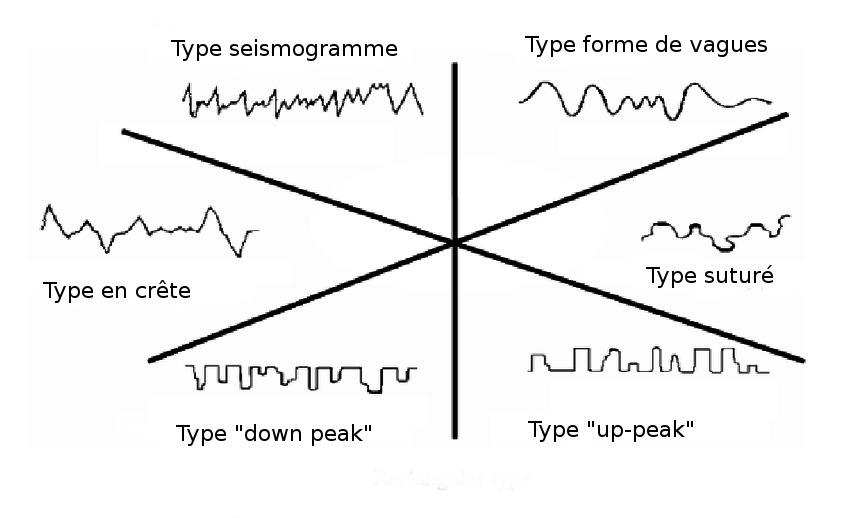
La géométrie des joints stylolithiques a été définie par Park and Schot, et comporte six formes essentielles:
- forme simple ou primaire comme une vague
- forme suturée
- forme "up-peak" (rectangulaire)
- forme "down-peak" (rectangulaire)
- forme en crête (conique et pointue)
- forme de sismogramme
Les géométries 🔽
Relation des stylolithes avec le litage
Six types ont été définis. Trois simples et trois mixtes, on ne s'attardera que sur les trois premiers.
- stylolithes horizontaux: c'est le type le plus couramment observé. Ces stylolithes se produisent parallèlement ou presque parallèlement à la stratification des roches. Ce type est le plus souvent trouvé dans des roches sédimentaires stratifiées, principalement dans les roches carbonatées, qui n'ont pas été affectées par une activité tectonique structurelle ou métamorphique intense.
- stylolithes verticaux: ce type de stylolithe est lié à la stratification à angle droit. Il peut ou non être associé à une activité tectonique. Il est causé par une pression agissant perpendiculairement au litage.
- stylolithes inclinés: ce type est oblique à la stratigraphie. Il apparaît dans des roches qui sont à la fois affectées ou non affectées par l'activité tectonique, et peut également être trouvé dans les roches ignées et métamorphiques.
Principaux types 🔽

Joints styolithiques mixtes 🔽

JSs : joint stylolithique parallèle à la stratification
JSt : joint stylolithique tectonique perpendiculaire à la stratification
Sources
Comment valider cette Earth Cache
Petit rappel concernant les "Earth Caches": il n'y a pas de contenant à rechercher, ni de logbook. Il suffit de se rendre sur les lieux, de répondre aux questions ci-dessous. Vous pouvez loger en "Found it" et envoyez-moi vos propositions de réponses, soit via mon profil, soit via la messagerie geocaching.com (Message Center), et je vous contacterai en cas de problème.

Localisation
Lorsque vous êtes en face du monument aux morts, regardez le côté gauche, et observez la zone orange de la photographie. 🔽

📌 Rappel des questions
- 1 : Dans quelles roches les stylolithes sont les mieux observables?
- 2 : Sur le monument, sous la zone masquée en orange sur la photographie (voir Localisation), quelle forme ont les stylolithes? Observez-vous un dépôt de matière dans les joints?
- 3 : Repérez la zone où se trouvent les fossiles (ce sont les éléments blanc en calcite); les stylolithes sont parallèles ou sécants à cette zone? Déduisez en le rapport avec le litage.
- 4 : Une photo de vous ou d'un objet vous représentant montrant l'église est obligatoire pour valider cette Earth Cache.
Merci par avance de ne pas poster de photo spoiler dans vos logs! 🙂
Bon Geocaching!

This cache was placed for the Mega Event ⚔️🛡️🏰 Au blason! 🏰🛡️⚔️ at Vaucelles Abbey GCB89NQ. The organizers envisioned this gathering as a convivial occasion for geocaching enthusiasts, nature lovers, heritage aficionados, and history buffs. Our aim is to allow every type of player to enjoy this hobby as they wish and to share moments of exchange and connection with others around historical sites in the Nord-Pas-de-Calais region.
🕒 Opening hours: open to the public
🧰 Equipment: none
📌 Questions
- 1: In which rocks are stylolites most clearly visible?
- 2: On the monument, beneath the area marked in orange on the photograph (see Location), what shape do the stylolites take? Can you see any material deposited in the joints?
- 3: Locate the area where the fossils are found (these are the white calcite elements); are the stylolites parallel to or intersecting this area? Deduce their relationship to the bedding.
- 4: A photo of yourself or an object representing you showing the church is required to validate this EarthCache.
Styloliths in Lesdain
What is a stylolite?
The name of stylolite (or stylolithe) comes from the Greek "stylos", pillar and "lithos", stone.
These are sawtooth surfaces during which the mineral material has been removed by dissolution under pressure, in a process that decreases the total volume of rock.
The stylolitic joints are very irregular discontinuities, bristling with spikes (stylolitic peaks) more or less acute, and materialized by an accumulation of clay minerals, iron oxyhydroxides, etc., within the joint. They are well developed only in limestones. These joints are usually darker than the rock.
Styloliths can be coloured. The colours are usually derived from iron oxide or manganese impregnations, similar to dendrites in sedimentary rocks. Other sedimentary rocks contain clay layers and malachite deposits along the stylolithic structures. The coloured deposits are residues of minerals that did not dissolve during compression. In some cases, calcite and quartz accompany the irregular surface of the stylolithic structures.
Stylolitic joints in seismograms in Burgundy limestone 🔽
Comblanchian limestone with fine pink stylolites 🔽
3D styloliths 🔽
Geometry
The geometry of the stylolitic joints has been defined by Park and Schot, and comprises six essential forms:
- simple or primary shape like a wave
- sutured form
- "up-peak" shape (rectangular)
- "down-peak" shape (rectangular)
- crest shape (conical and pointed)
- seismogram shape
Geometries 🔽

The relationship between stylolites and bedding
Six types have been defined. Three simple and three mixed, we will forget the last three!
- horizontal stylolites: this is the type most commonly observed. These Stylolites occur parallel to or almost parallel to the stratification rocks. This type is most often found in sedimentary rocks stratified, mainly in carbonate rocks, which were not affected by intense structural or metamorphic tectonic activity.
- vertical stylolites: this type of stylolite is related to the stratification at an angle law. It may or may not be associated with tectonic activity. It is caused by a pressure acting perpendicular to the bed.
- inclined stylolites: this type is oblique to stratigraphy. It appears in rocks that are both affected or unaffected by tectonic activity, and can also be found in igneous and metamorphic rocks.
- there are also 3 mixed types (horizontally inclined stylolites (vertical) transverse / vertically inclined (horizontal) stylolites transverse and network interconnection stylolites)
Main types 🔽

Mixed styolitic joints 🔽
JSs: stylolitic joint parallel to the bedding
JSt: tectonic stylolitic joint perpendicular to the bedding
References
How to validate this Earth Cache
A reminder about the "Earth Caches": there is no container to look for, nor a logbook. You just have to go to the place and answer the questions below. You can log in "Found it" and send me your suggestions for answers, either via my profile, or via the geocaching.com message center, and I will contact you if there is a problem.
Location
When you’re standing in front of the war memorial, look to your left and note the orange area in the photograph. 🔽
📌 Reminder of questions
- 1: In which rocks are stylolites most clearly visible?
- 2: On the monument, beneath the area marked in orange on the photograph (see Location), what shape do the stylolites take? Can you see any material deposited in the joints?
- 3: Locate the area where the fossils are found (these are the white calcite elements); are the stylolites parallel to or intersecting this area? Deduce their relationship to the bedding.
- 4: A photo of yourself or an object representing you showing the church is required to validate this EarthCache.
Thank you in advance for not posting spoilers in your logs! 🙂
Happy Geocaching!