
Lifau Beach
Lifau Beach is located in the Oecusse enclave, an exclave of Timor Leste. This beach is known for its historical significance as the landing site of the Portuguese in the 16th century. The clear blue waters are suitable for swimming and fishing. The beach is surrounded by lush vegetation and offers a peaceful environment for visitors. Historical landmarks and monuments in the area add to the cultural richness of Lifau Beach. The blend of natural beauty and historical importance makes it a compelling destination.

Lifau Monument
The Lifau Monument, located in Oe-cusse, Timor-Leste, is a historical site and the place where the Portuguese first arrived on the island of Timor. Founded in 2015 to commemorate 500 years of the Portuguese nation, a visit to the Lifau Monument provides a deep understanding of Timor-Leste's colonial history, and the impact of Portuguese culture will still be felt.
 Chester Keeler Wentworth and the sediment size scale
Chester Keeler Wentworth was born in Aspen, Colorado, on May 7, 1891, one of five children of Frank Louis Wentworth and Anna Maria Keeler Wentworth. Chester graduated from the University of Chicago with an A.B. degree in geology in June 1918. Chester took his M.S. degree in 1921, and his Ph.D. in 1923, both at the University of Iowa. It was during his time as a student at Iowa that Chester’s unusual combination of aptitudes led to the achievement for which he is most widely known — the Wentworth scale for the classification of clastic sedimentary rocks.
Chester K. Wentworth, Fellow of The Geological Society of America since 1923, died in Hilo, Hawaii, on January 6, 1969, after several years of illness. He is survived by his widow, Juliette Oliveira Wentworth, and by two sons by a former marriage, Robert and Gordon. Another son, Thomas, was killed in France in 1944.
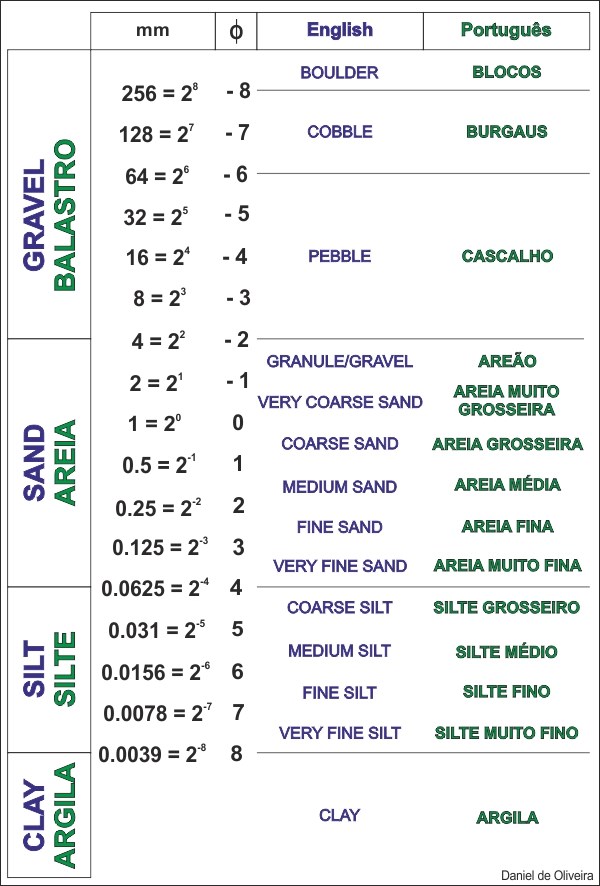
The original scale was devised in 1898 by the American sedimentary petrologist J.A. Udden was adapted (1922) by C.K. Wentworth, who expanded the definitions of the various grades to conform with actual usage by researchers; most sedimentologists have adopted the Udden scale with the Wentworth modifications.
Grain size
Grain size scale, in sedimentology, division of a continuous range of particle sizes into a series of discrete groups. Several such scales have been devised for the purpose of standardizing terms and providing a basis for statistical analysis. On most scales, the finest particles are designated clay, followed by silt, sand, granules, gravel, pebbles, cobbles, and boulders. The size limits for each grade vary from scale to scale.
In order to claim a find in this EarthCache you have to get yourself to the coordinates supplied. There, answer the following three (3) questions:1. Using the Wentworth Scale in the listing classify the sediment according to grain size.
2. Examine the sediment composition closely and tell me whether the sediment if mono (only one type of material) or multimineralic (more than one type of material)?
3. Does the sand also contain shell fragments?

Praia de Lifau
A Praia de Lifau, em Oecusse, Timor-Leste, é um local histórico e turístico crucial, conhecido por ser o ponto de desembarque dos portugueses em 1515 e pela presença do Monumento Lifau, celebrando os 500 anos da nação portuguesa, oferecendo belas vistas e um mergulho na história colonial, com uma praia limpa e estratégica, essencial para entender as raízes de Timor-Leste.

Chester Keeler Wentworth nasceu em Aspen, Colorado, em 7 de maio de 1891, um de cinco filhos de Frank Louis Wentworth e Anna Maria Keeler Wentworth. Formou em geologia na Universidade de Chicago em Junho de 1918. Chester completou o seu Mestrado em 1921 e o seu doutoramento em 1923, ambos na Universidade de Iowa. Foi durante seu tempo como um estudante em Iowa que a combinação incomum de aptidões de Chester o levou à conquista pela qual ele é mais conhecido - a escala Wentworth para a classificação de rochas sedimentares clásticas.
Chester K. Wentworth, membro da Sociedade Geológica da América desde 1923, morreu em Hilo, Havaí, a 06 de janeiro de 1969, após vários anos de doença. É sobrevivido pela sua viúva, Juliette Oliveira Wentworth, e por dois filhos de um casamento anterior, Robert e Gordon. Outro filho, Thomas, foi morto na França, em 1944.
A escala original foi concebida em 1898 pelo sedimentólogo americano J.A. Udden. Em 1922 foi adaptada por C. K. Wentworth que a expandiu em vários graus e que permanece até hoje a referência de classificação granulométrica de sedimentos clásticos.
A escala granulométrica, em sedimentologia, é a divisão de uma gama contínua de dimensões de partículas agrupados por séries de grupos discretos. Várias dessas escalas foram criadas com a finalidade de padronizar termos e proporcionar uma base para a análise estatística. Na maioria das escalas, as partículas mais finas são designados argila, seguido de silte, areia, areão, cascalho, burgaus, e blocos. Os limites de tamanho para cada grau pode variar de escala a escala.

A fim de reivindicar um found nesta EarthCache dirigiam-se às coordenadas fornecidas. Aqui reúne os dados necessários para poderes reponder às seguintes três (3) perguntas:
1. Utilizando a escala de Wentworth fornecida na listing classifica o sedimento.
2. Examina o sedimento com muito cuidado e verifica se o sedimento é monominerálico (composto por um só tipo de material) ou multiminerálico (composto por mais que um tipo de material)?
3. A areia contém fragmentos de conchas?

 The most exciting way to learn about the Earth and its processes is to get into the outdoors and experience it first-hand. Visiting an Earthcache is a great outdoor activity the whole family can enjoy. An Earthcache is a special place that people can visit to learn about a unique geoscience feature or aspect of our Earth. Earthcaches include a set of educational notes and the details about where to find the location (latitude and longitude). Visitors to Earthcaches can see how our planet has been shaped by geological processes, how we manage the resources and how scientists gather evidence to learn about the Earth. To find out more click HERE.