

Welcome to Sri Lanka at Hikkaduwa Beach & the
"Tsunami Honganji Viharaya" Buddha Statue!
This statue stands near the beach as a memorial to the 2004 tsunami.
This gave me the idea to create an EarthCache on this topic.
I hope to offer an educational EarthCache that you'll enjoy.
Here is some general information about this place on the south coast of Sri Lanka.
The imposing Tsunami Honganji Buddha statue in Paraliya is a powerful symbol of remembrance and resilience. Erected to commemorate the more than 35,000 victims of the 2004 tsunami, this 30-meter-high replica of the ancient Buddha of Bamiyan radiates peace and protection along the southern coast of Sri Lanka.
Source: Google
But here at this EC it's all about what you're standing on right now. The bright sand!
What are sediments ( regarding the Wentworth scale )
Sedimentum is the Latin word for sediment. Sediments are small particles from the water that settle at the bottom of a body of water due to gravity. They consist of sand (2–0.063 mm), silt (0.063–0.002 mm), even smaller clay particles, and plant debris, such as dead algae that have decomposed over time. Sediments are therefore a natural component of bodies of water and settle at the bottom, are stirred up again and transported further by the current. When they are in motion, the particles are called suspended solids; when they settle, we refer to them as sediments.
What is sand
Sand is formed from weathered rock, usually quartz. It can also consist of limestone if it originates from seashells or coral. Sand is defined by its size: a grain of sand measures between 0.063 and 2 millimeters. If it is larger, we refer to it as gravel. Sand found in tidal waters is rounded and further broken down by the constant movement of the water and friction with other grains.
What is silt
Silt can be classified between sand and clay: its grain size ranges from 0.063 to 0.002 millimeters. It consists mainly of very fine weathered rock such as feldspar and quartz. Just like clay, it can bind water well due to its small size. Pure silt is rare in water – it is usually part of a mixture with sand and clay.
What is clay
Clay particles are extremely fine and small, less than 0.002 millimeters in size. Clay consists mainly of minerals, i.e., non-organic components. When dry, it is very hard—it shrinks and cracks. As soon as clay combines with water, it swells and becomes sticky. It is an excellent moisture reservoir, but also binds other substances such as heavy metals and pesticides.
Grain size
Grain size is the equivalent diameter of particles (grains) of clastic sediments (products of weathering and mechanical rearrangement) and soil particles. The particle size classification according to DIN 4022 distinguishes between clay, silt, sand, gravel and stones. The grain size classification according to Udden & Wenthworth, modified after Doeglas, includes clay, silt, sand, granules, pebbles, cobbles and boulders. Both of the above scales use millimeters as the unit. An arithmetic scale is the grain size division according to Phi as a logarithmic transformation of the Udden-Wenthworth scale.
where d = grain size in millimeters. Grain sizes can be determined by different methods, such as sieve analysis, sedimentation analysis or optical methods. It should always be borne in mind that when determining from thin sections, only a two-dimensional section is recorded, which can cause considerable problems with more complicated grain shapes. The standard method for determining grain sizes in thin sections is the chordal section method. The following classification according to mean grain size has become widely accepted internationally for terrain analysis: fine-grained: 1 mm, medium-grained: 1-5 mm, coarse-grained >5 mm. In Germany, the grain size classification for crystalline rocks according to Teuscher is also commonly used.
Further information about the statue
Granite is a widespread, very hard, coarse-crystalline igneous plutonic rock (plutonite) that forms from the slow cooling of magma deep within the Earth's crust. It consists mainly of quartz, feldspar, and mica, is usually gray, pink, or whitish speckled, and is widely used due to its weather resistance, high density (\(2.63\) - \(2.75\text{\ g/cm}^{3}\)), and hardness (6-8 on the Mohs scale).
Here are the most important aspects of granite in detail
Formation:
As a plutonic rock, granite is formed by the solidification of magma several kilometers below the surface over millions of years. Erosion and uplift bring it to the Earth's surface.
Composition & appearance:
The main minerals are feldspar (mostly white, gray, reddish), quartz (gray, glassy), and mica (mostly black biotite). The structure is compact, massive, and mostly coarse-grained.
But now to the sand, and its classification
YOUR TASK FOR THE CACHE:
1.) How many types of sediments do you find?
"Look through the magnifying glass and tell me the components in terms of type and size."
Please sort the sediments according to the Wentworth scale.
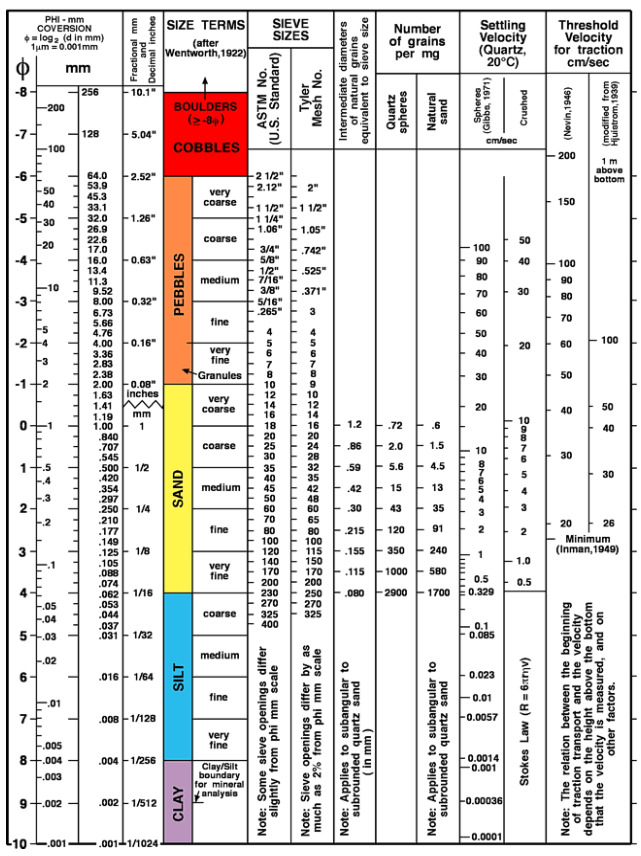
2.) Examine each of the sediments very carefully and check which mineral it is.
A.) Monomineral (consisting of only one type of material)
B.) Polyminerals (consisting of several types of material)
3.) Let dry sand trickle through your hands, then pat hands. What feeling remains on the skin?
A) The feeling as if the hands were roughened by sandpaper.
B) The feeling of powdered sugar between the fingers.
C) The feeling of moisture, although the hands were dry before.
4.) Describe in your own words why it is like that.
5.) How tall is the statue?
6.) Why do you think the statue is exactly this height?
7. What material is the statue made of, and can you identify the changes?
8. On which stone were the commemorative inscriptions written? (Type and color)
9. Can you identify any mineral crystals? If so, which ones?
10.) Take a photo for your log with yourself and the Buddha statue in the background.
Optionally, you can also draw a heart in the sand and include the date.
Example:

I hope you have a lot of fun with this EarthCache and a wonderful time in this country.
Send me your nine answers via the "Message Center" and include your log photo(s).
Then you can log your find immediately. If the answers are incorrect, I will contact you.
If I don't receive any answers or the log photo is missing, I will unfortunately have to delete your logs.
.........................

Willkommen in Sri Lanka am Hikkaduwa Strand & an
der "Tsunami Honganji Viharaya" Buddha Statue !
Zur Erinnerung an die Tsunami 2004 steht hier in der Nähe vom Strand diese Statue.
Das hat mich zu der Idee gebracht hier einen EC zu diesem Thema auszulegen.
So hoffe ich hier einen lehrreichen EC anzubieten zu können der Euch Spaß macht.
Hier nun allgemeine Informationen zu diesem Ort an der Südküste von Sri Lanka
Die imposante Tsunami-Honganji-Buddha-Statue in Paraliya ist ein eindrucksvolles Symbol der Erinnerung und der Widerstandsfähigkeit. Errichtet zum Gedenken an die über 35.000 Opfer des Tsunamis von 2004, strahlt diese 30 Meter hohe Nachbildung des alten Buddha von Bamiyan Frieden und Schutz entlang der Südküste Sri Lankas aus.
QUELLE: google
Hier bei diesem EC geht es aber um das worauf ihr gerade steht, dem schönen hellen Sand!
Was sind Sedimente ( bezüglich der Wentworth-Skala )
Sedimentum ist das lateinische Wort für Bodensatz. Sedimente meint kleine Teilchen aus dem Wasser, die sich, bedingt durch die Schwerkraft, am Boden eines Gewässers absetzen. Sie bestehen aus Sand (2 – 0,063 mm), Schluff (0,063 – 0,002 mm), noch kleineren Tonpartikeln und aus Pflanzenresten, zum Beispiel tote Algen, die sich im Laufe der Zeit zersetzt haben. Sedimente sind somit ein natürlicher Bestandteil von Gewässern und lagern sich am Grund ab, werden wieder aufgewirbelt und durch die Strömung weitertransportiert. Sind sie in Bewegung, heißen die Teilchen Schwebstoffe; setzen sie sich ab, sprechen wir von Sedimenten.
Was ist Sand
Sand entsteht aus verwittertem Gestein, in der Regel Quarz. Er kann auch aus Kalkstein bestehen, wenn er aus Muscheln oder Korallen stammt. Sand wird anhand seiner Größe definiert: Ein Sandkorn misst zwischen 0,063 und 2 Millimeter. Ist er größer, sprechen wir von Kies. Sand aus Gezeitengewässern ist abgerundet und wird durch die ständige Bewegung des Wassers und die Reibung mit anderen Körnern weiter zerkleinert.
Was ist Schluff
Schluff kann zwischen Sand und Ton eingeordnet werden: Seine Korngröße reicht von 0,063 bis 0,002 Millimetern. Er besteht hauptsächlich aus sehr feinem verwittertem Gestein wie Feldspat und Quarz. Genau wie Ton kann er aufgrund seiner geringen Größe Wasser gut binden. Reiner Schluff ist im Wasser selten – er ist in der Regel Teil einer Mischung mit Sand und Ton.
Was ist Ton
Tonpartikel sind extrem fein und klein, kleiner als 0,002 Millimeter. Ton besteht überwiegend aus Mineralen, also nicht-organischen Bestandteilen. In trockenem Zustand ist er sehr hart – dann schrumpft er und wird rissig. Sobald Ton sich mit Wasser verbindet, quillt er auf und hat klebende Eigenschaften. Er ist ein hervorragender Feuchtigkeitsspeicher, bindet aber auch andere Stoffe wie Schwermetalle oder Pestizide.
Korngröße
Korngröße, bezeichnetden Äquivalentdurchmesser von Teilchen (Körnern) klastischer Sedimente (Produkte von Verwitterung und mechanischer Umlagerung) und Bodenpartikeln.Es werden verschiedene Korngrößeneinteilungen verwendet. Die Korngrößeneinteilung nach DIN 4022 unterscheidet Ton, Schluff (Silt), Sand, Kies und Steine. Die Korngrößeneinteilungnach Udden & Wenthworth, modifiziert nach Doeglas, beinhaltet clay (Ton), silt (Silt), sand (Sand), granules, pebbles, cobbles (Kies) und boulders (Steine). Die beiden genannten Skalen benutzen als Einheit Millimeter. Eine arithmetische Skala ist die Korngrößeneinteilung nach Phi als logarithmische Transformation der Udden-Wenthworth-Skala.
wobei d = Korngröße in Millimetern. Korngrößen können mit unterschiedlichen Methoden bestimmt werden, wie z.B. durch Siebanalyse, Sedimentationsanalysen oder optische Verfahren. Zu bedenken ist stets, daß bei der Bestimmung aus Dünnschliffen nur ein zweidimensionaler Anschnitt erfaßt wird, was bei komplizierteren Kornformen erhebliche Probleme erzeugen kann. Standardverfahren zur Bestimmung von Korngrößen im Dünnschliff ist das Sehnenschnittverfahren. Folgende Einteilung nach der mittleren Korngröße hat sich für die Geländeansprache international weitgehend durchgesetzt: feinkörnig: 1 mm, mittelkörnig: 1-5 mm, grobkörnig >5 mm. In Deutschland auch gebräuchlich ist die Korngrößeneinteilung für Kristallingesteine nach Teuscher.
Weitere Information zur Statue
Granit ist ein weit verbreitetes, sehr hartes und grobkristallines magmatisches Tiefengestein (Plutonit), das aus der langsamen Abkühlung von Magma tief in der Erdkruste entsteht. Es besteht hauptsächlich aus Quarz, Feldspat und Glimmer, ist meist grau, rosa oder weißlich gesprenkelt und findet aufgrund seiner Witterungsbeständigkeit, hohen Dichte (\(2,63\) - \(2,75\text{\ g/cm}^{3}\)) und Härte (6-8 auf der Mohs-Skala) breite.
Hier sind die wichtigsten Aspekte von Granit im Detail
Entstehung:
Als Tiefengestein (Plutonit) entsteht Granit durch die Erstarrung von Magma in mehreren Kilometern Tiefe über Millionen von Jahren. Durch Erosion und Hebung gelangt es an die Erdoberfläche.
Zusammensetzung & Aussehen:
Die Hauptminerale sind Feldspat (meist weiß, grau, rötlich), Quarz (grau, glasig) und Glimmer (meist schwarzer Biotit). Das Gefüge ist kompakt, massig und meist grobkörnig.
Doch nun zum Sand und seiner Klassifizierung
EURE AUFGABE ZUM CACHE:
1.) Wie viele Arten von Sedimenten findest Du?
"Schaue Durch die Lupe und nenne mir die Bestandteile in Art & Größe"
Sortiere bitte die Sedimente anhand der Wentworth-Skala.
2.) Untersuche jedes der Sedimente sehr genau und prüfe um welches Mineral es sich handelt.
A) Monominerale (bestehend aus nur einer Materialart)
B) Polyminerale (bestehend aus mehreren Materialarten)
3.) Lass trocken Sand durch die Hande rieseln, nun Hände abklopfen. Welches Hautgefühl bleibt ?
A) Das Gefühl als wären die Hande wie von Schleifpapier aufgeraut.
B) Das Gefühl von Puderzucker zwischen den Fingern
C) Das Gefühl von Feuchtigkeit obwohl die Hände vorher trocken waren.
4.) Beschreibe in eigenen Worten warum dieses so ist.
5.) Wie hoch ist die Statue?
6.) Warum glaubst Du hat die Statue exakt diese Höhe ?
7.) Aus welchem Material besteht die Statue & kannst die Veränderungen erkennen?
8.) Auf welchem Stein wurden die Gedenkinschriften geschrieben? ( Art & Farbe )
9.) Kannst Du Kristalle von Mineralien erkennen? Wenn ja: Welche ?
10.) Erstelle für den Log ein Logfoto mit Dir & der Buddha Statue im Hintergrund
und wenn Du möchtest Optional auch noch ein Herz im Sand inkl. Datum.
Beispiel:
Natürlich freuen ich mich über jedes weitere eingestellte Foto um das Reisefieber zu entfachen.
Ich wünsche euch viel Spaß bei diesem EC und einen schöne Zeit an diesem Strand und Land.
Schickt mir Eure neun Antworten über das "Nachrichtencenter" & stellt das/die Logfoto/s mit ein.
Dann dürft ihr sofort loggen, sollten die Antworten nicht stimmen werde ich mich bei Euch melden.
Sollte ich keine Antworten erhalten oder das Logfoto fehlen, werde ich leider Eure logs löschen.
.........................
Wer möchte kann das Banner in sein Profil einbauen.
Whoever wants to can add the banners to their own profile.

Füge dazu einfach folgenden Code in Dein Profil ein: / Just add the following code to your profile:
<a href="http://coord.info/GCBHE2G" target="_blank"><img src="https://img.geocaching.com:443/401383b1-a1fb-4ac8-9b0b-6dee7b8b15bc.jpg" border="0" /></a>
Für die ersten drei Finder gibt es eine kleine Tabelle! / For the first three finders there is a small table!
1.) Walnis / MMXX
2.) Baduu
3.) .....
